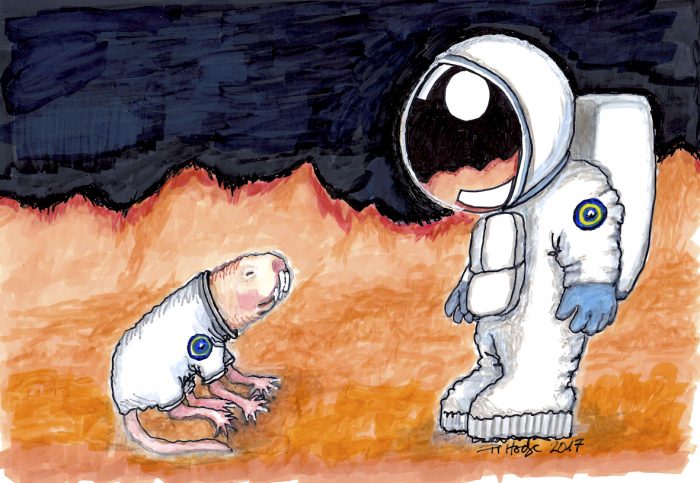
The Bible of Elaziğ (3)

Part three

(For the beginning of this story, see the earlier posts at part 1 and part 2.)
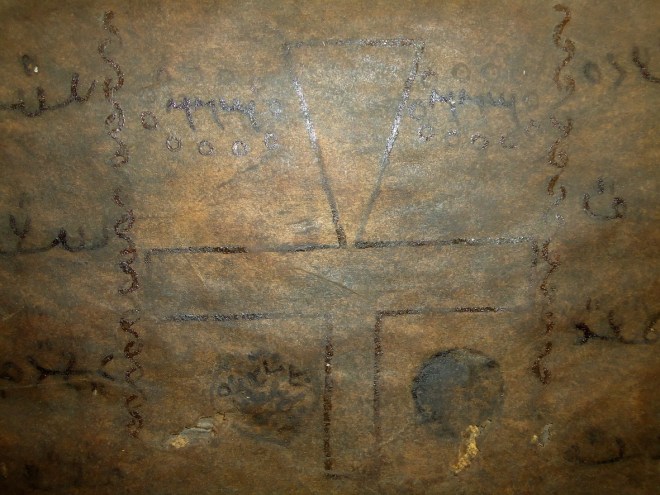
Five months after my reunion with Ali in the S-bahn in Berlin, I found myself on board a small passenger flight from Istanbul to the city of Elaziğ in Eastern Anatolia. My friend Markus and I were glued to the window, watching the drama of the panorama as it unrolled far below. On this late afternoon in March, the rugged landscape had the seemingly infinite detail of an etching traced into copper by the blazing sun.

We were nervous and high with the adventure of it all. At times we felt like characters in a spy novel – fully aware that in real life, they often end badly. Long ago at the university I’d seen the movie Midnight Express, which had left me with inescapable stereotypes of Turkish prisons, weeks of nightmares, and a lifetime phobia of passing through customs. A couple of years before I had been shaking like a leaf as I entered Turkey with Fred Luft’s group, even though – unlike the movie’s antihero – I wasn’t smuggling heroin across the border. (In fact, although my colleagues hadn’t told me this at the time, the cart I was pushing was loaded with drugs. Not heroin, but antihypertensives… When I learned this, later, I thought I’d have a heart attack on the spot.)

This time there was no reason to worry as we entered the country. Neither my name nor that of Markus would mean anything to anyone, and the only people who knew the purpose of our trip were members of a close-knit family who had the best possible reasons to keep it secret.

Coming out of the country might be a different matter.

This trip had been planned in so much haste that we’d arrived in Istanbul that morning with no idea of how we would manage the next leg of the voyage. A travel agent in Heidelberg had assured us that there was an airport in Elaziğ, but he couldn’t make reservations from Germany. “It will be easy from Istanbul,” he assured us.

Markus was cool with this laissez-arriver approach to travel, but it had been 15 or 20 years since I had done the backpacking thing. When you’re young, “Have sleeping bag: will travel” works fine. Now I found myself wondering, “Did I pack my toothbrush? Will I be able to buy one at the airport?”

In fact all we had to do was debark in Istanbul and change counters, at which point we found we could get an amazing rate to Elaziğ – the tickets for a round-trip transfer amounted to something like 100 Euros apiece. It was a relief because my wife and I were footing the bill for this whole adventure (with the help of a very generous sponsor who will remain anonymous until he decides to out himself).

The urgency of our preparations meant that I knew almost nothing about Elaziğ, except its location on the map and that it lay in a province of the same name. The river Euphrates begins in this region. If you follow its flow to the southeast, to the place where it encounters the river Tigris, you reach the purported site of the Garden of Eden. To the east, on the Armenian border, lies Mount Ararat. Mythical or not, this is incredibly exotic fare for anyone imprinted in the Judeo-Christian tradition.

I was traveling farther east than I’d ever been before. Once I had been to the island of Cyprus on another adventure that had taken me into the depths of a prehistoric copper mine, in the company of an archeologist, in pursuit of another story. But Elaziğ lay a few hundred kilometers nearer to the source of the rosy-fingered dawn.

* * * * *

Pursuing the script had reached a dead end. With the family’s consent, I’d finally uploaded a sample to an Internet site devoted to ancient alphabets, without saying anything about the purported content of the text. Maybe it would excite some fanatical devotee of this arcane subject. But aside from a single on-topic but ambivalent response, the posting drew no bites, and the discussion quickly meandered off into matters that were wholly irrelevant.

At the same time my Turkish associates were clearly under stress from their mysterious partners abroad. Word about the manuscript seemed to be leaking out – little wonder, with so much at stake. Yet given their intent to control the situation with the government getting involved, this was extremely dangerous.

Ali kept giving me reports of new events. A team from Switzerland had arrived in Turkey, he said, and was trying to get in touch with the holder the document. Another tale involved a group of Israelis. Both groups had been shown a picture or two, he said, but had never seen the object itself. The Israelis, supposedly, had offered to buy the book for 26 million Euros, sight unseen. In retrospect both stories should have seemed like the wildest exaggerations. But when you’re up to your elbows in something as fantastic as this, the demarcation between the real and the fantastic was easily blurred.

There was still the possibility of trying to decode the text using computational methods. But I was unwilling to start a process that might make a stranger aware of its contents without some sort of authentication. In the meantime another expert had raised a further objection: parchment would have been valuable material in ancient times, he said, so why fill the pages so sparsely? Counterargument: the beauty of the book suggested a treasured document, to be regarded almost as art, rather than a object of practical value to be passed from hand to hand.

Any further involvement on my part, I finally told them, would require a certainty that we were dealing with an ancient manuscript, rather than a modern forgery. That would be impossible without carbon dating the object, which meant obtaining a physical sample.

And I remained intensely concerned about the family’s efforts to preserve it. If they hadn’t done anything, every day that passed was damaging the book; it might become unreadable, or simply dissolve into dust. Since I had been unable to speak with anyone directly – the person they were talking to spoke only Turkish, and I’d only heard the Berlin half of their conversations – I wasn’t convinced they were taking adequate measures.

Regarding the contents, from an academic point of view, one could work with excellent photographic reproductions as well as the original. I had been told that infrared photos stood the best chance of detecting details that might reveal traces of forgery. A perfect record would also be of incredible value itself, in case the book was damaged, siezed, or destroyed.

A flurry of telephone calls passed between Berlin and Turkey. Finally it was agreed: I would be permitted to come see it in person with one friend, who would photograph the entire book. I could also obtain a sample for testing. The only catch: we’d have to travel to the far eastern part of Turkey, on our own dime.

* * * * *

Markus is a talented artist I met many years ago while working in Heidelberg. He worked downtown in a coffee shop where I’d sometimes hole up to write while nursing a monstrous caffeine habit. Markus’ vocation was photography, but the studio route wasn’t his gig. He preferred the unfettered life of a freelancer, paying his rent through occasional hours in the coffee shop. His real work was picking up: recently he’d been hired by the city theater to take images for their posters and brochures. He was also a master of pinhole photography, a method he had used to take beautiful images of Heidelberg for a calendar. He was allowed to hang them in the coffee shop and sell them over the counter to customers.

I’d noticed and asked about them once during a coffee run. “Markus took those pictures,” I was told. He wasn’t in at the moment, but he had regular hours. We met a day or two later and after that, whenever I came in, we’d talk about photography and art.

So he came to mind when I began looking for someone to capture a record of the Bible of Elaziğ. I’d already approached another photographer friend, who reluctantly turned me down. I could live with the legal murkiness of the situation given that the book might turn out to be a forgery. But if we found out it was real, the actions of its owners might well cause a dilemma with ethical and moral dimensions beyond the purely legal ones. I was willing to cross that bridge when I came to it, but I couldn’t expect anyone else to draw their line in the same place. Whoever got involved needed strong nerves.

Markus, on the other hand, was game after we’d talked the whole thing through. He’d do some checking on his own regarding the technical requirements of photographing an ancient manuscript, but in principle he had the necessary equipment. So I went to a travel agent – a Turkish immigrant with whom I had had many conversations and planned many trips – and began looking into flights.

* * * * *

The airport in Elaziğ was a scene of total melee. The moment we debarked, passengers flowed into a throng of relatives, other people pushing forward to board the plane we’d just exited, yet others huddled around simple stands selling soft drinks and chai. Right outside the main exit there was something going on involving crates of chickens that I never figured out.

Markus and I were so obviously strange that people stopped in their tracks and stared, the way they might have regarded a pair of extraterrestrials.

Originally my Berlin contacts had intended to accompany us, but things fell through at the last minute and we were on our own. I had a cell phone number for a person who was supposed to meet us. Each time I tried to call, a man aswered in Turkish; I tried to explain our situation but couldn’t make sense of his response against the din in the backgroud. I shrugged helplessly. We stood in front of the terminal and peered across the parking area, to the long line of cars creeping along the road on the far side.

We decided to walk across the parking lot; the moment we reached the road, a slender man wearing a dark blazer got out of a car, holding a cell phone. By some miracle, it was our contact. There was an advantage to looking like total aliens.

The Berlin contingent had assured me that he spoke German; it was, to put it kindly, another exaggeration. From broken sentences we pieced together that he had spent a couple of years in Hamburg, but it had been a very long time ago. We could barely communicate as he gestured us into his car and drove us to a hotel in the center of town. Markus and I dumped our bags in a double room, then returned to the lobby. Where were served chai.

There our communication with Abdullah, as I’ll call him, seemed to reach an almost total impasse. We understood that he’d pick us up the next morning – and he’d bring along a translator. Another “cousin”, named George, who’d been studying in England.

* * * * *

After a night of tossing and turning, I woke to a stunning view out the window of mountain crests hovering over the colorful chaos of the city. Markus and I made our way down to the hotel restaurant. For breakfast we found the usual fare of joghurt, strong cheeses, bread, and small boxes of cereal – no sliced salami in a country where pork was considered unclean.

Abdullah and George joined us as we ate. We were immediately relieved to find that George had been studying philosophy in Oxford, and his English was impeccable. Finally a way to communicate; we no longer had to untangle Abdullah’s limited German vocabulary distilled through Turkish grammar.

George was there simply to introduce himself. Abdullah would take us around in the morning, he said, and he promised to join us again for lunch. Until that point he had heard nothing of the Bible or the entire situation; as the story came together for him, in two languages, he simply gaped at the three of us. He peppered Abdullah with questions, then us, faster and faster, caught up in the excitement and the madness of the whole thing.

Finally he had his feet back on the ground and could translate. Some of my assumptions were quickly dashed – Abdullah was not really the relative of the Turks I had met in Berlin. Nor did he have the book directly in his possession. He was arranging a meeting with the owner.

We discussed our plan to photograph the entire thing with George. Capturing infrared images of 105 pages, plus the object itself, would require a darkened room and plenty of time. Markus and I had scheduled the work for that day and the next; our return flight was scheduled in two days. It was essential that we see it as soon as possible.

Abdullah peppered George with questions. What, precisely, were our intentions? What would happen to the book?

I tried to explain that our priority was to capture high-quality photographs of the document before it experienced damage through handling or exposure to the air. We would also need a small sample of the document that would be submitted to carbon 14 dating. If it turned out to be authentic, at some point it would pass into the hands of experts who would surely spend years studying it, in a way which would ensure its survival and dissemination to the world.

This was a sort of fencing – edging around the legal and ethical issues at hand. Whoever possessed the book was obviously interested in maintaining control of it, despite the fact that Turkish law dictated it would have to be turned over to the government, at least if it had been found within national borders. But high-quality photographs of the document would be immensely valuable in their own right. They would not only serve as a source of vital information, particularly if it began to disintegrate, but be the basis for a translation. And they could also be used to create facsimile copies that would be of interest to scholars everywhere. Not to mention that a collection of the earliest preserved examples of Christian art would be published on the front pages of newspapers everywhere throughout the globe. The rights to the images alone could be worth millions. It might be a way for the finders to profit from their discovery without committing a severe violation of governmental regulations.

For now, though, we were still acting on the assumption that it might be a forgery. If so, as long as they didn’t try to sell it, it was simply a sort of work of art whose legal status was questionable.

The way the discussion was going had made George nervous. “I don’t think it’s a good idea to talk about anything financial,” he said. I agreed – the main thing at the moment was simply to get access to the book.

George had an appointment and promised to meet us later, for lunch. Until then, Abdullah would “show us around,” he said.

* * * * *
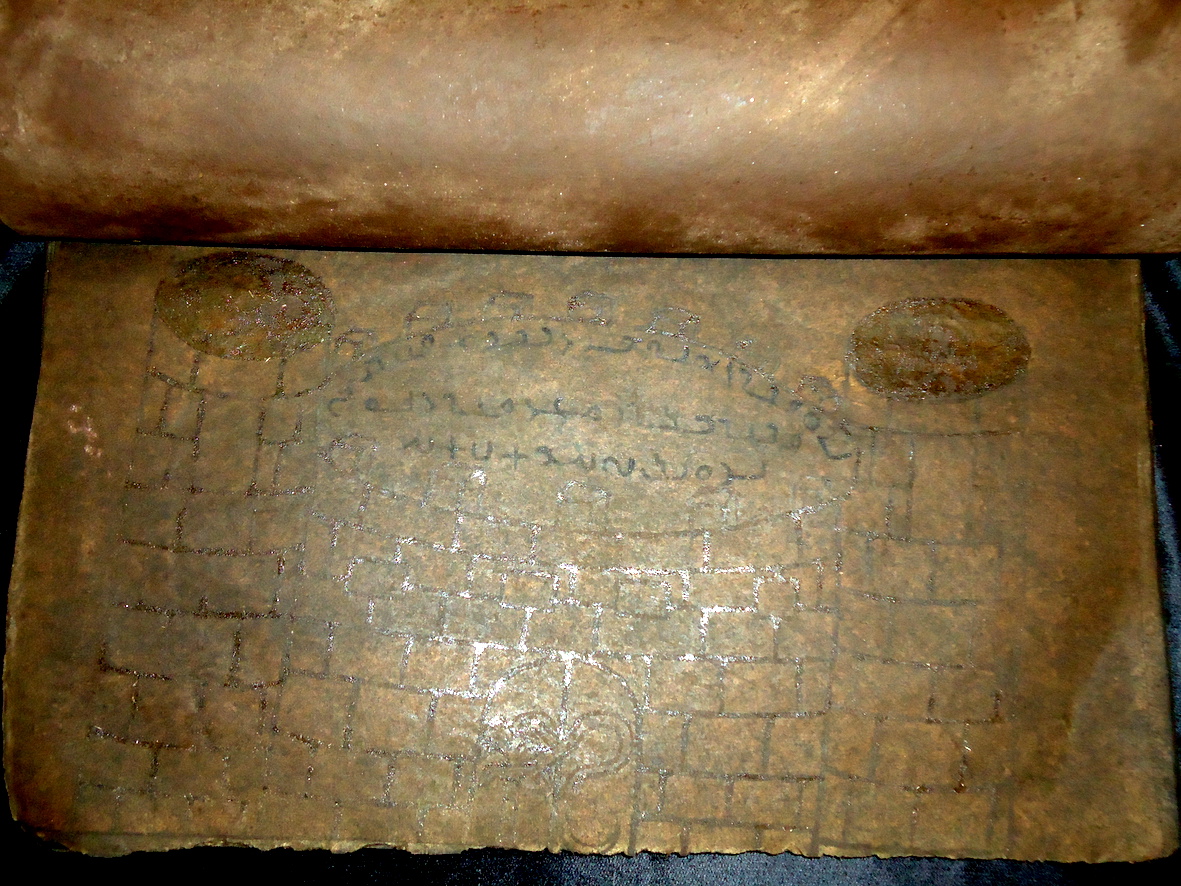
The morning dissolved into a strange sequence of scenes: climbing into Abdullah’s car, driving around, parking and walking by storefronts. He exchanged greetings with nearly everyone he met. At one point we entered a sort of alley between two tall buildings with shops lining either side. The windows along the whole row seemed to be filled with gold, shaped into watches, rings, jewelry, platters… We entered one that was barely large enough to hold the three of us and the shop owner, an aged man with a beard. He produced three stools from somewhere, then disappeared behind a door in the back. When he returned he was bearing a large pot (silver, not gold), from which he poured us – what a surprise – black tea.

A store filled with gold had to have excellent security… I wondered if we were about to get our first look at the Bible. Was it here, locked away in a safe, somewhere in the back?

It turned out this was just a social call. Or something. His eyes moved from Markus, to me, to Abdullah. He’d ask a question and Abdullah would answer. We had no idea what they were talking about. This went on through two cups of tea and lasted about half an hour. At that point Abdullah stood up abruptly and indicated the door.

It was one of three or four such stops, meeting various characters – all men – who offered us a constant stream of chai and cookies. I looked at Markus, who shrugged. I shrugged back. George told us later he never quite learned how Abdullah made his living. Perhaps, he said, going from shop to shop, making obscure deals. If so, it was a type of business that subsisted entirely on conversations carried out between men, and it was impossible to imagine a woman breaking into such a system.

Thinking back, I suppose everything that happened to day belonged to another series of tests, like those I’d apparently passed in Berlin. The paranoia was understandable, given the magnitude of what was going on. But it would have been nice to know a bit about the nature of the game and the criteria for success.

George rejoined us at lunchtime at a fast-food place with long tables and benches that reminded me of picnic tables pilfered from a campground. The food was good, but it was noisy inside – no place to talk about shady undertakings. Then it was back into Abdullah’s car for a ride somewhere else; I don’t remember where. Along the way I kept stressing the time factor to George. Both Markus and I had obligations in Germany that would make it impossible to postpone our flight back. We had less than 48 hours and an immense amount to do in that time.

Later in the afternoon we learned that it wouldn’t be possible to see the book until the next day. But we’d be picked up in the morning – the very first thing. Or so Abdullah promised, speaking through George, who was obviously just as frustrated as we were. He, too, had been infected by the possibility that we’d soon be looking at the earliest known version of a document pertaining to the New Testament.

* * * * *

George joined us for breakfast in the hotel, and Abdullah finally pulled up to the entrance of the hotel in the late morning. He found us waiting in the glaring sun at the curb, nervous and overly aware of the countdown to our departure from the country. Markus loaded his camera and equipment into the car and we headed off on a strange tour of the city, along a zigzagging route through narrow streets. We weren’t fitted with blindfolds! – I thought, ironically – but they weren’t necessary. We never could have retraced the maze of turns through an unfamiliar city.

Eventually we ended up in a suburb of low houses and a couple of apartment buildings set at the very edge of the city; beyond was a field with matted brown grass that stretched into a barren plain, then began a steady rise directly into snow-covered mountains. Abdullah gestured us out of the car, approached one of the houses, and rang the bell. We were greeted by a young man in a dark suit who gestured us inside.

We came into a living room complete with television set and recliner lounge, a long sofa, with a table in the middle and some chairs; the scene might have come straight out of American suburbia except for the bright floral patterns of the sofa cover. During my trips to the North I’d noticed such loud patterning everywhere – on the drapes, the furniture, tiling on the walls, women’s scarves. Minimalist aesthetics hadn’t reached the interior of the country. This room was relatively subdued, with a pale brown carpet and nothing hanging on the walls.

There we were greeted by a short, elderly gentleman wearing a headcap and a loose white robe. He gestured at two younger women and three or four children, who instantly vanished into the kitchen. Later George told us he was a Kurd, the population that made up most of the population of Elaziğ and the southeastern regions of the country. I never learned his name.

We submitted to many more questions. What were our intentions, our interest? I answered carefully and respectfully. I went through the whole story again, starting again, pausing for George to translate. I told him I had seen images and pursued the script through the libraries.

Did we want to buy the book?

No, no, I quickly replied. We wanted to help them determine whether it was truly as old as it appeared. We might be able to put them into contact with scholars who would study it for many years.

The old man nodded from time to time. He spoke for a while and George said: “This man has spent his whole life looking and has found many, many valuable things. He has seen this script and others before, and he says he can even read a part of it. He says that when the contents of the book become known, this will change the world.”

“What has he learned?”

The answer was lengthy. George paused to think and said, “It will change the relations between Christians and Islam.” The old man spoke again. “You are the first people he has ever shown it to, outside the family. There are others who are interested, but they have only seen two photographs.”

“We must photograph the book, to ensure that there is the best possible record,” I said. “We’ve brought special equipment.”

If we were willing to help the family bring the book to the world, the old man said, we could take photographs. And he said we would be free to do with them whatever we wished – as long as we made sure that the world learned about it.

What he meant was completely unclear, but Markus gave me a wide-eyed look. We had discussed the potential value of even just the photographs of the document. None of this meant anything, of course – we didn’t have them yet, and if the book was authentic, there was no guarantee that the law would permit their use.

“Where exactly was the book found?” I asked.

He replied that it had been discovered in a stone box, part of a sepulchre, perhaps, somewhere on the border of Turkey, Syria and Iran. With a war raging in the area, it might be argued that such a find was a desparate means of rescuing an artifact that otherwise might very well have been destroyed. But these were matters of law, about which we could say nothing.

It was finally time to see the Bible. The old man gestured to his young relative, who disappeared into the next room.

part 4 coming soon

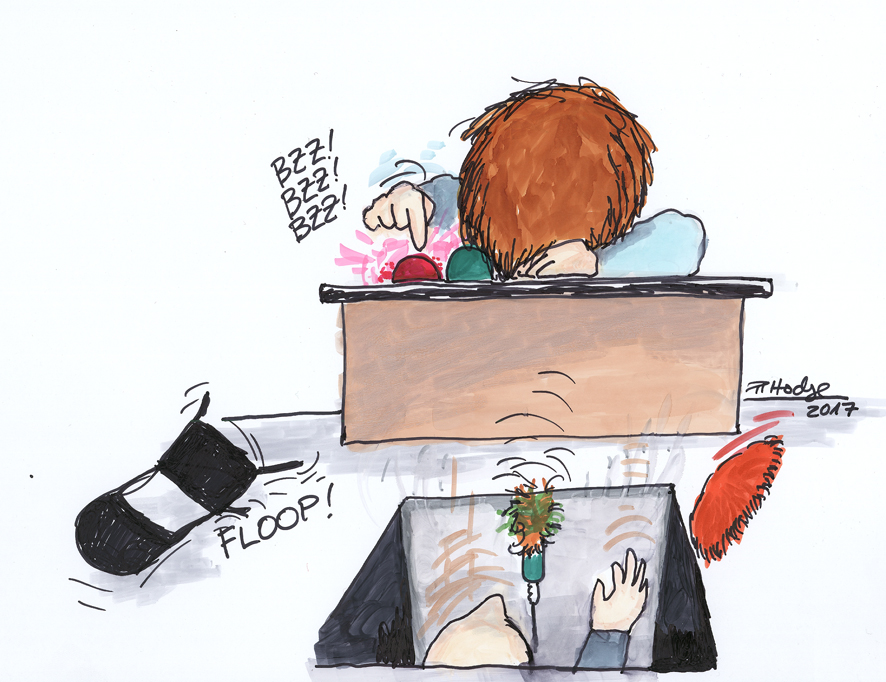
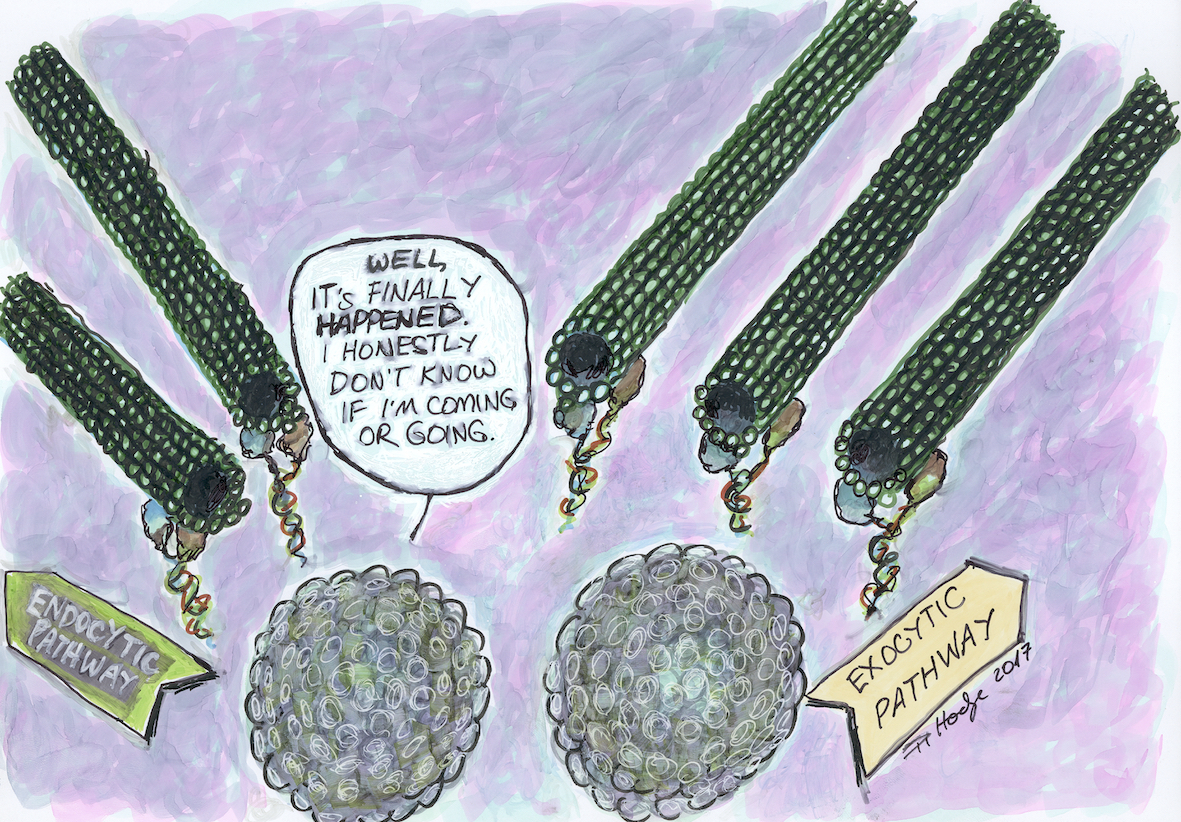
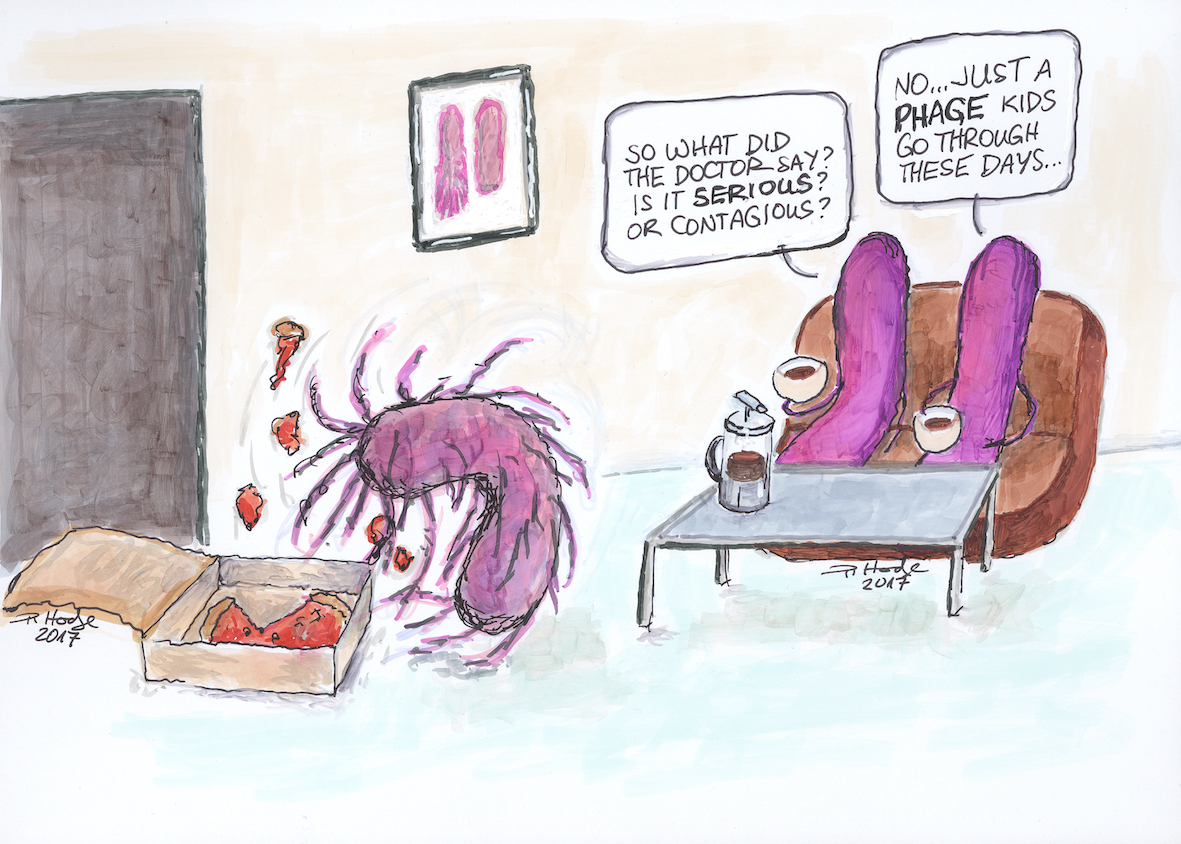
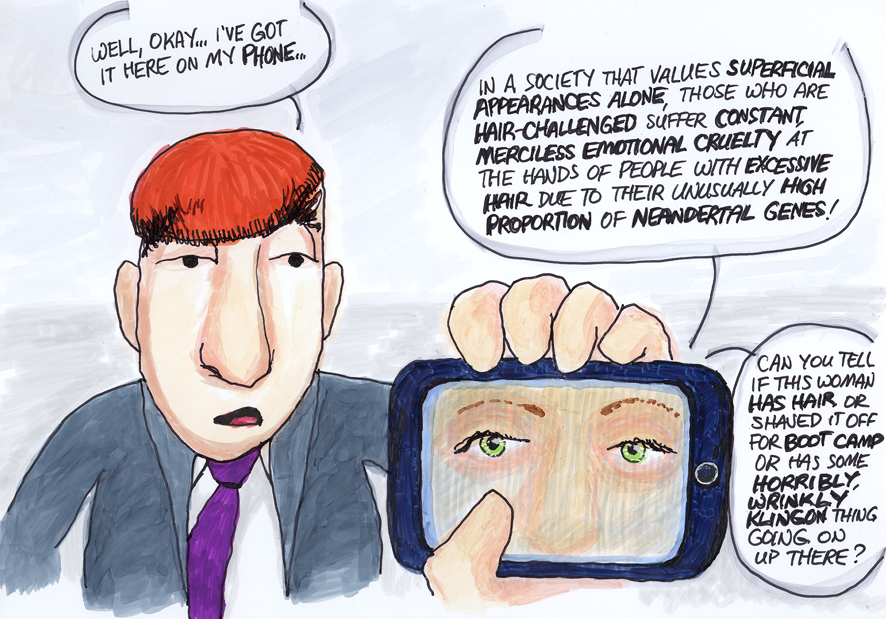
More technology transfer cartoons…

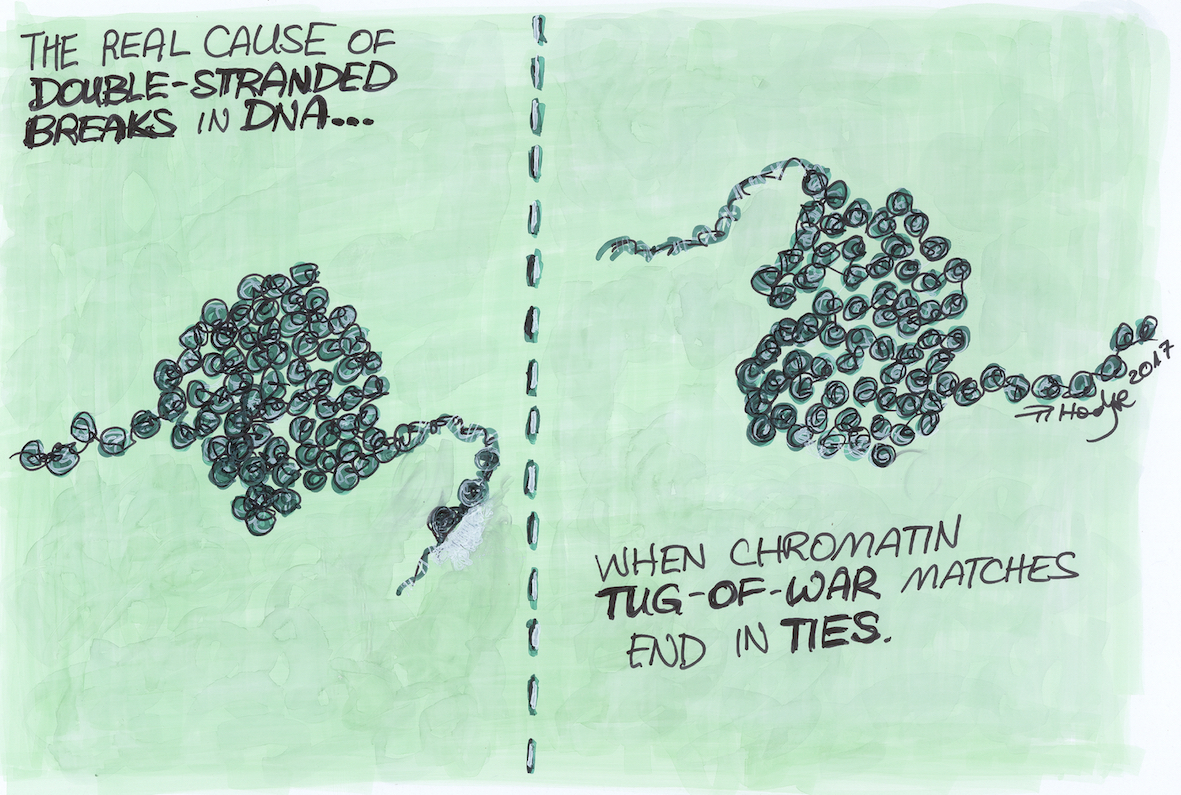
More from the OTTers (officers of technology transfer) today… This series is dedicated to my friends in the field, in honor of their patience as they encounter pitches that are… well, a generous way to put it would be “creative”. Often the first step in a project is to reach up and snag a basic researcher and tie him or her firmly to the ground, so they don’t end up sailing toward the stratosphere like a helium balloon. Because we know what happens to those.

For more cartoons, scroll down or select the category “Molecular biology cartoons” from the menu in the banner above. Enjoy! Pass along to your friends!


The Bible of Elazığ: a backroom to a parallel universe (2)

The first part of this story appears in an earlier article on the blog, which you can find here.

Part two

Ankara lies in the highlands of Central Turkey, in the center of this enormous country that sprawls along the entire coast of the Black Sea to the north, bordering Georgia, Armenia, and Iran to the east, Syria and Iraq to the south, and Greece to the west. The western coastline borders the Mediterranean; far to the north is the site of the mound of Hisarlik, where archeologist Heinrich Schliemann uncovered the ancient site he claimed to represent the city of Troy of classical antiquity. His discovery convinced many scholars that the tales of Homer were rooted at least partially in real, historical events. While researching another book I had discovered a curious fact about these excavations: one participant had been Rudolf Virchow, the famous Berlin physician whose work became the foundation of modern cancer research.

The boundaries of modern Turkey were fixed during the 19th and 20th centuries as a result of events over the long history of the Ottoman Empire, machinations that followed the First World War, and the subsequent war of independence headed by Mustafa Kemal Atatürk. The result is a huge territory that encompasses a multitude of cultures which have been extraordinarly difficult – some consider impossible – to integrate under a single political system. Istanbul and its inhabitants pursue a modern, Western lifestyle. Central regions are occupied by diverse populations grouped under the collective term “Anatolian”. The southeastern region is home to a vast group of Kurds with close cultural ties to populations in Iran, Iraq and Syria. In many cases the fates of the youth in this region are almost wholly dictated by the patriarchs of their villages, whose main interest appears to be the perpetuation of ancestral lifestyles, and dictate who may get an education and who may marry.
Ankara is home to a beautiful Museum of Anatolian Civilization and Culture which displays the ancient, turbulent history of this vast country. It has been occupied and overrun by virtually every Mideastern and Mediterranean culture since the times of the ancient Babylonians and Sumerians. A walk through its rooms passes exhibits containing 40,000 year-old relics of a prehistoric culture dedicated to the Earth mother, monumental heads of Sumerian kings, friezes recounting the Epic of Gilgamesh, and so on into modern times.

As I began looking into the plausibility of an ancient Bible, I discovered that early Christians had spread through central and eastern Turkey during the first and second centuries, establishing small communities devoted to the new cult of Christ. As far as I knew, the oldest religious manuscripts were written on scrolls of papyrus – but then I discovered that in about the second century CE, the Christians in precisely these regions began producing the first modern books. They wrote on parchment made from the skins of antelopes, goats, and gazelles, which were often bound and often wrapped in leather. So far, everything was consistent with the images I had seen.

Ancient documents, sculptures and other relics continue to be found throughout Turkey all the time, often by modern looters. Many never see the light of day. Some disappear into the hands of private collectors. Others are immediately snapped up by the Turkish government, under laws which give the regime automatic ownership of all artifacts of historical value.

The intent is absolutely valid: to protect objects of cultural importance, ensuring that they will be appropriately handled and become part of the public heritage. But this system presumes that the authorities will protect them and deal with them wisely. There have been many cases where artifacts disappear and end up on the black market anyway; others vanish for decades and reappear under suspicious circumstances. And there are rumors that early Christian documents that do not support Muslim interests have simply been destroyed.

Clearly any involvement with such artifacts puts a modern scholar on shaky legal ground. As my inquiries into the manuscript progressed this made me highly uncomfortable, but I justified my actions the following way: first, the document might well simply be a forgery, in which case the statutes probably wouldn’t apply. Secondly, they did not belong to me, and I had no say in their fates. Third, I would have no part in any attempt to remove them from the country. Fourth, it was completely unclear whether the document had actually been found in Turkey at all. There was reason to think it had been discovered across the border in Syria or Iraq, where wars had devastated all sorts of amazingly valuable artifacts. In that case, a rescue attempt was completely justified.

But the most important consideration on my part was the concept that if this artifact were real, it would be one of the most momentous discoveries in cultural history. Modern scholarship pertaining to the early Christian era stretches back to the efforts of the early Church to align the New Testament with the old and sanitize early accounts of historical events, and there it stops. The modern gospels appear to have been written in the first and second centuries CE, but the oldest existing versions date to the fourth or fifth centuries. Any document older than that – particularly one in an unknown language and script – would surely provide stunning new insights into the events described in the gospels. Its content might differ from others that have been passed down in incredibly significant ways.

Although I was raised in a Protestant church, I am not in any sense a believer in any traditional Christian sense of the word. But whatever this document contained belonged to the entirety of humanity. And whatever happened, whatever my personal feelings, I was determined that its contents should be made available to the world. That could be done through a photographic record of the manuscript.

* * * * *

I began talking to experts and combing through on-line archives of ancient scripts, hoping to identify the alphabet in which the manuscript was written. If that problem could be solved, the text would be readable. Someone had photographed the entire document, producing 105 pages that were still entirely legible.

I was constantly alarmed that something might happen to the manuscript. I knew nothing about the person who possessed the book or the conditions under which it was being kept. My very first effort was to ensure that it wouldn’t be damaged through mishandling or simple exposure to the air. If it was real, it had clearly been unearthed very recently, and unless extreme measures would taken it would rapidly begin to decompose. Once the document came into the possession of experts, it would probably never be touched by hand again, but only handled under the most careful measures required to ensure its long-term preservation.

My contacts in Berlin refused to put me in touch with the owner. I repeatedly pled with them to tell their Turkish relatives to go to a museum or institute with expertise in the conservation of manuscripts and obtain some sort of climate-controlled box where it could be stored. They promised to do so. Later I discovered, to my horror, that none of these requests had been followed.

* * * * *


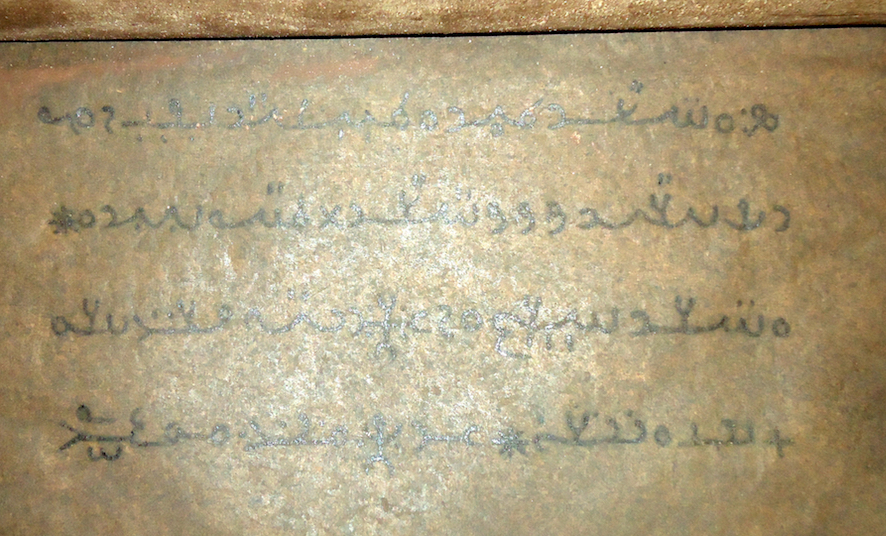
The script itself was magnificent: written in a clear hand apparently from right to left, with four straight lines per page. Beautiful characters slanted into each other and ended in strange half-circles. None of the experts I consulted could help with the script.

One Biblical scholar was highly skeptical – he knew of no written language that combined diacritic dashes and dots with the sort of strange, linked, cursive circles and crosses and s-like forms. “Probably a forgery,” he said. But who would invest such an immense amount of effort to invent such a form of writing from scratch, and eke out over a hundred pages that must say something – if it could never be read at all? Whoever had written it – ancient or modern – was telling some story, in some language. If it was a forgery, it was madness – but there was a method to it. If it was a forgery, why so many pages? Why invent an entirely new script? To make it more difficult to detect the fact that the forger didn’t perfectly master some ancient dialect? Think of the effort required to pull this off – and to keep going, for 105 pages!

I discovered that the third century CE was a time of immense linguistic innovation, in which any language might be written in virtually any alphabet: ancient Aramaic with Greek or Roman characters, ancient Latin in Hebrew letters, Arabic characters used to represent completely different languages…

The beauty of the writing itself was so seductive that I began spending vacation days holed up in the archives of the University of Heidelberg, poring over catalogs of scripts from all possible ancient sources.

The most similar writing systems seemed to be early Arabic alphabets called Nabataean, Jazm, and Musnad, Arabic Kufic, Pehlavi, Old Syriac, or Old South Arabian. Examples can be seen in the following reference: Abulhab, Saad D. “Roots of Modern Arabic Script: From Musnad to Jazm.” Sawt Dahesh. 50-51 (2007-2009), published by CUNY Academic Works and available online here.

The resemblance was never complete, but such early Arabic scripts date from different centuries and different locales. It was plausible, given the time and place in which it was presumably written, that this manuscript might hold the only known example of a particular script. But I kept looking, and even now I keep my eye on discoveries of new scripts and manuscripts – thinking that someday, one of them will leap out and match it.

I can only warn you: don’t go down that rabbit hole. After hours everything blurs into one another and you begin seeing similarities everywhere. One day I was sure I had pinned the script down when I stumbled across some reproductions of “ancient Greek magical papyrii…” The next morning I woke up, took another look, and realized there was virtually no resemblance at all.

* * * * *

During a crazy adventure you shouldn’t be deterred by petty obstacles such as not being able to read a language, or identify the language, or even the alphabet it was written in.

In fact, the uniqueness of the script itself might not pose an insurmountable obstacle. If I could break the system into individual letters, methods from computational linguistics could be applied. It might be pinpoint elements of vocabulary and structure that would identify the language, and at that point someone should be able to read it.

That would be a costly effort, and it would require bringing in someone passionately interested in deciphering the document. It would also require having more than just a sample; I’d need photographs of the entire manuscript. It would also mean bringing in another outside party who would be the first to know its contents, and yet was willing to keep the entire story under wraps until we could establish the authenticity of the book.

That would be a huge risk considering the fantastic potential value of the artifact. If it were real, judging from other historical manuscripts, the value of this book would well over 100 million Euros. And that was a conservative estimate.

Before undertaking anything of the sort, it would be necessary to definitively exclude the possibility that it was a modern forgery.


The story continues in Part three, coming soon.

The Bible of Elazığ: a backroom to a parallel universe

Bizarre, serendipitous adventures in science communication

Part one

This incredible story goes back a few years and adheres as closely to truth as memory and my notes permit. I have changed some names, for reasons that will become clear. It began a few months after I had finished a book called The Case of the short-fingered Musketeer, which concerns the heroic efforts by physician/scientist Friedrich Luft and his lab to discover genetic mechanisms underlying essential hypertension. I covered that story in the book, as fully I could. But except to a few close friends, I’ve never recounted the extraordinary events that happened in its aftermath.

To put things into context, the research carried out by Fred and his group involved a family of farmers living in Northern Turkey. They suffered from a genetic disease that was thought to be unique at the time, but over the course of the project Fred’s group uncovered a number of other families around that globe that are affected. People suffering from the hereditary condition called Bilganturan’s syndrome have very short fingers and toes, a short overall stature, and amazingly high blood pressure.

One unusual aspect of the group’s research was that the Turkish family had been actively involved in the project for many years, which made their perspective an important part of the story. When I told Fred I wanted to write a book about their work, he decided to mount a new trip to visit the family on the Black Sea. I tagged along on a week-long expedition, where the scientists collected samples that would eventually lead to the solution of the family’s unique condition. Later we paid a visit to a Nihat Bilganturan in Ankarra, the physician who had written the first paper about the family’s disease in the early 1970s. He was an amazingly colorful figure whose work had taken him to the US, Saudi Arabia and around the world – I’m still hoping that a massive autobiography that he was working on will be published someday.

Those two visits represented my entire experience of Turkey when I set out to write the Musketeer book. That obviously wouldn’t do: so much of the tale revolved around crossing cultural and societal borders, and two of the main characters were young physicians whose Turkish parents had immigrated to Germany in the 1960s. One branch of the family affected by the disease had moved to the Stuttgart region. To have any hope of realistically portraying their thoughts and their lives, I carried out extensive interviews with many of them – usually through translators. But I still needed more.

Living in Berlin brings you into daily contact with many such immigrants and their children, from all walks of life. Whenever I could I began engaging these people in conversations, in hopes of improving my understanding of their situation. One of those chance encounters led to the wild and unexpected adventure I’ll describe here.

* * * * *

For ten years I’ve had a small apartment near the S-Bahn station in Pankow, not one of the glamourous areas of the city. The steady rise in rents is a sign that things are improving, but the cafés and shops in the neighborhood have had a hard go of it. Just as you get to know the regulars, a place changes hands.

The corner near my place used to be occupied by one of those night shops you find all around Berlin. Mostly run by Turks or other immigrants, their main source of income is a flow of pedestrians who stop by for beer or cigarettes, then step outside to smoke and drink. They bring their empty soldiers back inside, collect the refund, then buy the next round. The city hadn’t yet toughened up on indoor smoking, so there was a perpetual cloud emerging from a back room where they had a row of computers that people could use to surf the Internet. It was handy if you needed a late-night e-mail fix, but hard on the lungs – and you certainly didn’t want to watch the surfing habits of the denizens that hung out there.

The place was run by two middle-aged Turkish men who would chat the ear off anyone who expressed an interest in their home country. When they found out about the book I was writing… Let’s just say they began considering themselves key, confidential informants on every possible topic. I had long reached the saturation point by the night somebody broke in and absconded with their computers, upon which the place passed into the hands of a younger generation of German Turks and a new set of informants.

I didn’t see the original owners again until about two years later, when I was at the Friedrichstrasse in Berlin, running late for some appointment. I ran up the steps to the S-bahn and arrived on the platform just as the doors of the train were closing. I jammed my way in, sat down, and tried to catch my breath. When I’d recovered enough to take in my surroundings, I noticed a short, hefty guy with bristly white hair sitting across the aisle, staring at me. I couldn’t place him until he came over to sit down next to me. It was one of the original owners of the shop.

The first thing he said was, “You’re a scientist, aren’t you?”

No, I said, but I certainly knew enough of them.

“We need your help,” he said.

* * * * *

Such moments of serendipity happen in Berlin all the time, and there’s no predicting what will come of them. You meet people by chance, talk about nothing in particular, and then run into them a couple of years later when your lives have entered a new phase.

Ali, as I’ll call him here, was cagey about the topic on his mind. The first step was to exchange cell phone numbers. Maybe we could meet in a day or two down by the Yorckstrasse? It sounded like a small adventure; how could I possibly refuse?

So the next Saturday I took the S-bahn to the station south of Potsdamer Platz. Ali collected me on the platform and led me down the stairs, then on a long walk farther to the south down a boulevard lined with trees. We turned east and walked a hundred meters more where he stopped, opened an unmarked door, and gestured that I should enter. Inside was another world: a Turkish tea shop.

I hadn’t noticed them before, but in certain neighborhoods you’ll find many such doors; at any moment they might open to reveal a cluster of men, reading newspapers and drinking tea and arguing about impenetrable topics. Here there were four or five guests sitting around a table, engaged in the usual activities under the drone of a television set mounted on the wall. It was tuned to one of those strange dramas that had been perpetually running on the TV in the restaurant of our hotel in Turkey: a melange of soap opera and family story in which people would shout at each other; someone would unexpectedly burst into tears, followed by the sudden appearance of a gun. An utterly foreign dramaturgy that was impossible to follow if you didn’t know the language.

As we entered the shop, conversation broke off abruptly and the heads of the men turned to rake me with a suspicious, penetrating stare. Ali said something that seemed to appease them; after a comment or two they turned back to their newspapers. A young man emerged from behind a counter and, without asking, served us black tea in small, glass cups. The tea was steaming hot and had to be taken in small sips. We chatted about something; I don’t remember what, but it was nothing meaningful.

What am I doing here?

After ten or fifteen minutes of this, Ali stood up. “Come,” he said, and gestured toward a door behind the counter. We passed into the back room, a combination between office and storage room, with a desk littered with papers, stacks of boxes, and an ancient leather sofa creased and stained by ages of wear. There was a rust-encrusted bicycle leaning against one wall. Ali moved some stuff off the sofa. “Sit,” he said, and I sat down on the sofa, sinking in deep. Now really wondering what I was doing there.

My host sat down at the desk and shuffled some papers around. He got out his cell phone, scowled at it a while, and punched in some numbers. An excited conversation. He hung up and smiled at me. “You want some more tea? I’ll get us some more tea.” And he left.

Ten minutes later he returned with tea and another Turkish man who hadn’t been outside – tall, thin, balding, with black horn-rimmed glasses. Mehmet, let’s say. We sipped and once again, talked about nothing in particular for a while. The newcomer asked about my work, in a way that suggested I was being cross-examined. To turn the tables, I asked about his work.

“I’m a lawyer,” Mehmet said.

Mysteriouser and mysteriouser.

* * * * *

This was the first of five or six meetings that eventually took place in that tea shop near the Yorckstrasse or another nearby. Each time I had the feeling I was undergoing some sort of test, and each test I passed unlocked a bit more of an incredible story. Later I understood that the people I was meeting had very good reasons for their extreme caution and distrust of strangers. But at the time this all seemed like a bizarre symptom of a cultural code I didn’t understand – especially since they had approached me for help, rather than the other way around.

It was the third meeting, I think, when they asked me if I had any experience with “very old things.”

What kind of old things?

Very old… objects.” Mehmet’s eyes were glued to my face.

“Old” could mean almost anything – historical? archeological? paleontological? I had nothing like professional experience in any of those domains, but if he was talking about something truly ancient, I’d at least gotten my feet wet. As a high school student I’d joined a month-long paleontology trip across the state of Kansas, which culminated in the discovery of a dinosaur near Lake Wilson. Then at the university I’d fulfilled part of my science requirement with classes in archeology. The high point of that period was a year in Bordeaux, where alongside an intensive program to become a French teacher, I’d taken a year-long course in prehistoric art. Most weekends the professor would take us on expeditions to the caves of the Dordogne, where we’d stand under glowing painted figures of animals or follow a herd of mammoths that had been engraved on the walls of the twisted corridors. Once we spent four hours walking through the grotte Rouffignac carrying only lanterns, which was as near as you could get to the experience of a prehistoric sculptor who had followed the same route 30,000 years ago. For some reason those ancient artists rarely depicted humans; when they did, the images were usually tucked away in nearly inaccessible corners of the caves. At one point the guides lowered us students down into a hole on a rope, one-by-one, to bring us face-to-face with a drawing of a human head.

I came out of my reverie, and realized that I was tired of whatever game Ali and Mehmet were luring me into. If they wanted my help, it was time to let me in on what was going on.

“What kind of objects?”

They gave each other a long glance. Finally Ali said, “A cousin of mine, in Turkey… found some things. Very old manuscripts. We would like to know what they are.”

“Where are these things?”

“In Turkey,” Ali said. A pause, and another glance. “But they have pictures.”

He didn’t have them now, he said. But he would call his cousin, who might be able to send some. “Maybe you can come back tomorrow.”

* * * * *

Finally catching a glimpse of the pictures took two more trips to Yorckstrasse and two more visits to the back room, then an invitation to dinner in a Turkish restaurant. There we were joined by a third man whose name I never learned and whose relationship to this strange band of “relatives” – as was the case for Ali and Mehmet – never became completely clear. Later I found out that the term “cousin” was being used in the broadest possible way. And that my new-found acquaintances were playing fast and loose with some of their facts. But they’d succeeded in hooking me with a story and drawing me into an adventure that was just beginning.

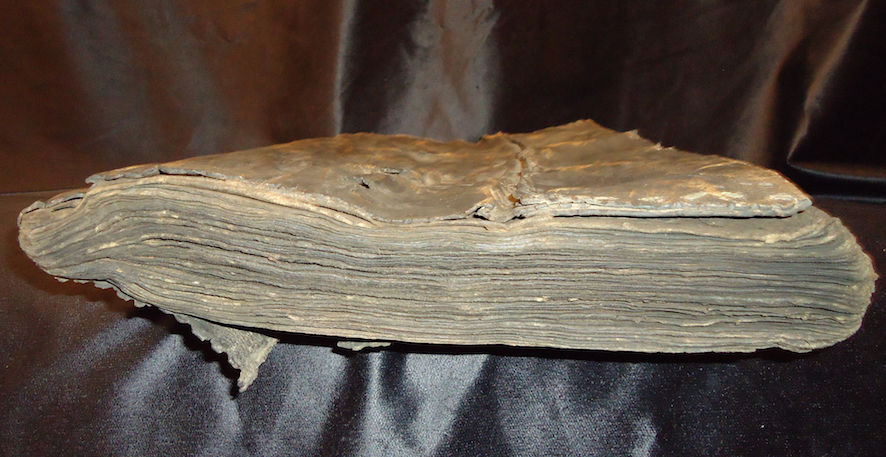
Ali finally resolved some issues with the Internet – his “relative” was only willing to provide the images on a secure server for the shortest possible time. The first time we tried to log on – from another shop with Internet access – they had already been deleted. The second time we could scroll through a few of the photos. There was a thick brown book wrapped in some kind of warped leather, and a few shots of inner sheets of parchment containing drawings and line after line of a very odd script that resembled nothing I’d ever seen before.

It was impossible to say anything from images alone, of course. But I had to admit that the thing looked old – amazingly old.

The manuscript was 105 pages long, completely legible, and the images were stunning and incredibly intriguing. There were several crosses, in styles I didn’t recognize. Another image represented a snake, curled in an S-like form followed by the strange script. Its tail was curled around what looked like an infant.

Later they told me that the images had been examined by an expert. If his analysis was to be believed, the book was a Bible, although no one had been able to decipher the text. From the images they believed it to represent a part of the New Testament.

And one of the initial pages with a cross held a notation – written in what the expert claimed was a recognizeable dating system. If their interpretation was correct, the book dated from the year 232 CE.

Unbelievable. Especially given the fact that the oldest extant New Testament manuscript anywhere in the world – except for a few fragments – dated from the third or fourth centuries CE!

What to do? Armed with a few images that they were finally willing to part with, I decided to hit the libraries and talk to scholars from the fields of ancient manuscripts and Biblical history. It was immediately clear that a true Biblical manuscript even remotely that old would be a momentous, Earth-shaking finding.

All of this had dropped into my lap completely by accident, but if there was anything to the story at all, I had to pursue it.

The story continues in Part two, coming soon.

Tips for reducing talk anxiety (2b, more responses to reader comments)

This is a follow-up to the original piece.


Dr. Krishna Kumari Challa wrote: Well, if you are an introvert, your brain goes haywire with the great stimulation given by larger audiences (an introvert’s mind needs less stimulation to have the same level of understanding about a situation). Controlling it is more important, according to psychologists, before thinking about the points given in the blog. Only when the stimulation is controlled you can control other things. That is why introverts try to hide behind something, look at their papers or at the screen instead of the audiences in the initial stages. They try to reduce the stimulation by doing so.
I would be grateful to you if you could give tips on how to reduce this ‘too much stimulation’ issue.


Hi Krishna – an excellent point! My experience with students suggests that there are surely “types”, such as those you call introverts, who dislike being the focus of attention and whose brains experience an exaggerated response that powerfully influences their bodies and behavior in public presentations and similar situations. Usually giving them help requires close observation, then developing an individual plan of practice that addresses specific behavioral symptoms – like those mentioned in the earlier post. This will take time and patience. Here, too, it can be useful to help them focus on the content of their presentation, and this is a theme to be covered in a future post. That said, I’m not a psychologist, and some types of anxiety clearly have very deep roots that need to be addressed therapeutically before any satisfying “cure” is really achieved.

But still there are things that can help: It’s crucial to try to define the parameters of the problem as precisely as possible. Are there any situations in which the person manages to handle their anxiety? Are they equally affected if they give the presentation to two or three close friends, or their lab? Is one of the issues trust: with people they know, does a fear of disapproval or a negative response disappear? If they can handle small groups, then this can become a cornerstone of practice. They need to give the talk as often as possible in such settings in a way that helps them internalize the positive effects and extend the experience to situations with larger audiences.

Personally I learned something about this through music. My first violin teacher, Lewis Hoyt, said that one of his teachers had always told him to imagine the heads in the audience as cabbages! Later he began studying through a new method which took exactly the opposite approach – enjoying the presence of an audience and fully engaging them as human beings in your personal music, work, or story. Over the long term, if one can manage it, this tends to work better than pretending like they aren’t there.

Your point about “control” reminds me of the student I discussed in point 9 of the original article – where the issue was managing all of the ideas bombarding his brain and the flow of the content. A few simple strategies to ensure that you can stay on track (point 8) and won’t get lost go a great way toward reinforcing confidence. The trick is to extend them to behaviors that are really hard to control: blushing, stammering, shaking, etc.

Each speaker needs to build on the strengths she/he has and use them to support areas of weakness. Can you tell a joke? Can you tell a funny little personal story about something that happened during the project? If some weird little accident happens, can you improvise and get people to laugh? There are lots of potential methods to change the atmosphere – disasrming a stressful situation – which can almost instantly relieve a lot of the tension. As a teacher or speaker you may have to dig deep into the rhetorical repertoire to find something that works, but there’s often something there to draw on.

A lot more needs to be said about this; I’ll keep thinking about it, and the comments on the piece have been extremely helpful in pulling out essential points for consideration. I’ll be teaching several courses over the next couple of months and will be able to report more specific examples from actual practice.


If you like these pieces, you might be interested in the article:

“The Dinner Party: Learning to explain your work to a general audience can make you a better scientist.”


If you’d rather enter the bizarre, twilight world where science collides with humor, check out the Devil’s Dictionary of Scientific Words and Phrases, or the text of a talk I gave in Oslo in 2015, plus everything else in the categories “Hilarious moments in science communication” or satire.


And if you haven’t yet seen the most popular post so far from this blog, check out the “God” article:  “Even God’s first paper got rejected.

Lloyd the organoid and other new cartoons

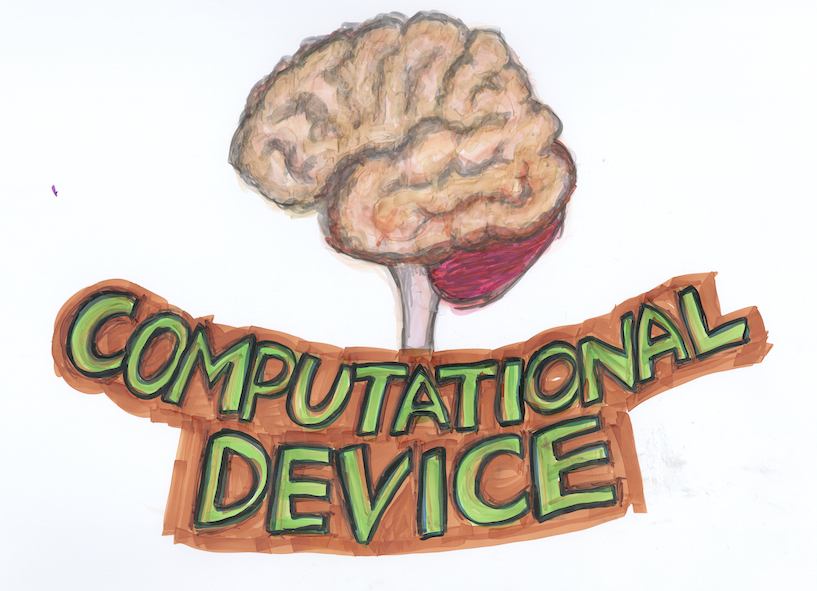
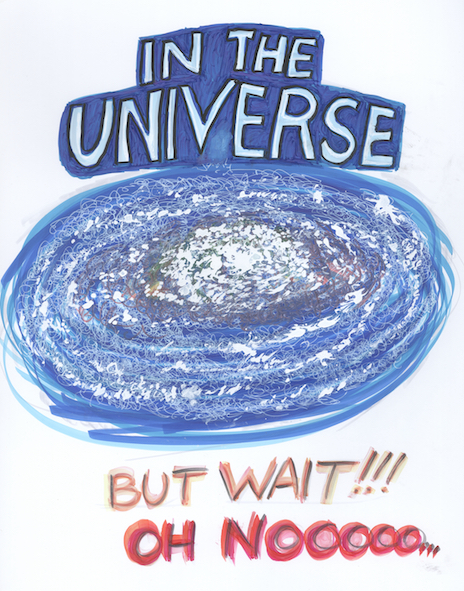
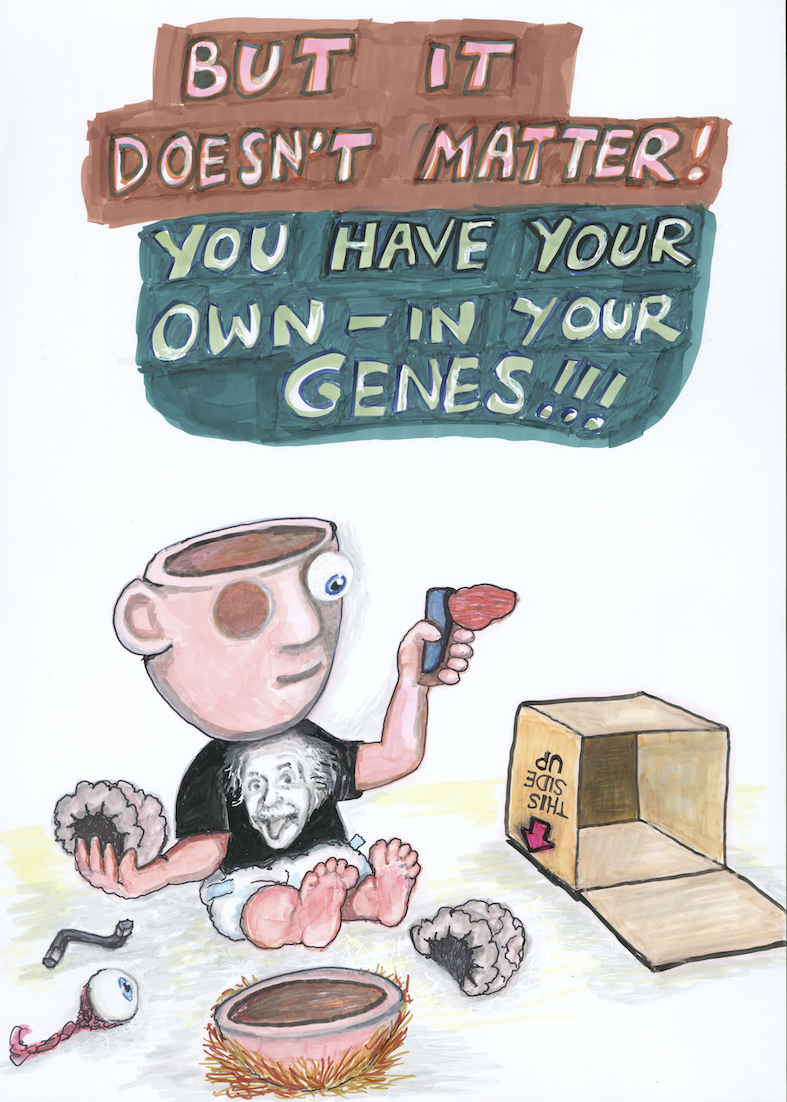
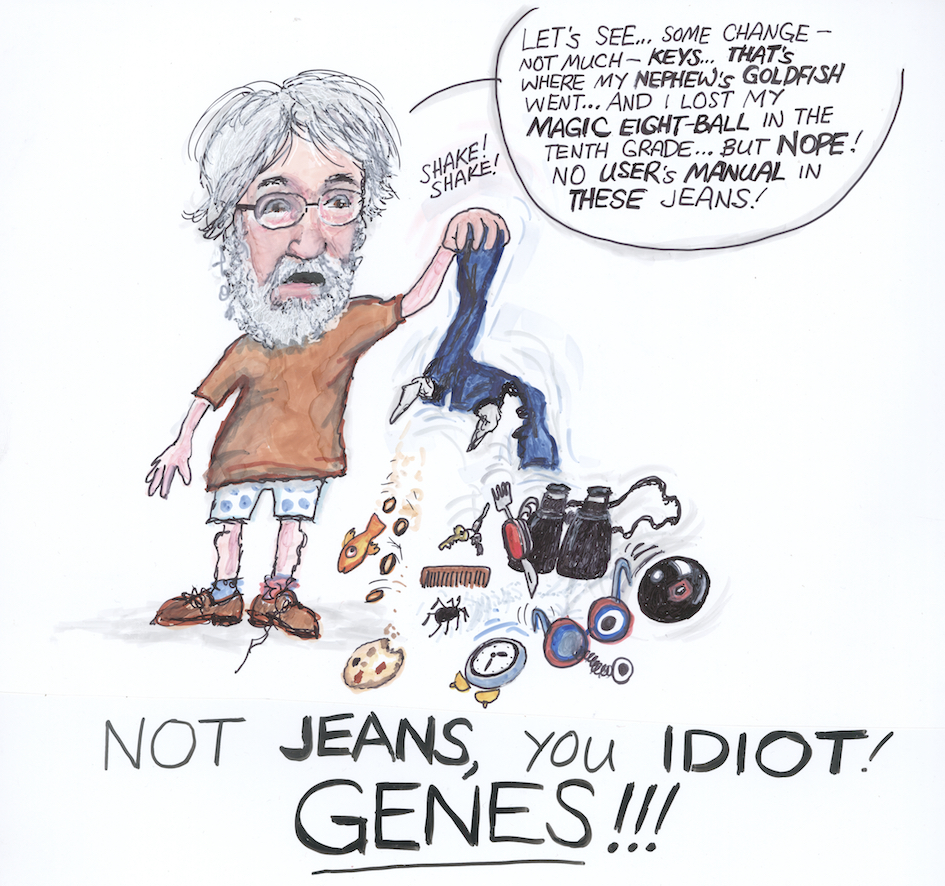
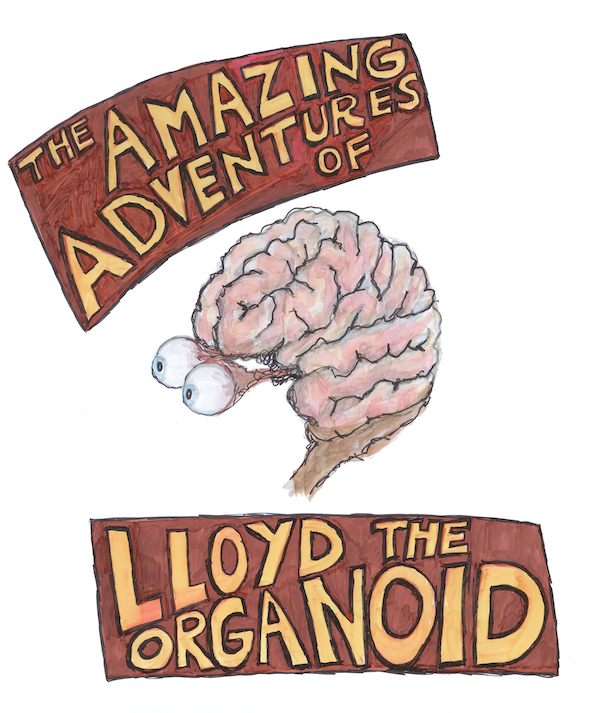
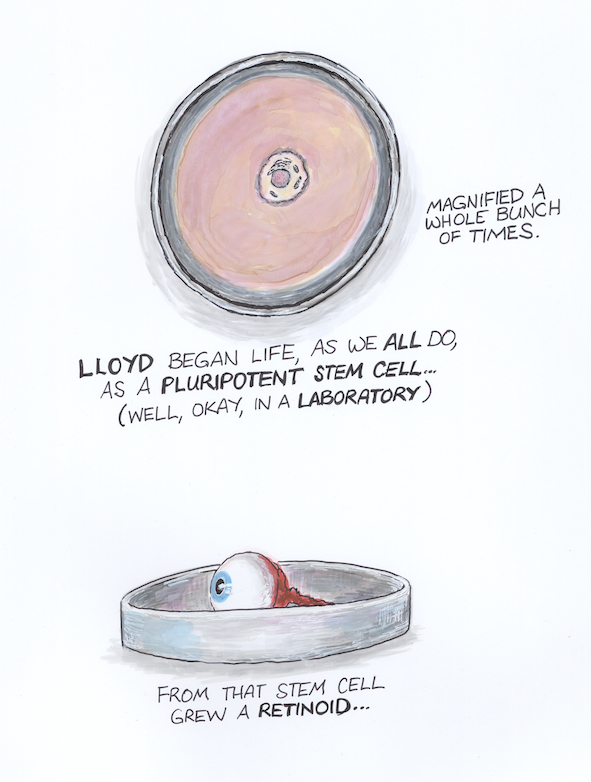
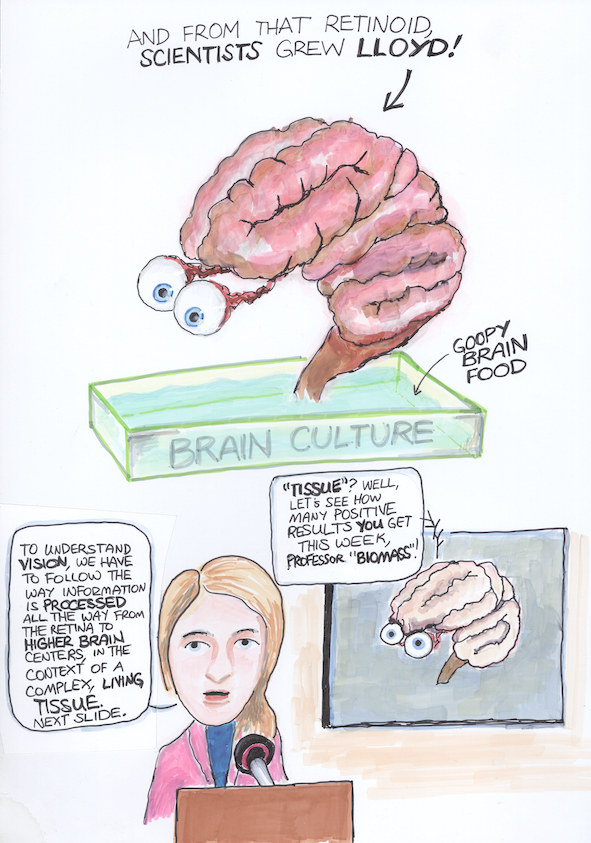
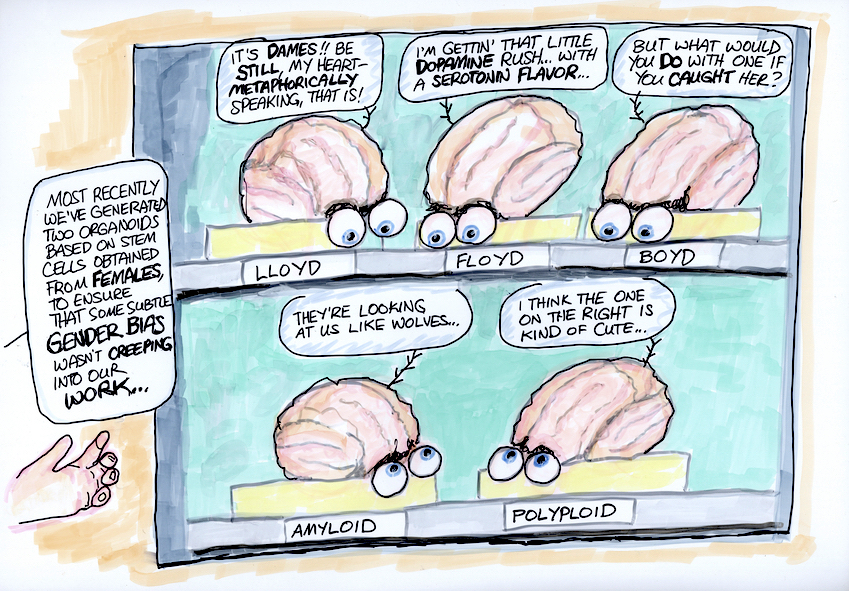
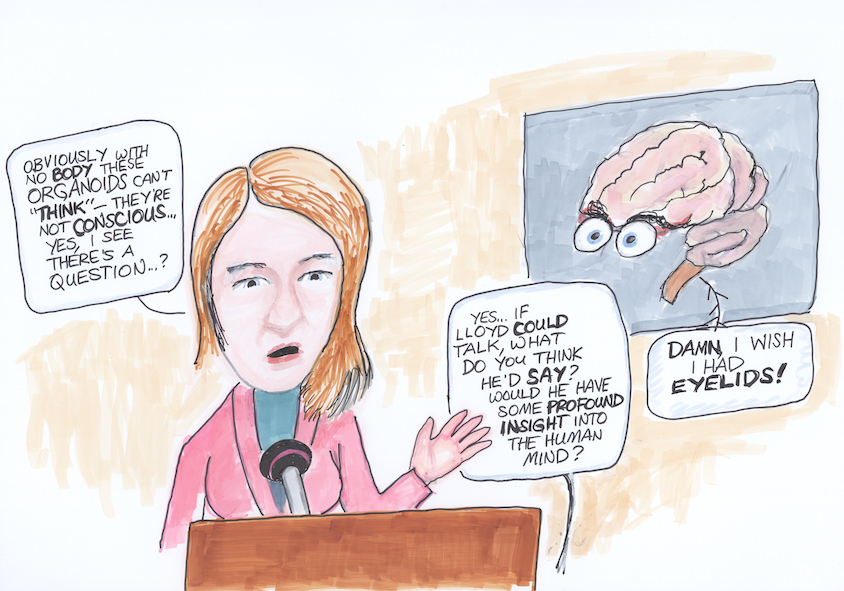
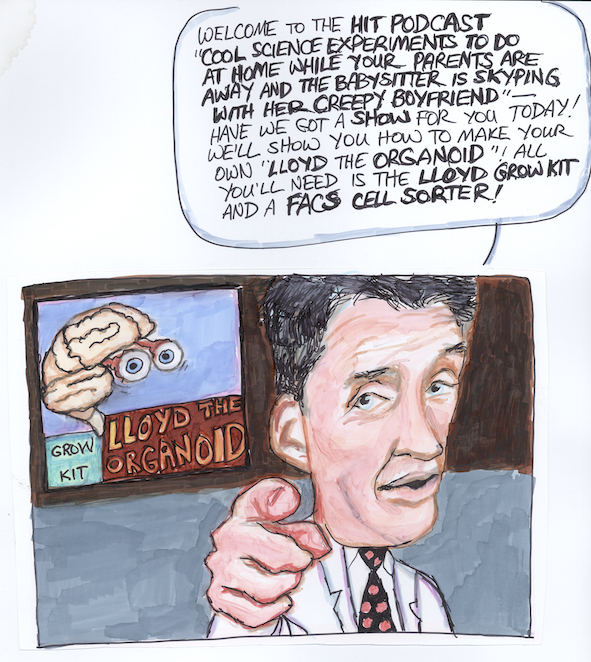
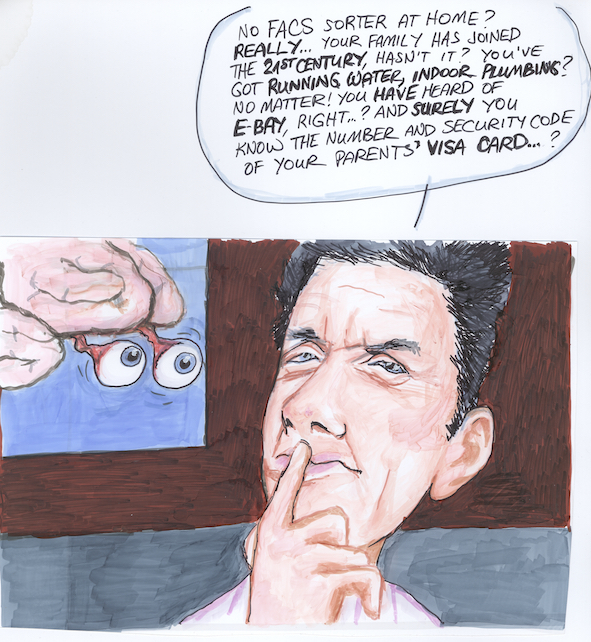
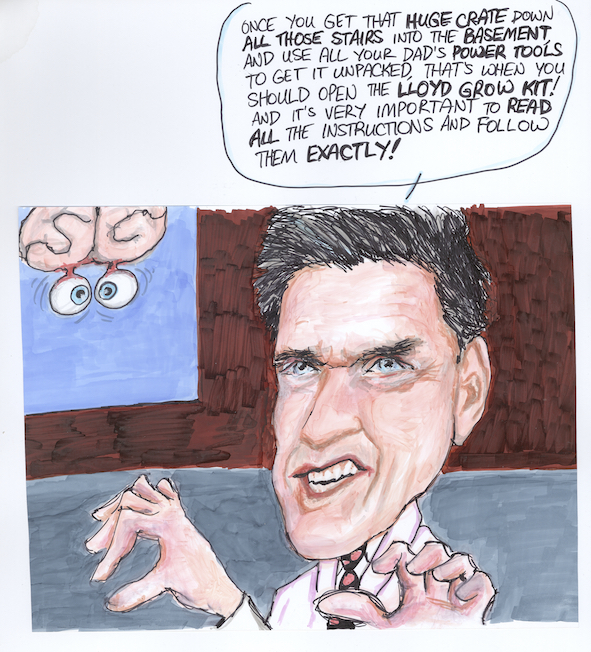
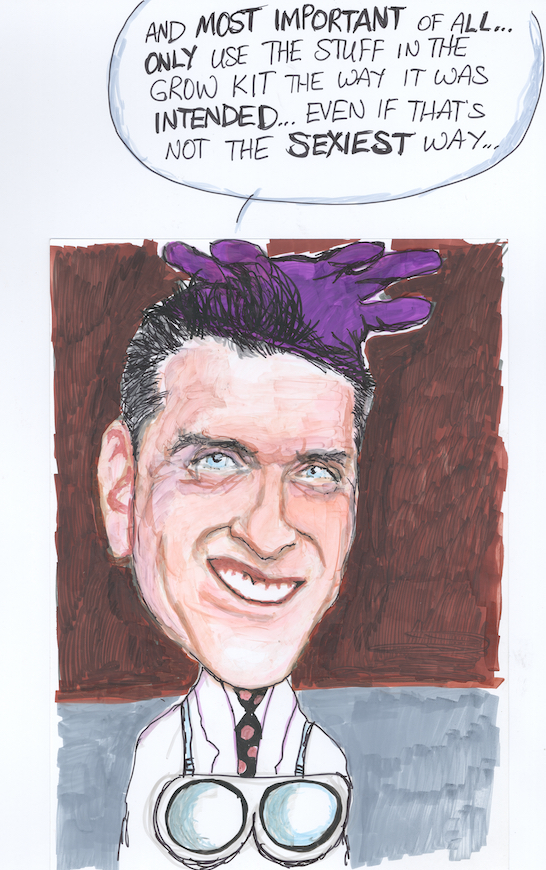
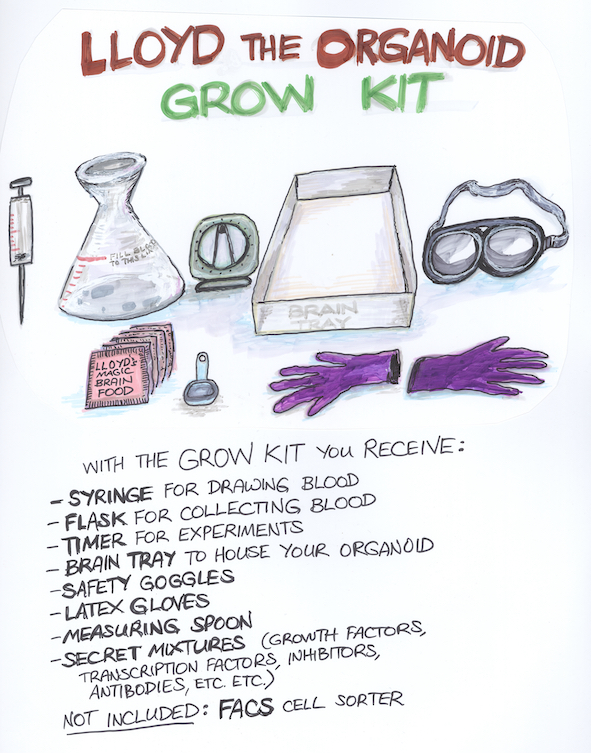
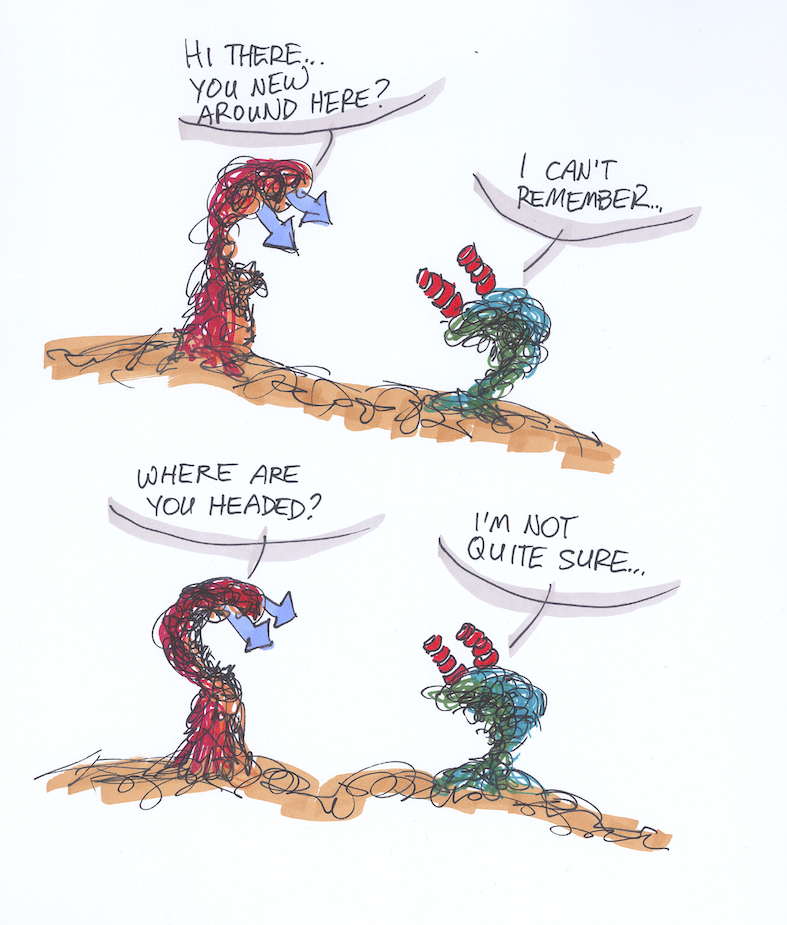
As promised, my cartoons from the Long Night of Sciences held last Saturday here on the MDC campus. Starting a new series called Lloyd the Organoid, etc.

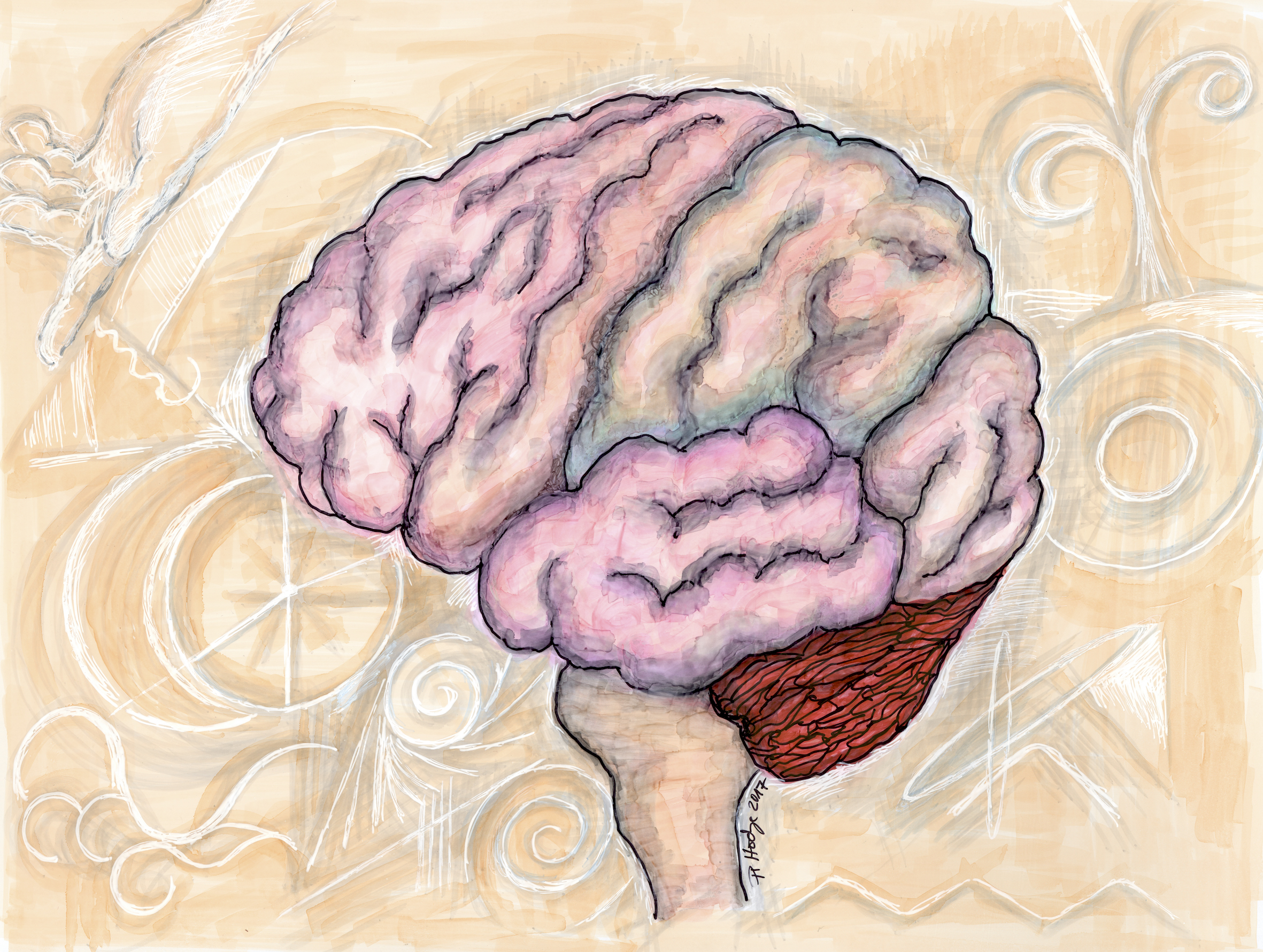
  1. “The brain: a user’s manual”

2.

3.

4. (Note: any resemblance to late-night television host Craig Ferguson is purely coincidental.)

Coming soon: the Instruction manual for the GROW KIT!


Even God’s first paper got rejected

All images and texts on this site copyright 2017 by Russ Hodge


Editor-in-Chief   

The BIBLE


Prof. God
Paradise Avenue
Heavenly Realm


Dear Prof. God,


Thank you for submitting your paper, “Genesis: A method of generating matter,
space, time, and living species from Nothingness,” for our consideration. We agree
that the creation of the universe might be of interest to our general readership.
However, after considering the reviewers’ comments, we regret that we are unable
to publish the manuscript in its current form. If you feel that you can satisfy their
concerns with further experiments, you are welcome to resubmit a revised version
of your manuscript at a later date.

The following represent only a small selection of the most significant issues,
in our view, but for a resubmission you should address all the reviewers’ comments,
which are in the 5000 GByte attachment appended to this file.


Reviewer #1:

Hasn’t this author ever heard of controls? The author should have started
with two samples of Nothingness, applied the method of creation to one
while observing the other to ensure that the various reactions did not occur
spontaneously over time. He provides no quantitative description of this
Nothingness, gives no account of the conditions under which it was produced,
and no proof that Nothing was actually there.   

There are no references to previous literature, so we have no way to judge
the author’s qualifications in the field or the extent to which this work is
innovative vis-a-vis that of other groups.

The indirect, third-person style of the text is old-fashioned and should be
updated. Phrases such as, “In the Beginning God created” should be modernized
to a form like, “In a first step, we produced…” Another example:
“And God found that it was good” should be replaced with,
“The results confirmed our initial hypothesis.”


Reviewer #2:

From what I can tell, the physical and biological systems described in the
paper seem to have gone from a very low state of order to high complexity
within a remarkably short period of time. This hints at the use of extremely
powerful catalysts, which are not described anywhere in the text. Are they
commercially available? If so, were the manufacturer’s protocols rigorously
followed?

In fact, the author has failed to offer any model or hypothesis that could
mechanistically explain the results, or justify the claim that His efforts
somehow caused them. The implication is that things happened just because
He willed them to. This is the reason we have double-blind experiments, people!


Reviewer #3:

The human cloning experiment was not described in nearly enough detail.
What types of cells were extracted from the male’s rib, and what method was
used to generate induced Pluripotent Stem Cells and then the female? More
significantly, since the cell was derived from a male, where did they get the
second X chromosome? Was it simply a clonal copy of the first? Theoretically
it is possible, I suppose, that the female was actually genetically male but
suffering from some sort of defect in her SRY gene. If that were the case, half
of her gametes would be chromosomally Y. This would lead a quarter of her
offspring to be entirely X-less, i.e., Y-Y, which might explain the violent behavior
of some of her children. Or perhaps radical genetic engineering technologies
were used to create the female, such as CRISPR/Cas9, although I hope not,
because the fight over the patent was already a mess, and getting God
involved certainly wouldn’t make things go any smoother.

In any case, the type of genetic modifications needed to make a female from
a male would have been in direct violation of every ethical standard and
numerous international laws. Not to mention the horrendous, ensuing inbreeding
effects that could be expected in a population descended entirely from a couple
who were not only closely related, but actual clones.

Please note that I did not receive any paperwork indicating that the project
had been submitted to ethical review. Apparently the Author considers
Himself superior to any sort of moral authority; either that, or he paid
someone off. If I am wrong, and an Ethics Commission did in fact approve
the project, please let me know the country. I would consider moving
my laboratory there.


An animal that runs on hybrid fuel

Research highlight from the MDC – a great story from Gary Lewin’s group in the current issue of Science


When oxygen gets scarce, the naked mole-rat throws a metabolic switch to draw energy from fructose rather than glucose

The naked mole-rat, a rodent native to Africa, can survive with little or no oxygen far longer than other mammals. The secret lies in its metabolism: in addition to the basic system by which animals generate energy from glucose, naked mole-rats have a backup system based on fructose. This discovery comes from Gary Lewin’s lab at the Max Delbrück Center (MDC), in a collaboration with the groups of Michael Gotthardt (MDC), Stefan Kempa (MDC and BIH), and Thomas Park (University of Illinois in Chicago), as well as scientists from several other countries. The work is published in the April 21 edition of the journal Science.

Oxygen is so essential to life that a very short deprivation is fatal to animals. Their cells need a constant supply to drive the chemical reactions that produce energy from food. In ancient times, cells evolved a form of metabolism that used the sugar glucose as a source of fuel and the high reactivity of oxygen atoms to extract its energy. This process was so efficient that glucose-based metabolism could fuel the bodies of humans and even larger animals, and it has been maintained over the course of evolution.

But life in a harsh environment can alter even very basic aspects of an animal’s biology. Long ago, something drove the ancestors of the naked mole-rat underground. There the rodent’s biology and behavior began an evolutionary dialogue with the extreme conditions it encountered. This led to some highly unusual adaptations. Naked mole-rats are insensitive to some forms of pain, and have lifespans that exceed 32 years – ten times the norm for most other rodents. Only one or two cases of cancer have ever been detected in the species. And now MDC scientists have discovered that the animal can go with little or no oxygen for extraordinary lengths of time.

Such characteristics have attracted the interest of scientists around the globe – including neurobiologist Gary Lewin. Over several years, his laboratory has gained deep insights into the biology of pain by comparing the nervous system of the naked mole-rat to that of mice and humans. Upon learning that the naked mole-rat could cope with little or no oxygen, he was immediately intrigued – and his lab was well prepared to pursue the biology behind this unique attribute.

Linking oxygen deprivation to a unique metabolic system

Oxygen deprivation was clearly connected to the animal’s biology, lifestyle and environment. “Naked mole-rats huddle in huge, underground colonies of up to 280 individuals,” Lewin says. “This means that they continually experience sharp declines in levels of oxygen and dramatic increases in carbon dioxide. Without adaptations, this would be just as deadly to the naked mole-rat as it is to other animals.”

Most organisms on Earth are suited to the surface atmosphere, composed of about 21% oxygen and only tiny amounts of carbon dioxide (about 0.04%). Reducing oxygen to about 5% is fatal for a mouse within about 15 minutes; total deprivation causes fatal damage within about a minute. The naked mole-rat, however, can cope with as little as 5% oxygen and high levels of carbon dioxide for hours on end with no apparent distress or ill effects. And amazingly, it can survive at least 18 minutes without any oxygen at all.

“Under these conditions the animal enters a sort of suspended animation,” says Jane Reznick, a postdoc in Lewin’s group and a lead author on the current paper. “It falls asleep and its heartbeat slows to about a quarter of the normal rate. When oxygen is restored the heart rate rises, and the animal quickly wakes up and goes about its normal behavior.”

This hinted that some backup system was protecting its heart and brain – two organs that are highly sensitive to oxygen in other species. Without it, their cells cannot produce energy and rapidly suffer fatal damage.

Hitting the stop button on an assembly line

There had to be some fundamental difference in the naked mole-rat’s metabolism. To find it, the scientists enlisted help from the MDC’s Metabolomics Unit, headed by Stefan Kempa. His team uses advanced technology to capture global and quantitative snapshots of cellular metabolism. Their methods reveal the presence of tiny metabolites: molecules that are created through the processing of fuels like glucose. Networks of enzymes break glucose down into small products that move through the metabolic pipeline, generating energy along the way.

“These experiments are a bit like hitting the ‘stop’ button on an assembly line,” Kempa says. “If you were to do that in a factory, then look at partially assembled pieces and the bits that were tossed out, you’d get an idea of what was being built, and how it was constructed.” Further experiments traced the remnants of the sugars as they flowed through an alternative metabolic route that generated energy without consuming oxygen.

Comparing mouse and naked mole-rat tissues under conditions with and without oxygen revealed some curious differences. In naked mole-rats, oxygen deprivation triggered a shutdown of cellular energy factories called mitochondria. In the mouse they continued to operate but quickly malfunctioned – mitochondria need oxygen to run.

But the most startling finding had to do with the sugar molecules found in the animals’ blood and tissues. Overall, naked mole-rats had a lot less glucose than mice, which hinted that other sugars might be providing an alternative source of energy. During oxygen deprivation, there was a significant rise in levels of other sugars. Naked mole-rats had more sucrose – and truly stunning was the amount of fructose, which had skyrocketed.

Can tissues run solely on fructose fuel?

Could the naked mole-rat be using fructose rather than glucose as a source of energy? The two sugars weren’t that different – even our own bodies make use of fructose-based metabolism, although this only happens in the kidney and liver. These organs have an enzyme called ketohexokinase, or KHK, which can trim fructose into a form that can be plugged into the energy production line. From that point on the modified fructose, called F1P, is handled like glucose. Since the subsequent stages of processing don’t require oxygen, it wouldn’t be absolutely necessary in a metabolic system based on fructose.

“In humans, fructose metabolism occurs only in the kidney and liver because they’re the only tissues that contain KHK,” Lewin says. “We found that brain tissue from the naked mole-rat contained high levels of F1P – suggesting that KHK was at work – but only under oxygen deprivation. This told us two things: that their brains might really be using fructose as a source of energy, and that the switch only happened when oxygen grew scarce.”

The evidence for fructose metabolism was accumulating, but so far it was all indirect; the next step would be to determine whether the animals were actually using the alternative source of fuel. First the scientists performed experiments using brain tissue to test whether neurons could function if they were deprived of glucose and fed exclusively on fructose. While an hour of this treatment severely damaged the cells of mice, naked mole-rat neurons continued to show activity. Experiments carried out in Michael Gotthardt’s group showed even more dramatic results for the naked mole-rat heart, which could beat just as well when supplied with fructose as it could using glucose.

“This was proof that fructose can replace glucose as an energy source in the naked mole-rat brain and heart,” Reznick says. “It helps explain how these organs – and the animal as a whole – can recover from long periods of oxygen deprivation.”

A two-part system for switching to alternative fuel

Cells can only use fructose as an energy source if they can absorb it from their surroundings. This requires a protein called GLUT5, which snatches fructose and draws it into the cell. In mice and humans, GLUT5 appears in kidney and liver cells, but other tissues have almost none. It’s another factor that restricts fructose metabolism to the kidney and liver in humans and prevents it from serving vital organs such as the brain and heart. In the naked mole-rat those tissues – and most other cells – have at least ten times as much GLUT5.

“This gives the naked mole-rat a two-part system that allows it to survive long periods of oxygen deprivation,” Lewin says. “Throughout its body you find both the GLUT5 transporter and the KHK enzyme that converts fructose into a usable energy source.”

Fructose metabolism has been encountered in human diseases including malignant cancer, metabolic syndrome, and heart failure. This hints that there might be some link between the naked mole-rat’s metabolism, its resistance to cancer, and possibly even its extraordinary lifespan.  Only further research will tell – but the current study provides an interesting new handle on such questions.

“It’s important to understand how these unusual animals make the metabolic switch without any obvious long-term damage to their tissues,” Lewin says. “We might learn something about how our own cells attempt to cope with situations in which they are deprived of oxygen, such as strokes or heart attacks. Our work raises questions about the biology of fructose metabolism that will ‘fuel’ research for years to come.”


Russ Hodge

Thanks to Jana Schlütter and Martin Ballaschk for comments on an earlier draft.

Reference:

Thomas J. Park1, Jane Reznick2, Bethany L. Peterson1 , Gregory Blass1 , Damir Omerbašić2, Nigel C. Bennett3, P. Henning J.L. Kuich4, Christin Zasada4, Brigitte M. Browe1, Wiebke Hamann5, Daniel T. Applegate1, Michael H Radke5,10, Tetiana Kosten2, Heike Lutermann3, Victoria Gavaghan1, Ole Eigenbrod2,  Valérie Bégay2, Vince G. Amoroso1, Vidya Govind1, Richard D. Minshall7, Ewan St. J. Smith8, John Larson9, Michael Gotthardt5,10, Stefan Kempa4, Gary R. Lewin2,11 (2017): „Fructose driven glycolysis supports anoxia resistance in the naked mole-rat.“ Sciencedoi:10.1126/science.aab3896

1Laboratory of Integrative Neuroscience, Department of Biological Sciences, University of Illinois at Chicago, Chicago, Illinois, United States of America; 2 Molecular Physiology of Somatic Sensation, Max Delbrück Center for Molecular Medicine, Berlin, Germany; 3Department of Zoology and Entomology, University of Pretoria, Pretoria, Republic of South Africa; 4Integrative Proteomics and Metabolomics, Berlin Institute for Medical Systems Biology, Max Delbrück Center for Molecular Medicine, Berlin, Germany; 5Neuromuscular and Cardiovascular Cell Biology, Max Delbrück Center for Molecular Medicine, Berlin, Germany; 7Departments of Anesthesiology and Pharmacology, University of Illinois at Chicago, Chicago, Illinois, United States of America; 8Department of Pharmacology, University of Cambridge, Cambridge, United Kingdom; 9Department of Psychiatry, University of Illinois at Chicago, Chicago, Illinois, United States of America; 10DZHK partner site Berlin, Germany; 11Excellence cluster Neurocure, Charité Universitätsmedizin Berlin, Germany