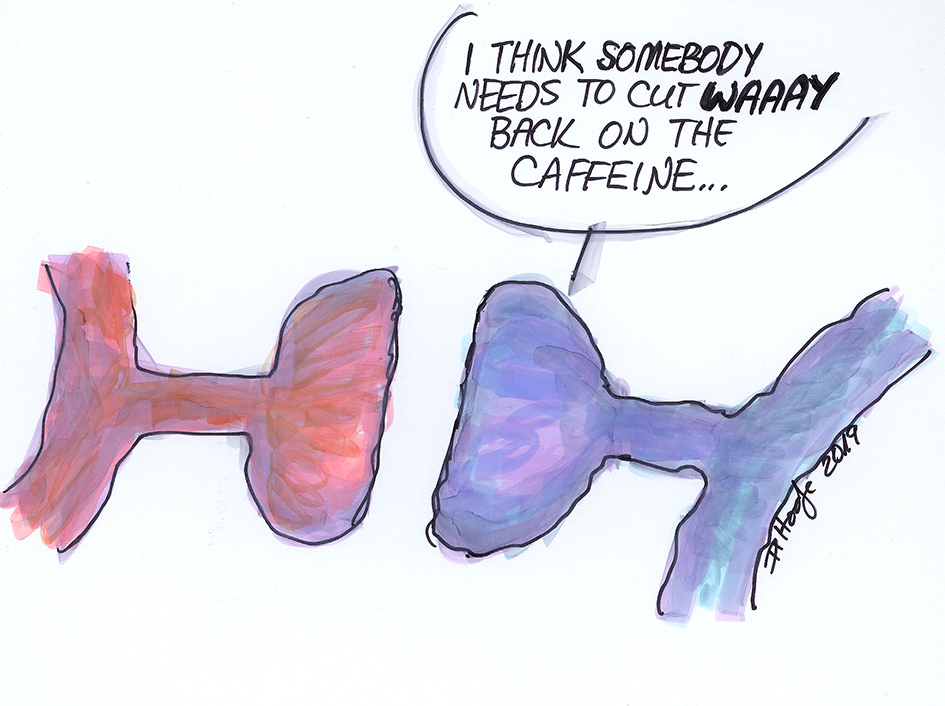
Finally an update to the Devil’s dictionary! Today’s words: vitalism, homunculus, -ify

See the complete Devil’s Dictionary of Scientific Words and Phrases here.
all entries in the Devil’s Dictionary copyright 2020 by Russ Hodge

vitalism  an outdated view of life that was ultimately supplanted by materialistic theories such as evolution and the billiard ball model of the universe. Vitalists held that inorganic substances such as water or black coffee had to be perfused with a spiritual energy to have any kick to them. Vodka or whisky worked best.

homunculus  a miniature person postulated to exist somewhere inside a normal human being, probably in a tightly folded form. A homunculus is smaller than a dwarf or gnome, more on the scale of an elf or fairy, but larger than a blood corpuscle. Natural philosophers considered the existence of homunculi essential because without one, how could a physical body make decisions or move its limbs – for example, to answer its cell phone? They reasoned that there had to be a tiny person inside who makes all the decisions and pulls the strings: a sort of Mission Control, or Wizard of Oz, or perhaps a product made by Apple. The homunculus theory lasted quite a while until someone pointed out that the homunculus, too, would have the same problem – it, too, would require a wizard or some other being to tell it what to do. This led to the unhappy theoretical conundrum of infinite recursion, otherwise known as “it’s elephants all the way down.” To solve the paradox some bright bulb proposed that the body of the homunculus contained a Philosopher’s Stone, a sort of smart rock. How it got there is unclear; probably the elf or fairy had to swallow it.

Some people give their homunculi names, like “Bob” or “Ezekial”, or “my little Princess.” In Boston, for reasons that are unclear, everyone’s homunculus is named “Herman.” This explains why they pronounce the word “hermunculus”, or in extreme cases, “hoimunculus.”

-ify  a suffix added to a word and thereby transforms an object into the thing that the suffix is attached to, whether it wants to change or not. What it was before the transformation is anybody’s guess. Liquify, for example, describes the process of making a liquid out of something that shouldn’t be, such as hair, or a motorcycle. Solidify, by contrast, creates an unnatural solid. An example of solidification is to turn cream into butter and then carve it into a life-sized replica of Leonardo da Vinci’s Last Supper, or perhaps a sculpture of a cow – which is creepy, akin to some form of cannibalism or incest.

Other uses of -ify include:

pacify – to make something such as a screaming child peaceful, usually either by sticking a silicon or rubber object in its mouth, or by shooting it (contrast with Peacemaker)
mortify – to exhibit such poor manners that you kill someone
petrify – to scare something so badly that you turn it to stone
classify – to force a bunch of unruly objects – such as first graders – into a group, despite their protests
crucify – to force people to stand for very long periods of time with outstretched arms, sometimes using a wooden structure as a support
clarify – to take something murky and extract everything of interest until it becomes so transparent it is practically invisible
ratify – to turn something into a rat
carrotify – to make a carrot out of something that was never meant to be one
satisfy – to disrupt a person’s natural state of grumpiness and render them content, usually only very briefly
edify – to rename someone Ed (not to be confused with edwardify, edwinify, etc.)
codify – to turn something into a type of fish that sucks on the mud at the bottom of lakes or oceans (contrast with catfishify)

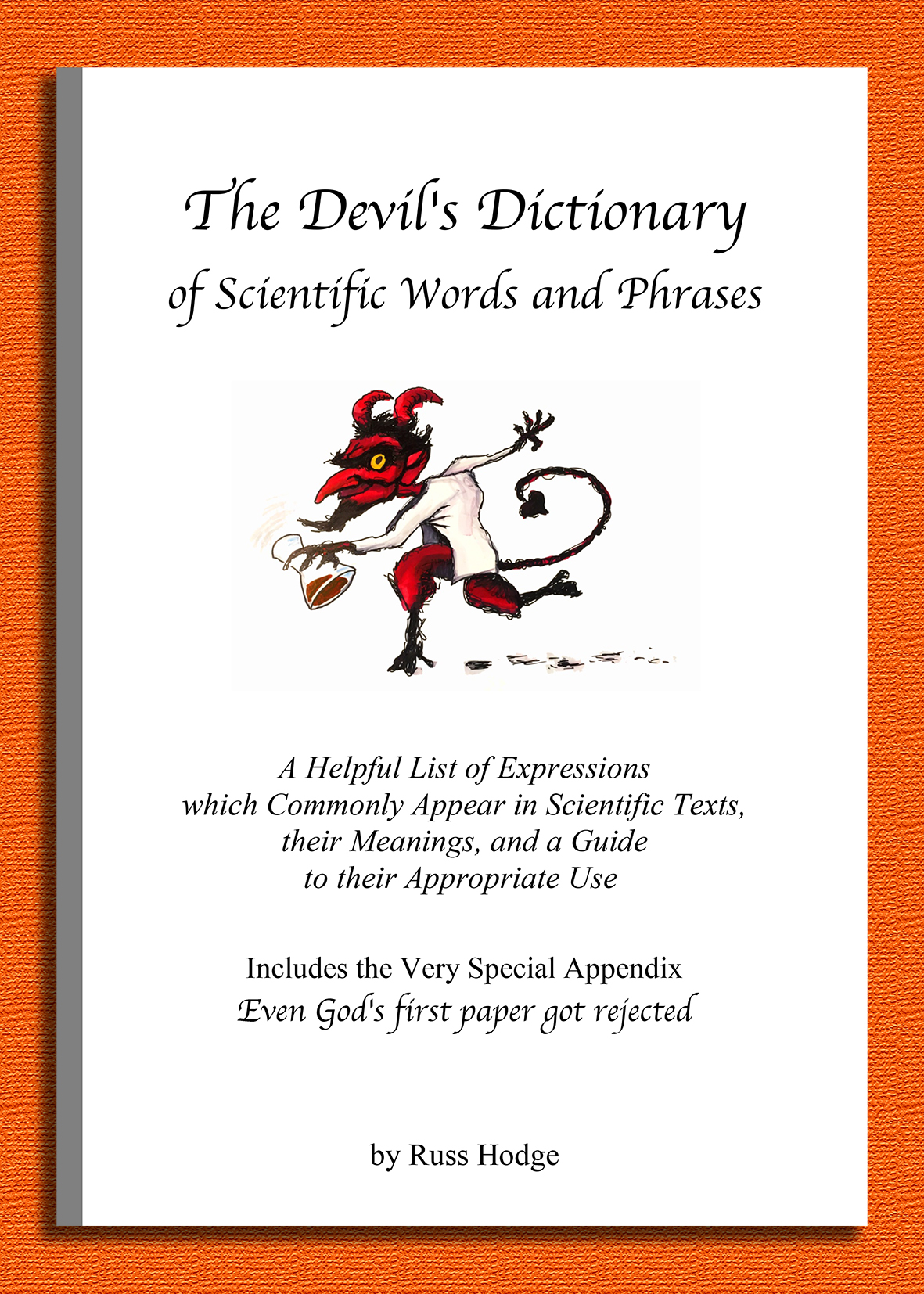
Need that perfect birthday gift for a scientist? Get your printed copy of the Devil’s dictionary here. I’m also planning to publish a book of the cartoons and a new calendar this year.

If you liked the Devil’s dictionary, you might also like the series:
Molecular biology cartoons

The best of PubMed

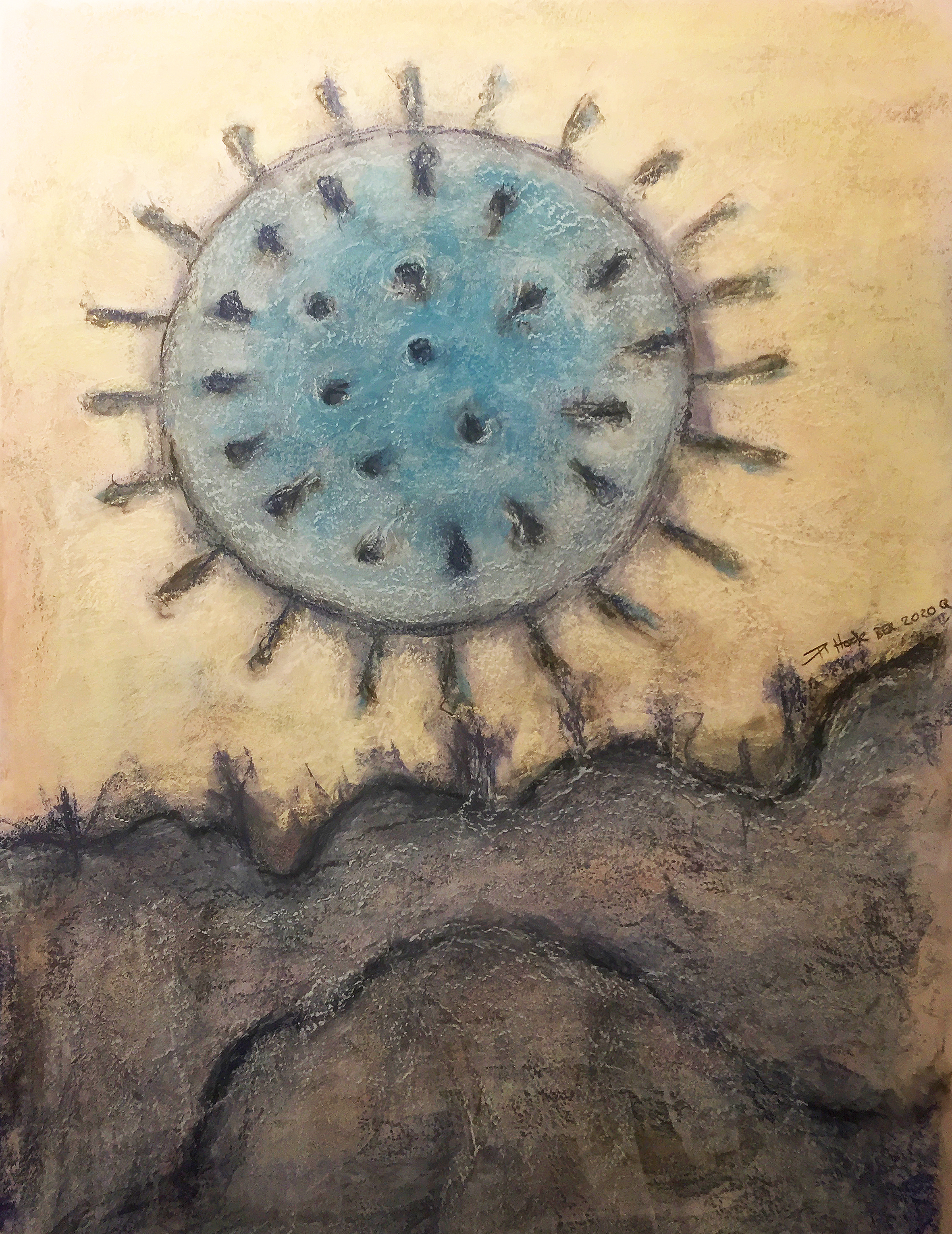
Fresh from the Quarantine: An image of the Coronavirus

It’s been a long time since an update – I know! Sorry! But I’ve been busy and the drought is now officially at an end.

I’ve just finished a new painting of the coronavirus interacting with a human cell…

I’m offering it freely to anyone who would like for any non-profit publication or other use – just cite the following:

Artwork by Russ Hodge, www.goodsciencewriting.wordpress.com

I’ve done a lot of painting during the quarantine and will be posting it soon at my on-line studio: www.russhodge.wordpress.com


In case you haven’t seen it…

In case you haven’t visited the site in a while…

I am posting my artwork now on my new “studio” blog. If you like the non-scientific artwork, check in there from time to time. A couple of the newest pieces are below.

And for those of you in the Berlin area, I’m giving a concert and having an exhibition of my paintings in Neukölln in mid-March… If you’re interested in attending the concert, space is limited, so drop me a line and I’ll reserve you a seat.

Tell your friends!

Both events are hosted by the Wunderkammer; check out the rest of their program at the Wunderkammer website.

An update to the Devil’s dictionary: WORMS!

See the complete Devil’s Dictionary of Scientific Words and Phrases here.

all entries in the Devil’s Dictionary copyright 2020 by Russ Hodge

worm   Worms belong to the family Wormidae, which is the Latinate designation, although the word “worm” descends from the Old Lower High German Wurm, which meant dragon, suggesting that the species have undergone a significant reduction in size and a few other changes over evolutionary time. There are two major classes of worms, each of which consists of about a zillion subtypes. These are arranged in subclasses, at least theoretically; in practice, no two scholars agree on the criteria by which this should be done. It’s a good thing for wormologists: if they could solve the problem it would put most of them out of business, since most publications on worms have to do with taxologies. The major classes are the flatworms, or Flatidae, and the fatworms (Fatidae). In the historical literature one sometimes sees the nomenclature Flatulae and Fatulae, but these terms were modernized because they couldn’t be used without provoking hysterical laughter and confusion. To tell the difference all you have to do is step on one. A Fatidae will make an audible, somehow satisfying popping sound when you apply weight to it, whereas a Flatidae will hardly be perturbed at all. In fact, some subtypes of Flatidae are almost impossible to kill – you can chop them up into pieces and they regenerate entire worms; eat them and they take up residence in your gut; apply a flamethrower and you’ll probably burn down your lab before you kill them. This would pose an immense overpopulation problem except that Flatidae are so thin you can stack a million on top of each other without the pile getting appreciably thicker.

The unifying characteristic of worms is their lack of legs, which might cause them to be confused with snakes, except that they also lack teeth. As a means of locomotion, they draw on the musculature of their digestive system, which is basically a tube that starts at the mouth and ends at the tail – although it takes an expert to tell the difference, and even worms sometimes get confused. Basically, worms are intestinal tubes that lack limbs and other unnecessary embellishments.

Worms have an important ecological function, as the biological equivalent of Roombas. They creep along the ground and suck up anything in their path. Molecules inside the worm digest the stuff they eat and transform it into soil, which plants require to grow. (Providing the worm is headed in the right direction. If it moves backwards, the process is reversed.) Plants transform the soil back into worm food, which is their major function. All of this requires lots of energy. Environmentally speaking it would probably be more efficient simply to eliminate the plants, but then the worms would just get into mischief.

NEW: Need that perfect birthday gift for a scientist? Get your printed copy of the Devil’s dictionary here. I’m also planning to publish a book of the cartoons and a new calendar this year.

If you liked the Devil’s dictionary, you might also like the series:

Molecular biology cartoons

The best of PubMed

New blog for artwork

Dear friends,

I’ve just started a second site – russhodge.wordpress.com – where I’ll be publishing my non-scientific paintings from now on. If you’re interested, visit the site. It’s still not complete, but there are already over 200 works in the galleries, most of which are for sale as originals or reproductions. I’ll be adding the titles and names to the portraits over the next few days.

More updates in the Devil’s dictionary

All the best for 2020!
If you like the site, please share and recommend it to your friends!

today’s entries: tohuwabohu, vegan, zither, and zoology.

See the complete Devil’s Dictionary of Scientific Words and Phrases here.

all entries in the Devil’s Dictionary copyright 2020 by Russ Hodge

tohuwabohu  a state of absolute chaos, similar to the state of the very early universe, or the laboratory after a party.

vegan  an extraterrestrial being from a planet that orbits the star Vega, in the constellation Lyra. The biochemistry of their world is so fundamentally different from that of our own that vegan refugees have a hard time finding anything edible on Earth.

zither  an annoying instrument which only functions after being pounded on, pinched or stroked. While this is also the case for most other equipment, true zithers are seldom seen in modern laboratories. If you’re asked for one, first determine whether your colleague has a lisp and is actually asking for “scissors”.

zoology  the scientific study of zoos, a field which has produced remarkable insights into interactions between predators and their prey – particularly crocodiles, polar bears, zookeepers and small children, although not necessarily in the same cage at the same time. A number of general principles have emerged from zoological research: cotton candy should not be sold within the grasp of great apes, and people should not climb over fences to take selfies with lions. And anyone who makes rude faces at an orangutan or disturbs a shark by knocking on the glass may well get what is coming to him. In recent years zoology has taken on the wider theme of studying any interaction between species that have been removed from their native environments and sequestered together in an unnatural habitat, such as a marriage.

NEW: Need that perfect birthday gift for a scientist? Get your printed copy of the Devil’s dictionary here. I’m also planning to publish a book of the cartoons and a new calendar this year.

If you liked the Devil’s dictionary, you might also like the series:
Molecular biology cartoons

The best of PubMed

The Devil’s dictionary: Now available in printed form!

Want that perfect gift for your scientist friend/spouse/group leader/ collaborator/competitor…? The complete Devil’s Dictionary is now available as a bound book… 80 pages of craziness…

Contact me by email or through the blog if you’re interested:
hodge@mdc-berlin.de

At long last: the return of the Best of Pubmed!

This piece continues the long dormant BEST OF PUBMED series, a regular feature of the early days of this blog. All of the following are actual articles that appear in the NCBI’s database of medical literature. In addition to their unusual titles and topics, the contents of the articles are often worth a look, as seen in some of the below.


The Renaissance or the cuckoo clock. Jonathon Pines, Iain Hagan
Philos Trans R Soc Lond B Biol Sci. 2011 Dec 27; 366(1584): 3625–3634.

This one begins:

‘…in Italy, for thirty years under the Borgias, they had warfare, terror, murder and bloodshed, but they produced Michelangelo, Leonardo da Vinci and the Renaissance. In Switzerland, they had brotherly love, they had five hundred years of democracy and peace—and what did that produce? The cuckoo clock’. – Orson Welles as Harry Lime: The Third Man

Orson Welles might have been a little unfair on the Swiss, after all cuckoo clocks were developed in the Schwartzwald, but, more importantly, Swiss democracy gives remarkably stable government with considerable decision-making at the local level. The alternative is the battling city-states of Renaissance Italy: culturally rich but chaotic at a higher level of organization. As our understanding of the cell cycle improves, it appears that the cell is organized more along the lines of Switzerland than Renaissance Italy, and one major challenge is to determine how local decisions are made and coordinated to produce the robust cell cycle mechanisms that we observe in the cell as a whole.


Is extinction forever?. Brenda D. Smith-Patten, Eli S. Bridge, Priscilla H. C. Crawford, Daniel J. Hough, Jeffrey F. Kelly, Michael A. Patten
Public Underst Sci. 2015 May; 24(4): 481–495.


Morbidity in assistants at surgical operations. D. Laerum, K. Skullerud
Can Med Assoc J. 1974 Mar 16; 110(6): 632–passim.

(In other words, watch out when the Doctor passes you a sharp instrument!)


Male Weaponry in a Fighting Cricket. Kevin A. Judge, Vanessa L. Bonanno
PLoS One. 2008; 3(12): e3980.  Published online 2008 Dec 24.


Women’s Preferences for Penis Size: A New Research Method Using Selection among 3D Models. Nicole Prause, Jaymie Park, Shannon Leung, Geoffrey Miller
PLoS One. 2015; 10(9): e0133079.  Published online 2015 Sep 2.

(Wonder what type of models they’re referring to…)


Sexual Hookup Culture: A Review. Justin R. Garcia, Chris Reiber, Sean G. Massey, Ann M. Merriwether
Rev Gen Psychol.

Published in final edited form as: Rev Gen Psychol. 2012 Jun 1; 16(2): 161–176.


Frequencies of injuries and causes of accidents during ski touring on ski slopes – a pilot study. [Article in German]. Ruedl G, Pocecco E, Kopp M, Burtscher M.

Erratum in Sportverletz Sportschaden. 2013 May;27(2):100-4.

CONCLUSION:

Based on the findings of this pilot study we recommend abstaining from alcohol and not listening to music during downhill skiing to reduce the injury risk during slope touring.


How frequent and why are skiers and snowboarders falling? [Article in German]. Philippe MRuedl GFeltus GWoldrich TBurtscher M.

Sportverletz Sportschaden. 2014 Dec;28(4):188-92.

 CONCLUSIONS:

The incidence of falls among skiers and snowboarders was substantially lower when compared to that in 2002… We strongly assume that the lowering in fall incidence may positively affect the injury incidence.


“Spidey Can”: Preliminary Evidence Showing Arachnophobia Symptom Reduction Due to Superhero Movie Exposure. Yaakov S.G. Hoffman, Shani Pitcho-Prelorentzos, Lia Ring, Menachem Ben-Ezra

Front Psychiatry. 2019; 10: 354.


Superhero” boys live to tell the tale—just

BMJ. 2007 May 5; 334(7600): 928.

One UK hospital reported that five boys sustained serious injury while dressed as Spiderman or Superman. At least three of them had tried to fly without a planned landing strategy. Four of the boys sustained fractures and one a minor head injury. Guidance for parents of putative superheroes is available from the American National Association for the Education of Young Children.