Letting science communication (and a cat) out of the box

This is the introduction to a talk I gave in Oslo last Friday, Sept. 12, 2014, at a conference on science communications. A video of the complete talk, including the more serious part, can be seen at this link. It’s the last two film segments on the page.

Thank you Unni for that very kind introduction. It was all true, even the parts that sounded like some weird movie that you would probably never recommend to your friends. My name is Russ Hodge and it’s a great pleasure to speak at this wonderful event. I’ve been to Oslo many times and always enjoy the trip to your beautiful city. I come here every year the first week of December to teach a course on presentations skills to molecular biologists. I don’t know how successful it is, but nobody has ever died during it, or even been seriously injured, and they keep inviting me back, so you may draw your own conclusions.

I couldn’t remember exactly how many times I have been to Oslo, so last night I sat down and tried to figure it out. I came the first time in 2007, and have come one time every year since, so I could apply this formula:

2014 –  2007 = 7

I use the same formula when somebody asks me how old I am. Here, of course, the calculation doesn’t work out; you have to add another trip to include both 2007 and 2008. Subtraction can be sneaky that way.

Now this is a biological problem (the migratory patterns of a human being, me), and I used a calculator on my computer to solve it. That makes it an example of bioinformatics. Everyone says bioinformatics is really hard, but I didn’t find it that bad at all. Of course it depends on the methods you use. For example, bioinformaticians sometimes use Markov models or Monte Carlo simulations, but those would have been a whole lot harder, especially since I don’t know what they are. So I just used basic subtraction. (By the way, I have to do the same thing when somebody asks me how old I am.)
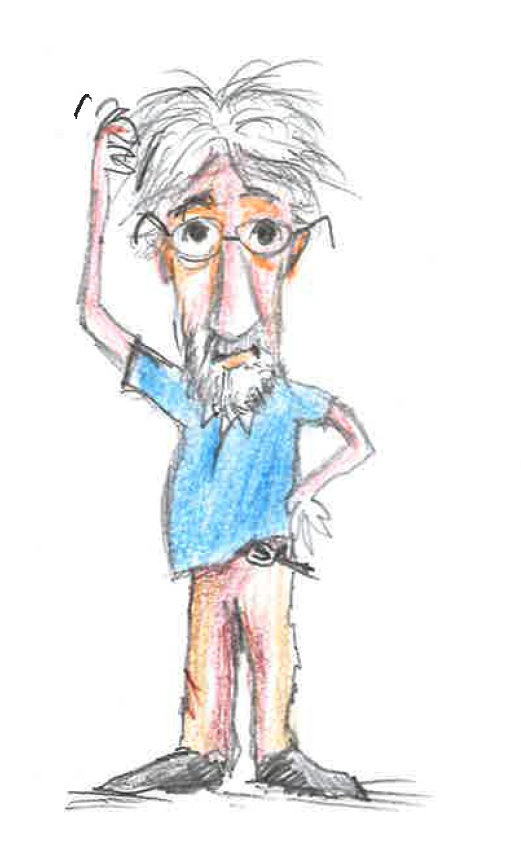
Untitled30

Russ, puzzling over a problem in bioinformatics

Of course these results don’t have any statistical validity, so I added this:

(2014 –  2007) + 1 = 8    (p < 0.05)

I know even less about statistics than bioinformatics, but I do know that statisticans always put a p in there somewhere, and it’s always greater or lesser than some other number, so there you go. If you want to know more about this, we’ll be hearing later from a biostatistician, Jo Røslien, and I’m sure he’ll be glad to explain it to you.

Eight trips to Oslo, wow. There aren’t many places in the world I’ve been eight times. I’ve probably been home a few more times than that. If you ask my wife, she might not agree, but then, she’s not a bioinformatician.

When you’ve been to a place eight times you’re practically a native. That’s how I feel about Oslo. Of course, I don’t speak a single word of Norwegian, which makes me a strange sort of native. Sort of a foreign native. Still, Oslo has some surprises even for a native. For example, when I arrived yesterday, Oslo looked DIFFERENT. Was there more than one Oslo? Had I flown to the wrong one? It took me a while to figure out the problem, but I finally did: all my other trips have been in DECEMBER. I don’t know if you’ve noticed this, but it’s DARK in December. I arrive in Norway, get off the plane, and I just automatically say, “Would somebody please turn on the lights?”

In science, the hardest part of finding an answer is sometimes clearly identifying the problem, and that was certainly true in this case. Once I knew that Oslo was too bright, there was a simple solution – just put on some sunglasses.

So once again, thank you for inviting me to Oslo, where I feel like a native, but a special kind of native, who only comes out in the dark and has poor communication skills. Maybe a native Norwegian bioinformatician. Or a native Norwegian vampire. Or a native Norwegian bioinformatician vampire. If you have any of those in Norway, that’s exactly how I feel.

* * * *

Science communication is serious business, and I do have some serious things to say about it, and I promise I will. But one of the most important things I have to say about it is that we ought to have more FUN at it. I’ve been a professional science communicator for 17 years. It’s a great job, but sometimes it’s hard. You run up against a lot of walls. If you could see them coming, you could avoid them, but they’re sneaky, and they’re mostly invisible. You’re writing an article, or you’re talking to someone, and boom, you run against an invisible wall, and you go flying on your ass. Over and over again.

I’m going to talk quite a bit about invisible walls today. These walls are in the minds of scientists, and in the minds of science communicators, and in the minds of the people we’re trying to talk to. I’m going to talk about ways to make invisible walls visible, and what that means for science and science communication.

But first let me say that if you see somebody run along, and he bangs into an invisible wall and falls down, and then he gets up and starts running and it happens all over again, you’re probably going to laugh. It’s not so funny when it happens to yourself… Well, why not? Why not laugh at ourselves a little bit? So I decided to start a CRUSADE to make science communication more FUN.

Now the crusades of history involved huge armies of religious people setting out to take over a foreign country. I’m not religious, and my crusade is very small; in fact, there are no followers except for a few people who read my blog and may be seriously disturbed. But a lot of great ideas start small. That’s also true of bad ideas, I know. The trick is to tell the difference. How? Only time will tell. I’m still at the very beginning of my crusade, the early planning phase, sort of the grant application phase. For example, I haven’t picked which country this crusade will invade. Maybe Norway? We’ll see.

So today I’m going to talk about invisible walls, and making science communication fun, and hopefully say something useful along the way. We’ll see.

* * * *

Sometimes I think science communication is difficult because we’ve gotten ourselves into a box and we need to get out. This inspired the title of my talk, LETTING SCIENCE COMMUNICATION OUT OF THE BOX, in case you’ve forgotten. There’s also a CAT in the title, which you may also have forgotten, but that’s okay, I’ve just reminded you.

I’m sure most of you realize I’m alluding to a famous experiment proposed by the physicist Erwin Schrödinger. In fact, one of the speakers this afternoon, Chris Vøløy, is involved in a project called Schrödinger’s cat. Actually his project is called “Schrødingers katt” , which is Norwegian, so I might be translating it wrong. For all I know, in Norwegian this might mean “Einstein’s parrot.” Chris, are you here? Did I get this right?

Schrödinger’s cat is a THOUGHT experiment, which means the cat is an imaginary cat. Now if a biologist were to do an experiment with an imaginary animal, he’d face a challenge getting his paper published, but in physics you can get away with these things.

Nobody has ever done Schrödinger’s experiment, or if they have, they won’t tell you about it, because it would violate all kinds of regulations about the ethical treatment of animals. Okay, it’s a metaphorical cat, but even metaphorical animals deserve some respect.
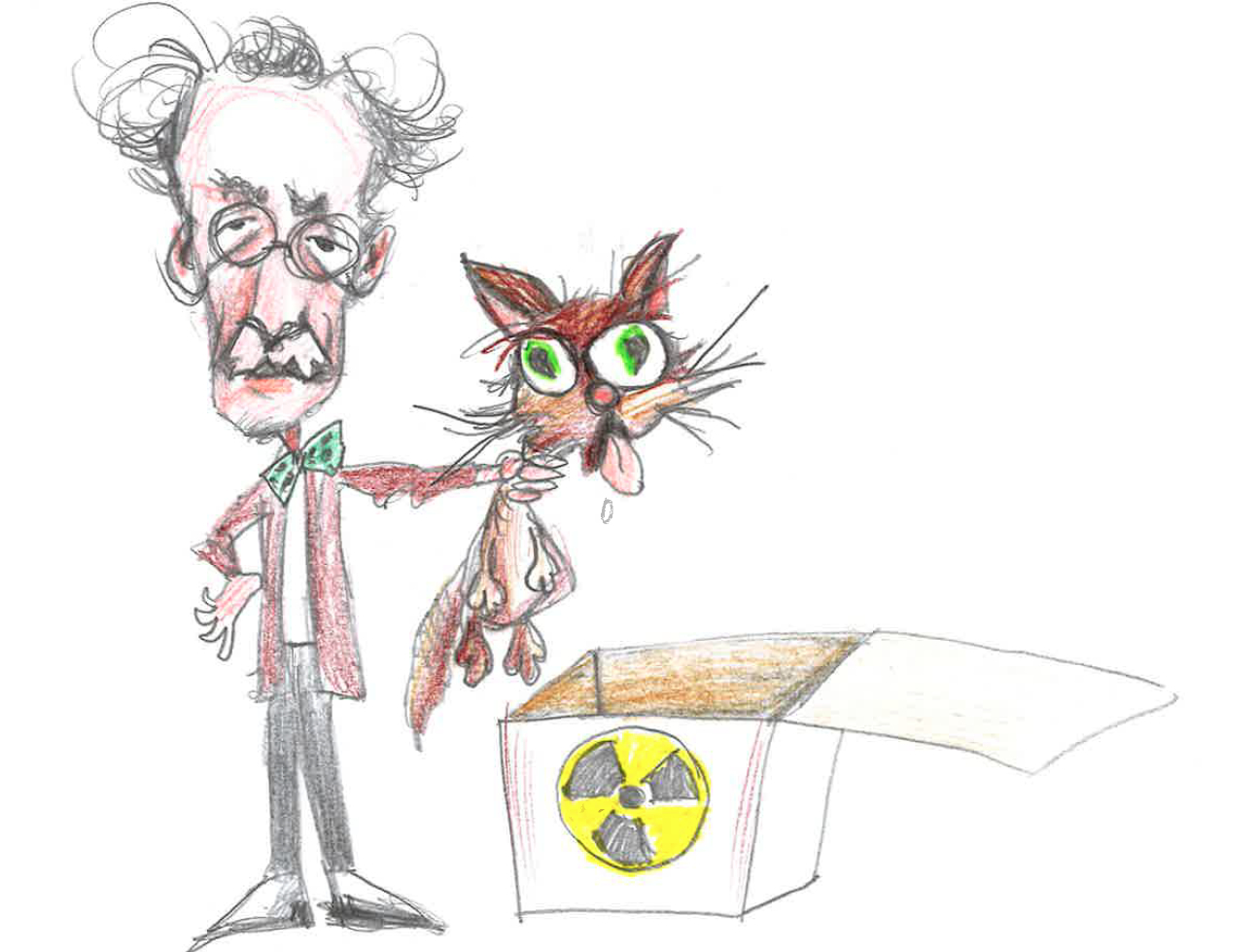
Untitled32

Erwin Schrödinger and his cat

Schrödinger’s experiment also violates all kinds of rules of common sense (for example, the difficulty of getting a cat into a box). Again, in a thought experiment that doesn’t matter. For example, in a thought experiment I could be the King of Norway. Or the Queen of Norway.

Anyway, Schrödinger’s experiment with the cat is interesting for science communication because it’s unethical, illegal, probably impossible, and on top of that, NOBODY UNDERSTANDS WHAT IT MEANS. Well, it meant that Erwin Schrödinger didn’t like cats very much. But other than that nobody really understands it. And yet 79 years later here we are still talking about it. If that’s not successful science communication, I don’t know what is.

Basically the experiment involves locking up a cat in a steel box with one atom of a radioactive substance that would decay after a certain period. Now it’s a bit irritating that Schrödinger leaves some details of the experiment vague, and others he explains in great detail. For example, he doesn’t mention what type of atom you should pick, or how you capture only one atom, or how you know you’ve got the right one. Another detail he doesn’t explain is whether in this experiment, he is the King of Norway or not.

But he does go into detail about the placement of the atom in a Geiger counter. Once everything is in place, if the atom decays, “the counter tube discharges and through a relay releases a hammer that shatters a small flask of hydrocyanic acid.” In case you don’t know, that’s a particularly nasty type of poison. Anyway, you’re not supposed to look into the box. The question is this: At some point, the half-life of the radioactive substance, there is a 50 percent chance that the cat will be alive. Schrödinger doesn’t tell us what the probability is that the cat will be dead, but there’s a formula for this somewhere; you can find it on the Internet.

With all of this Schrödinger wanted to make a specific point. Schrödinger says that until somebody opens the box, the cat is in an indeterminate state. It’s not really alive and not really dead. Actually he puts it a different way, and if you ask me, it’s a pretty disgusting. He says, “The living and dead cat (pardon the expression) [will be] mixed or smeared out in equal parts.”

This is why I said it’s important to choose the right radioactive substance. If you have a substance that decays in one hour, that’s fine. But suppose you pick a substance that takes longer to decay, a lot longer. Maybe weeks or years. I don’t know if you’ve ever kept a cat in a box for a really long time, but I’m telling you, it smells bad. It smells bad whether the cat is dead or alive, but those are different kinds of bad smells. You’ll definitely know. And even if you don’t, the cat will know.

Now as I said, this is a thought experiment, so we don’t have to care that much about the methods, or the results, or the discussion. Today Schrödinger would never get this published, except on a blog, or in The Journal of Impossible, Ridiculous, and Pretty Disgusting Thought Experiments. Well, maybe not. I know the editors of that journal personally and they might not even publish it.

In fact, there is a group of people in California who are actually doing this experiment, or at least an experiment that’s pretty close. I’m sure you’ve heard of them. I’m talking about those companies that offer cryopreservation. You pay the company a lot of money and when you die, they will wrap you up in tin foil and freeze you. The idea is that in 100 or 200 years, or 1000 years, or a million years, scientists will be able to cure the disease that killed you. They’ll even be able to cure it after you’re dead, which is pretty wonderful.

This is supposing, of course, that in one million years the company will still exist, and that California will still exist, rather than sinking in an earthquake, and that in one million years there has never been a power blackout in California. Right. In a state that elected Arnold Schwarzenneger governor. Good luck. In fact, there have already been blackouts. You have to hope the company has some big batteries somewhere, with a lifetime somewhat longer than the battery on your laptop.

Anyway, if the electricity has stayed on all the time, and if somebody remembers the human popsicles stored in the freezer in the basement, and if science learns to cure cancer and Alzheimer’s disease and develops some sort of nanotechnology to repair the damage that being frozen for a million years causes to a human body, maybe those people will be revived. You can pop them into the microwave. But first remove the aluminum foil. You shouldn’t put aluminum foil into a microwave. I’ve tried, and the results are not pretty.

The frozen people will probably wake up in some sort of Star Trek universe, where there’s all kinds of new technology they have to learn. The iPhone one million point five. People who use Macs will have an advantage. I’m sure we’ll still have Macs in a million years. But we won’t have PCs. PCs will have become extinct, like dinosaurs, maybe because of an asteroid strike.

Well, until all that happens, those people in California are in a state like that of Schrödinger’s cat. Except for the part about being mixed or smeared out. That’s might happen if the electricity goes out. But if everything goes well for a million years, we hope they’ll be reasonably intact. It’s hard to say. They’ll probably be fatter – water swells a bit when it turns to ice – but they’ll have been transformed from a state of death to a state of life. So yes, I guess you can say that currently, those people are in an indeterminate state like Schrödinger’s imaginary cat.

The search for the VRAC

The Jentsch lab and the FMP Screening Unit identify a long-sought channel that helps cells reduce their volume

Some important scientific questions resist a solution for years, until a new technology appears that seems to put an answer within reach. Success depends on creativity – finding a way to translate an old question into a form that can be handled by the new method – but also on timing. And a bit of luck never hurts.
About four years ago Thomas Jentsch thought that the time had come for an all-out assault on a question that had teased biologists for decades. The campus had been acquiring instruments that might be the key to the solution. But the clock was ticking; other labs had the technology, too, and were interested in the same question: How do cells reduce their volume?

All types of cells undergo alternating phases of expansion and shrinkage as they divide, specialize, migrate, and cope with changes in their surroundings. In a liquid environment without any barriers, particles move from areas of high concentration to low. This applies also to water “particles”, which tend to diffuse until they have reached the same concentration everywhere. Water will flow from regions of high concentration (where it is diluted by a low concentration of osmolytes like ions, the constituents of salt, or other particles) to areas of low water concentration (where it is diluted by a high concentration of salt or other particles). So if cells are exposed to a hypoosmolar solution (which contains fewer osmolytes), water will flow into the cell, which now contains more osmolytes than its extracellular environment. But because the cell is enclosed by a membrane, the particles within it cannot simply be diluted to reach an equilibrium with extracellular concentrations. Instead, osmotic pressure will build up inside.

The same accumulation of internal water can occur when the number of internal particles increases through a breakdown of organic molecules, like glycogen to sugar, and cells may expand until the membrane is stretched to its limits. In order to keep from bursting, the cell needs to lose particles such as chloride or potassium ions, or organic osmolytes such as the amino acid taurine.

The loss of these particles decreases their internal concentration, which eventually becomes lower than in the external medium. This leads to a reversal of water flow, cell shrinkage and a recovery of the previous, normal cell volume and shape – called regulatory volume decrease. This volume decrease was known to be associated by a loss of negatively charged chloride ions (anions) from the cell through a channel.

Many aspects of the transport of chloride and other ions are well understood thanks to years of research on the part of Thomas’ lab and many others. This type of work has exposed hundreds of types of ion channels in cell membranes. These pore-like structures are composed of proteins woven through the membrane in a way that allows them to open and close. Channels are highly specialized to admit specific ions or other particles in response to changes in electrical charge, pressure, or other conditions. Their behavior is usually regulated by intricate biochemical networks. Most ion channels are so essential that any flaw in their components or their regulation can cause serious diseases – Thomas’ lab has established many such connections.

Much less was known about the outward passage of anions like chloride and other particles as cells shrink. Scientists postulated the existence of a specialized channel and had even given it a name: the volume-regulated anion channel, or VRAC. “VRAC was a hot topic,” Thomas says. “Hundreds of papers were being written about it and it was the subject of major international conferences.”

Despite all the interest, and the fact that the biophysical properties of the channel and some of its important functions were known, no one was able to actually find the channel protein. Occasionally a lab claimed to have identified a protein that belonged to it, but one by one, these candidates were discredited. While a number of drugs interfered with the channel’s behavior, they also disrupted other cellular processes. Without identifying a specific protein, scientists could understand neither these effects, nor the way swelling triggered changes in the channel’s behavior.

Part of the interest – aside from the fact that the channel served an important basic function in all types of cells – arose from observations that it, too, seemed to be linked to serious diseases. In any case, Thomas doubted that VRAC could hide much longer. The sequencing of the genomes of humans and other organisms had led to the development of technologies that permitted scientists to scan the DNA sequence for molecules with specific functions. Recent papers by other groups hinted that they were using these methods to search for the channel.

“Identifying the VRAC would finally give us a handle on some of these questions,” Thomas says. “Basically, it would open up an entirely new field.”

* * * * *

Until fairly recently, the study of gene functions almost always required an arduous, molecule-by-molecule approach. The earliest methods involved forward genetics: a scientist found an organism with a specific variant of a feature or a defect, then studied patterns of inheritance to establish that a single gene was involved. You might not identify it for years, or decades, but at least you knew it existed.

Modern biochemistry made it possible to do reverse genetics, through which scientists interfered with a specific gene and then studied the consequences for an organism. Most of these approaches depended on physically removing or altering genes, and thus eliminating the proteins they encoded.

The 1990s brought a powerful new alternative based on introducing artificial molecules called small interfering RNAs (siRNAs) into cells. siRNAs are composed of nucleotides, like other RNAs and DNA. This means that strands with complementary sequences will dock onto each other, which is the reason for the double-stranded helix structure of DNA. RNAs are usually single-stranded, but if an siRNA docks onto a complementary mRNA it produces a short, double-stranded region. Cells normally take notice and dismantle the molecule before it is used to make proteins. So artificially introducing siRNAs into cells has become a new, effective way of “knocking down” particular molecules by interrupting the flow of information from gene to RNA to protein.

Since the first applications of siRNAs in plants and simple model organisms, researchers have adapted them for use in human cells. The completion of the human genome revealed the entire set of mRNAs encoded in it, and scientists working in companies began constructing vast “libraries” of siRNAs to target them all. Theoretically this could be used to block the production of every human protein, one-by-one. Along the way, you would probably hit a molecule required for a particular function – such as the VRAC – and shut it down.

Humans have over 22,000 genes, meaning that the project would require at least that many experiments – actually the number would be much higher. There is no way to predict with certainty that a particular siRNA will work reasonably well within a cell. The way to get around this was to develop multiple siRNAs for each target and then challenge cells with two or three different versions; one of them would usually work.

But 22,000 experiments – let alone two or three times that number – could not be performed by hand. Robots and automation would be required at each step: to prepare samples, perform experiments and collect the data, and sophisticated software to analyze the results.

In the genome age, the technology and software needed for genome-wide siRNA screens began coming together, leading to several successful projects that have produced fascinating new insights into the functions of genes.

Several years ago the FMP created a Screening Unit, now jointly operated with the MDC, and acquired high-throughput, automated equipment to manage such large-scale projects. Headed by Jens von Kries, the facility has made significant contributions to a number of campus projects, many drawing on the tens of thousands of compounds that the unit has collected from researchers, pharmaceutical companies, and other sources. A typical use of this vast library is to challenge cells with substance after substance, hoping to disrupt a specific process in cells – with the aim of further developing the “hit” into a research tool, possibly even a drug. Chemists associated with the Unit then step in to tinker with a successful substance to strengthen its effects, make it less toxic for cells, or lend it other desirable properties.

The Screening Unit had also acquired a library of siRNAs that targets every known gene and then, through grants including a successful application from Thomas to the European Research Council (ERC), also a machine called FLIPR that was needed for following the time course of hundreds of experiments in parallel. So the necessary tools were on hand to search for VRAC components. “But first an extremely reliable experimental procedure had to be developed to detect the opening of the VRAC channel upon cell swelling,” Thomas says. “Any test that will be carried out tens or hundreds of thousands of times has to deliver clear, dependable results.”

Postdoc Tobias Stauber and PhD student Felizia Voss took the first steps toward developing a robust experimental protocol. This required almost two years, and as Thomas says, “There was no guarantee that we would find VRAC, even with this whole-genome approach, and certainly no guarantee that we would find it first.” Failure would have been particularly hard on Felizia, who was devoting her entire time to the project, and other PhD students who had become involved. Positive results would provide an impressive story for their dissertations; no one wanted to consider the alternative.

Tobias and Felizia began by growing cultures of human embryonic kidney cells – a favorite model for genetic research because the cells readily take up foreign molecules such as siRNAs. First they equipped cells with a yellow fluorescent “reporter” protein that would reveal whether cells changed their concentration of anions upon swelling. The cells were placed in a diluted medium in the presence of the ion iodide, which entered the cells through the opened VRAC channel and quenched the fluorescence. Although VRAC opening leads to a net loss of cellular chloride and volume regulation, the addition of external iodide, which is not present in the interior of the cell, leads to a net influx of iodide – channels are like “holes” that allow movement in both directions. The basic idea was that an siRNA that blocked the production of VRAC within the cell would abolish, or at least reduce, the loss of fluorescence upon exposure to a diluted medium containing iodide.

“This entire approach depended on an assumption that simply might not turn out to be correct,” Thomas says. “If a single specific molecule were required for VRAC, we might find it in the experiments. But if several molecules formed VRAC together, and each of them could be functionally replaced by another one, we might never find it with this approach. In fact, we discovered that VRAC has five components, and only one is absolutely required – we were lucky that only four of the subunits can replace each other.”

The scientists optimized the transfection of siRNAs and other aspects of the experiments, such as the number of cells, and established appropriate controls. Once this had been accomplished, it was time to scale up the experiment for a genome-wide search for VRAC components, trying to eliminate one essential component of the channel.

Now Katina Lazarow, a postdoc with the Screening Unit, stepped in to adapt the procedure to the instrumentation. Each step of the pipeline of experimentation and analysis had to be adapted to the specific question the scientists were trying to answer. This required many months of intense work – often through the weekends. The actual screen would also take about two months of work, once again including weekends.

* * * * *

Such a large experiment required automation for the preparation of cell cultures, introducing a different siRNA into each one, then capturing images that would show whether the intervention had any effect on VRAC. These steps were performed in a specialized piece of machinery called the FLIPR, acquired second-hand with funds from Thomas’ grant and the Screening Unit.

The machine has become an important addition to the Screening Unit because it allows scientists to prepare experiments in all 384 “wells” of a assay plate in parallel, and follow changes in fluorescence over time, also in all the wells in parallel. The scientists needed to follow the exact time course of a decrease in fluorescence, because it is a measure of the flow of anions through VRAC.

Applied to the whole genome, this produced more than 130,000 fluorescence curves to analyze – a step that obviously required bioinformatic analysis. Miguel Andrade’s group at the MDC took on the task.

“We specified the parameters necessary to distinguish possible VRAC components from all the other proteins that didn’t affect the transport of chloride ions out of the cell,” Thomas says. “In the end we were left with a list of about 200 proteins that might be involved.”

More analysis and experiments were required to whittle the list down to just a few – hopefully just one – candidate. Part of this could be done by a computational analysis of the proteins’ sequences. The main goal was to find molecules with patterns indicating they were likely inserted into membranes. But other types of molecules might be worth investigating as well. A biochemical signal – passed along by a specific protein – might be required to operate the channel, even if that protein wasn’t a direct component of VRAC. Blocking it might shut down the channel just as well as eliminating one of the membrane proteins. The data collected in the experiments may eventually shed light on these processes. “We now have a treasure trove of data that remain to be analyzed; first we were concentrating on candidates for channel components,” Thomas says.

Felizia, Tobias and Thomas took on the list of candidate membrane proteins and began sorting through everything that was known about the functions of the candidates, from other experiments. The aim was to distinguish promising proteins from those that were less so – “And you had to be careful not to discard any molecule that might turn out to be the real one!” Thomas says.

After this analytical effort, over 80 proteins remained for one-by-one investigation through more experiments. Using the same experimental protocol, they challenged the cells with new siRNAs directed against those same 80 genes. The scientists dug in for another period of hard work.

This time, disruptions of only one molecule – a protein called LRRC8A – continued to interfere with VRAC. “So far we had only covered one aspect of VRAC function, the cells’ uptake of iodide,” Thomas says. “Now we wanted to explore another aspect – to measure its effects on electrical currents. We did this using a method called patch-clamp.” Two PhD students from Thomas’ lab, Florian Ulrich and Jonas Münch, joined the team and worked for about a year on the analysis of VRAC. They discovered that the knock-down of LRRC8A also reduced chloride currents. This meant that LRRC8A was either a direct component of the channel, or it exercised a firm control on VRAC functions. Thomas’ lab began the next round of experiments to find out.

* * * * *

“Proving that LRRC8A protein was a direct component of the channel required a number of steps,” Thomas says. “Upon a closer look we saw that it fulfilled a number of important criteria. First, it was expressed by many types of cells in the body, all of which need to regulate their volume and are thought to express VRAC. And a study of its sequence showed that it had regions that would be embedded in membranes – but was it really present in the plasma membrane that encloses cells?” The scientists generated antibodies that attached themselves to LRRC8A and observed under the microscope that LRRC8A indeed moved to its expected position at the outer membrane.

So far, so good – but was LRRC8A the channel itself? The scientists overproduced the protein in cells and measured currents activated by swelling. “Of course we had hoped that this would boost swelling-activated currents way beyond those in normal cells,” Florian says. “But were dismayed to see that rather than increasing currents, overproducing LRRC8A actually decreased currents!”

Thomas had an explanation for this behavior: “Channels are often composed of multiple proteins woven together in the membrane,” he says. “LRRC8A might form a channel together in a complex with other proteins, and if we had too much of LRRC8A, it may assemble with these other proteins at the wrong ratio, leading to complexes that cannot pass currents.”

What might those proteins be? Obvious candidates were molecules that were very closely related to LRRC8A. The cells of humans and other animals have many such “homologs”: far back in evolutionary history, in ancestral organisms, biochemical mistakes occasionally produced multiple copies of many genes. In the species in which they originally occurred, the copies would be redundant. That meant they could be lost again, which often happened as the genes naturally underwent mutations.
In some cases, however, spontaneous mutations enabled the copies to develop new functions. So the human genome contains four other versions of LRRC8 (labeled LRRC8B through E) that may function in a similar fashion.

“Databases containing information from other experiments showed that these molecules, too, are widely expressed in various types of cells,” Thomas says. “When we began to study these molecules individually, by introducing them into cultured cells, we noticed something interesting. Most of them remain inside the cell, in the cytoplasm. But if we introduced them along with LRRC8A, they move to the membrane.”

This indicated that LRRC8A binds to these related LRRC8 proteins, and that certain combinations of LRRC8s might be required to create the channel. Another round of experiments removed and restored various combinations of the proteins. Since siRNAs usually achieve only a partial blockage of a given protein, and might affect other molecules than the intended target, it was necessary to turn to another method. Here the scientists used a new technique called CRISPR-Cas, which interferes with genes directly at the level of DNA rather than its messenger RNA products. CRISPR-Cas allows scientists to make a physical cut in the genome and eliminate a specific gene. The results replicated the findings of the siRNA experiments and importantly showed other LRRC8s were involved in VRAC, but always in combination with LRRC8A.

The scientists found that each of the other LRRC8 proteins, B-E, could be deleted alone without abolishing VRAC currents. But when B-E were eliminated together, VRAC currents were gone just as if LRRC8A itself had been removed. “This showed that LRRC8A needs at least one of the other subunits to form a channel, but that LRRC8B through E are redundant – in other words, they can replace each other,” Felizia says. “And we even generated a cell line lacking all the forms A through E. Currents could only be restored when expressing A with at least one of the other family members.”

Importantly, different combinations of proteins yielded channels with different biophysical properties. “These are intrinsic channel properties,” Tobias says, “which demonstrates that LRRC8 proteins are not just involved in the signaling system that opens the channel upon cell swelling, but are an integral part of the channel itself.” This observation solved another enigma in the field – VRAC currents seemed to vary in different cells and tissues. “Our work now explains the variability of currents because different cells in the body make different amounts of these proteins. The different combinations may serve cell-specific functions.”

The project also provided hints toward answering another interesting question about channels involved in cell shrinkage. “The loss of volume involves expelling small organic molecules such as taurine,” Thomas says. “There was a controversy among experts – some claimed that these molecules exited via the VRAC, whereas others thought they might use yet another channel.”

Further experiments revealed that VRAC accomplishes both functions. The lab used to a radioactive form of taurine whose export from the cell could be tracked. Darius Lutter of Thomas’ group adapted a test that would measure its efflux, and the scientists found that taurine’s behavior aligned with the presence or absence of various LRRC8 molecules and VRAC behavior.

“All in all, these experiments reveal that the channel is directly constructed from combinations of LRRC8A and other LRRC8 forms,” Thomas says. “They give us the first clear route to explore the mechanisms by which cells shrink and shed particles in response to swelling. Those functions are crucial in the context of all types of cells, and this work provides the basis for understanding how they become defective in a number of serious diseases.”

Even with the well-coordinated collaboration and intensive efforts on the part of Thomas’ labs and the Screening Unit, the group’s search for the VRAC took four years. But the race would only officially be won if his team was first to publish on the subject. The scientists quickly wrote up a paper on the project and submitted it to a major journal.

All the way along, Thomas had been worried that other groups might be working on the problem; after four years, getting scooped would be a hard blow. Those concerns turned out to be justified. On the very same day that the article appeared in Science, another lab published a paper in the journal Cell that identified LRRC8A as a component of VRAC. That work did not, however, demonstrate that the “A” form had to be combined with another LRRC8 to create the channel.

“Our work puts the whole field of cell volume regulation on firm ground,” Thomas says. “The signals that connect an increase of cell volume to the opening of the VRAC are enigmatic, and we now have a handle to investigate them. We have suspected that defects in VRAC are involved in a number of diseases, and now we can develop mouse models to confirm those roles and look for other functions of the channel.”

Reference:
Voss FK, Ullrich F, Münch J, Lazarow K, Lutter D, Mah N, Andrade-Navarro MA, von Kries JP, Stauber T, Jentsch. Identification of LRRC8 heteromers as an essential component of the volume-regulated anion channel VRAC. TJ.Science. 2014 May 9;344(6184):634-8. doi: 10.1126/science.1252826. Epub 2014 Apr 10.

My work in early music

For those of you who don’t know about my other professional career, the “Anglistenchor” of the University of Heidelberg and my instrumental ensemble “Syntagma” are performing the second of two concerts under the title “Strike the viol” in Heidelberg this Sunday, July 27, 7pm at the Peterskirche. If you want to hear Baroque music like you’ve never heard it before, come by! Tickets can be purchased on-line or directly at the concert. You can see a short interview with me and the conductor and a member of the choir here. This time the composers are JS Bach, Purcell, and their contemporaries.

…and now back to science…

Searching for Oslo: a non-hypothesis-driven approach

Note: I will be speaking at a conference on science communication in Oslo in September. This is not the talk I will give there; however, it was inspired by the invitation.

First let me thank the conference organizers for this wonderful event and inviting me to this lovely city. I’ve been to Oslo many times and have always enjoyed it, but I’m not the type of tourist who studies up on a place before he goes. In fact, and this is embarrassing to admit, I’m not even sure exactly where I am. I told one of my kids I was coming to Oslo and she said, “Where exactly is Oslo, anyway?”

“It’s up, and to the left,” I told her.

Actually I didn’t have the slightest idea. I’d never looked it up on a map. I realized that I hardly ever use maps anymore. Almost nobody does. You don’t need to. You just go to the airport on time, go to the right gate, and the airlines and trains take care of the rest. Or you have an iPhone. You tell it where you want to go and it calculates your route, starting with your exact current position. Your iPhone says: “Go out the door. Turn left. Walk 1,213 kilometers. Turn right.”

If you’re going to go looking for something, it’s a good idea to start out with a general idea of its location. In the case of Oslo, it’s helpful to know that it is located in the Milky Way galaxy. It helps more to know it’s in our own solar system, even right here on our planet. It’s hard to calculate the odds of that happening; we’d need to know more about the state of the early universe at 0.00001 seconds after the Big Bang. However Oslo got here on Earth, its location is convenient. If it were anywhere else in the solar system, for example on Mars, we probably wouldn’t know it existed.

Once you have narrowed the search area to Earth, you’re getting close. At that point my knowledge of geography starts to get fuzzy, so you should just stop somebody and ask for directions.

But a little more information can help. I knew Oslo was in Scandinavia, which means you won’t waste a lot of time looking for it in the Pacific Ocean, or South America. I would like to note, here, that Scandinavia is a concept I don’t fully understand. We usually give names to continents, or countries, or hurricanes, or new species. As far as I can tell Scandinavia doesn’t fit into one of those categories, so I’m not sure why it needs a special name. On the other hand, if people want to call themselves Scandinavians, I guess there’s no law against it. At least they picked a nice name. Usually these things are decided in a committee, and you know how committees are. If you let a committee pick the name, Scandinavia would probably be called “Roger”.

I don’t know if you’ve ever seen a map of Scandinavia, but it’s huge. And there are a lot of blank areas. Many of these appear to be isolated regions that have never been explored. Scandinavia is so large that there could be 10 Oslos hiding out there, and you could spend your whole life looking for them, especially if they didn’t want to be found. Plus, we’re lacking a lot of information that would have been helpful. It is unclear how many groups have gone off searching for Oslo and failed to find it. These were negative results, so they couldn’t get their papers published. In other cases, groups found one Oslo and then broke off the search, never considering that there might be 9 more Oslos out there. So the data may be skewed toward one Oslo that happens to be easiest to find.

Today you should never start any scientific project without an exhaustive search of the literature, for example, by typing “Oslo” into Google. Here you find one fact that can significantly narrow the search area: Oslo is located in Norway. With that piece of information alone you can eliminate 2/3rds of Scandinavia from the search area. So it would only take 0.33333… lifetimes to search the remaining area and find 10 Oslos. The probability of finding only 1 Oslo would be a tenth of that, so you ought to calculate 3.3333… lifetimes. In a grant application, that comes to three full-time positions and one third-time position, probably a technician.

Now I think it’s reasonable to invest that much effort in searching for Oslo, especially since you might find other things while you were at it. Who knows what remains to be discovered in these large, unexplored areas of the country? You might find a species of Archaea that evolved 3 billion years ago in a thermal vent on the ocean floor. It’s a long ways from that deep ocean vent to a valley in Norway, but you can crawl a long way in 3 billion years. Especially if the colony is being driven by a male Archaea, who doesn’t waste time seeing the sights along the way, and keeps the pit stops as short as possible. You might also find the last surviving tribe of Yeti. Or secret UFO landing sites. You should keep your eye out for these things. If you find one of them, you should mention it in your supplemental data.

It’s quite common in science to start looking for one thing and end up finding something else. In fact, sometimes you find things when you aren’t looking for anything particular at all. You know how it is: you come into the lab on a Sunday, just to putter around a bit, and suddenly, lying there in your Petri dish, is the ribosome.

This is the type of science we call non-hypothesis driven research. You grope around in the dark and suddenly your hands grasp onto something. Please don’t think of this as a reference to some sort of sexual activity because it is not. In any case, in non-hypothesis-driven research, you should always be prepared for surprises. You’re out in the field looking for Oslo, or maybe a new species of Archaea, and suddenly you find a Yeti. You’ll never get a Yeti back to the lab in a Petri dish. So when you’re doing non-hypothesis driven research, you should always take along a big net. And some tranquilizer darts.

It’s hard to get funding for this kind of research. When you apply for a grant they always ask what you’re expecting to find. This is kind of silly, because if you already knew, you wouldn’t need their money to find it. So when you’re applying for a grant you just sort of pretend that you don’t know what you’re going to find.

That’s harder to do when you’re trying to get funding for non-hypothesis-driven research. Under the section on “Expected results and impact,” you can’t just write, “I have absolutely no idea.” Instead you should say something like, “We expect to find either a new species of Archaea, the city of Oslo, or a Yeti.” It’s wise not to mention secret UFO landing sites in grant applications.

You work hard to finish the application, send it off, and then you start waiting. You wait for years and years, and you never hear back from the grant commission. The entire system is biased against non-hypothesis-driven research.

But think where we’d be without it. I don’t know who the first person was who discovered Oslo, but he certainly didn’t find it by using a map. Without that bold pioneer, we wouldn’t be here. We’d be somewhere else. Probably in Stockholm.

A novel, non-hypothesis-driven method to determine the location of Oslo

Abstract. Traditional methods of locating large foreign cities involve a time-consuming, manual inspection of maps, sometimes with the aid of a magnifying glass. Recent years have seen the development of automated, high-throughput technologies such as Google Maps. These methods, however, are of limited applicability in cases where you don’t have the right map, or when you are at Starbucks and the Internet server crashes. Here we use Oslo as a model system to develop a novel, non-hypothesis-driven approach for determining the location of any large object on Earth. The method can easily be adapted to find other cities as well as smaller entities, such as new species of Archaea, or Yeti.

On the publication of “Remote sensing” by the magazine Occulto

Some remarks given on May 31, in Berlin, on the presentation of the newest edition of Occulto…

My name is Russ Hodge, and I’m honored that Occulto is publishing my short story “Remote Sensing” in the new issue. I believe this is the first time the magazine has published a short piece of fiction, and I hope it won’t do any permanent damage.

Originally I had hoped the story would come up here on stage with me. I would just introduce it and step back and let it speak for itself. But at the last minute it got cold feet. “You go ahead,” it said, “I’ll just wait here at the bar.” A lot of stories are shy in public, and the authors are to blame. Some writers bring their stories on stage and undress them, right there in front of everyone. As if stories don’t have feelings. Well, they can experience humiliation like anybody else. They can also be quite passionate. Check into a hotel room with a story sometime, order some champagne, light some candles, and you’ll see what I mean.

Stories shouldn’t need much introduction because they are small, complete worlds, self-contained and self-sufficient, like a universe within a snow globe. Inside a story, the normal rules of logic and even the laws of physics don’t necessarily apply. You wouldn’t want this strange reality to leak out into the real world. Suppose, for instance, you put some antimatter into a story. If it escaped it could cause what physicists call a naked singularity. I don’t know what that means, or why it’s naked, but I do know that a naked singularity could cause the end of the world, which one should avoid whenever possible.

This story is probably safe. There are no genetically modified organisms that might escape and destroy the world. There is a small amount of radioactive material, but it is handled with extreme care.

The topic is the relationship between a young man and his grandfather, during the last few months of his grandfather’s life. The story ends before anyone actually dies, which avoids a lot of medical terminology, gruesome details about the autopsy, or all the ways lawyers earn money on a fresh corpse. Some authors write on and on about these things, but that’s not my style. I killed a character one time and it made some of my friends so mad that they stopped talking to me.

That happened in another story, which was about a man who got bitten by two snakes. The first bite occurred immediately before the story began and the second came right at the end. Basically, by the first sentence, the guy was already dying. I did my best to save him, and he put in some effort himself, but it was no use.

Neither of us saw the second snake, hiding under a rock on the last page. Suddenly it was just there, and it scared the hell out of both of us. Now I’m a great believer in the craft of writing, and I know people who plan a story down to every detail. I’m not like that. Hemingway said, “If in a story there’s a gun hanging over the fireplace, it had better go off.” But you have to plan these things. Somebody grabs the gun and tries to shoot it, only to discover that the author forgot to buy any bullets.

But a lot of the process of writing is still a mystery to me. I start with a character, and a first sentence, and they seem to take over from there. Just about anything can happen. Like that second snake. Suddenly there it was, and it seemed inevitable. The same thing happened with this story: the final sentence appeared out of nowhere, through a process that I don’t understand. But you know it is exactly the right ending.

Well, my friends didn’t agree about the snake. The story was only about 10 pages long, but that was enough for them to develop a deep emotional attachment to this character. I tried to tell them that he was purely a fictional construct, and that he didn’t really exist. They would have nothing of it. You’d think I’d murdered a family member. A family member they got along with.

“You can’t kill him,” they said. “You’ve got to change the ending!” I apologized, but told them the matter was out of my hands. “It’s a story about a guy who gets bitten by two snakes,” I said. “That’s just how it is.”

This incident taught me an important lesson. Now I try not to kill anyone in a story unless it’s absolutely necessary. I also try to follow this principle in my daily life. Going around murdering people just for the entertainment value of it can cause all kinds of complications.

Well, I promise you there are no snakes in this story in Occulto at all. Which is really a bit odd, considering that the story is set in my home state of Kansas. I can tell you first-hand that we have plenty of dangerous snakes. Copperheads, rattlesnakes, water moccasins. The copperheads like leafy spots in the shade, rattlesnakes lie on rocks in the sun, and water moccasins hang out in the lakes and rivers. Basically, you’re not safe anywhere. All right, you could hide in your mailbox. You won’t find any snakes there, because the mailboxes are already occupied. By black widow spiders.

I never considered myself a “regional” writer until I moved to Europe and lived here for about 20 years. One morning I woke up and found all my stories moving back to Kansas. Maybe it’s nostalgia. Or some sort of neurodegenerative disease that is wiping out my short-term memory. Maybe I’ll wake up someday and believe that it’s 1966 and I’m in the second grade.

What I really think is that I’m experiencing a universal law of physics, or an old folk saying – it’s one of those two, I can’t remember which: You never fully appreciate something until it’s lost. That’s certainly true of our health, and of many more things. For example, your car keys. And life itself. The only people who can totally enjoy life are dead people. And the rule also applies to your mother-in-law. You never really appreciate her absence until she comes for a visit.

So maybe I should say a few words about Kansas. This is totally unnecessary in understanding the story, but I don’t know what else to talk about.

Kansas occupies the exact geographical center of the continental United States. On the maps they show us in grade school, the US is at the center of the world. This is somewhat inconvenient for the Russians, whose country is split in half, and to get from East Moscow to West Moscow you have to travel across the whole world, but we paid for the map.

In cosmological terms, astronomers tell us that all the galaxies in the sky are flying away from us at tremendous speeds. Put all this information together and you discover that Kansas lies at the navel of the universe.

People are proud of this location but we don’t make a big deal out of it. You have to remember we didn’t choose to live there. A long time ago when the government drew Kansas on a map, that’s where they stuck us. We would have preferred to be closer to one ocean or the other, but nobody asked. Somebody has to live at the center of the universe, and it just happens to be us. Anyway, we have lots of other things to be proud of. Right at the moment I can’t think of any, but ask me again in a couple of weeks. I’ll do some research.

This location is why so many aliens visit Kansas: imagine you’re traveling from one end of the universe to the other, at warp speeds; at some point you need a pit stop. We’re conveniently and centrally located. We have clean bathrooms, good coffee, and really good steaks. About a quarter of Kansans claim to have been abducted by aliens. The aliens don’t intend us any harm. They take you for a few hours, and subject you to strange experiments, hoping to find a steak in you somewhere. When the experiments show that you aren’t a cow, they let you go again.

Some facts about Kansas: the state flower is the sunflower, the state bird the Meadowlark, and our state song is “Home on the Range.” We learn it in the first grade, and it goes like this:

Oh give me a home where the buffalo roam
And the deer and the antelope play…

When they teach us this song you think, this doesn’t sound like the Kansas I know. Sure, we have a lot of deer. If you live in the outer suburbs they come right into your yard. In deer season, you can hunt them right from the back porch. But you have to be careful. It’s easy to mistake your neighbors’ lawn ornaments for a deer, and people are awfully sensitive about having their lawn ornaments shot to pieces. In deer season it is not unusual to see garden gnomes, plaster statues of the Virgin Mary, and bird feeders outfitted in fluorescent orange hunting jackets.

But there are strange things about this song. Where the deer and the antelope play. Now we know that the plural form of deer is deer. Nobody, even in Kansas, puts an –s on deer. But the antelope… We’re not so sure about that one. “Antelopes” sounds fine to me. So in the song, they’re either talking about one specific deer and one specific antelope, or a bunch of deer and that one particular antelope.

Try as I might, I have never seen that animal. And I’ve looked for it, believe me. Every time I’ve driven through my state, I have kept a sharp eye out. But I’ve never seen the antelope.

And where are the buffalo that are supposedly roaming around all over the place? Your teacher says, “We killed them all.” Doesn’t seem like nice behavior towards an animal featured right there in the first line of your state song, but there you have it.

And the song neglects other prominent species in our state. Right now, for example, Kansas is up to its neck in llamas. Everywhere you go these days, somebody’s started a llama farm. I don’t think you can milk one, and their eggs are inedible, but a llama must be good for something. Whatever it is, we should consider changing the state song. For example,

Oh give me a home where the buffalo used to roam
And the deer and the camelids play…

The song goes on to say,

…Where seldom is heard
a discouraging word
and the skies are not cloudy all day.

Here, we’re talking outright lies. I’ve heard a lot of discouraging words in my time – a lot, it is true, from foreigners from places like Paris, and Nebraska, but every once in a while a native will rip you with a criticism. And we do have clouds. There is the tall and majestic variety, which look like clipper ships, or six-packs of beer, or Snoopy on his Sopwith Camel, and other times they’re low and grey, hiding tornadoes and hail and all sorts of other unpleasantness.

Or perhaps I’ve misinterpreted this line. Maybe the song intends to say, “The skies are not cloudy all day long.” In other words: “Okay, we have clouds, but they never stay in the sky all day long, because eventually the wind pushes them into Missouri.” In any case, you have to admit, the original is either a lie or is misleadingly ambiguous.

The state motto is Ad astra per aspera, which is Latin, which is interesting considering that the number of Latin speakers in Kansas is approximately the same as the number of ancient Romans. If you say it really fast, with a Kansas twang, it sounds like “a disaster for aspirin,” but you can run it through Google Translate. Our motto means, “To the stars with difficulty.”

They got that right. It’s difficult for anybody to get to the stars, but it’s a special challenge in Kansas. We don’t have any mountains. If you climb a mountain the stars are still far away, but they’re just a little bit closer. States with mountains have an unfair advantage when it comes to going to the stars.

Ontogeny recapitulates sobriety:

From the Archaeal origins of life
to the pinnacle of evolution – a PhD

Some remarks made upon the award of the title Dr. to Dr. David Fournier

Considering the evolution of life on Earth, and the evolution of David Fournier in particular, aren’t you just smacked in the head by Haeckel’s famous principle, “Ontogeny recapitulates phylogeny”? Since that first twinkle in his father’s eye, well, actually since about four minutes after that first twinkle, David has passed through all the stages. He has made the transition from one-celled organism to undifferentiated clump of cells, worm, fish, tadpole, and rat, sometimes in the space of a single weekend. On another weekend David passed through the phases of Civil War reenactor, clownfish, and a member of the French Olympic curling team, but that’s another story. At every stage of his life, David has been curious. He was a curious tadpole. Among PhD students, he has a uniquely philosophical attitude; you can stop him on the street and discuss theories of the universe that turn out to be completely false, but are so elegantly constructed that it takes you a long time to figure that out. If you call David at three a.m. he will quote from the works of George Wilhelm Friedrich Hegel, with footnotes.

Anyway, if evolution were a ladder, which it is not, and don’t let anyone tell you otherwise, but if it were, David now stands at the summit. Along with other members of homo molecularbiologicus, and the even more highly developed member of its clade, homo bioinformaticus. The relationship between these species almost perfectly reflects that of Neandertals and modern humans. You may interpret that however you like.

After he passed through a pupal stage in school, David was squeezed by the French university system into a Wurst-like form, a saucisson, a sort of cocoon, sucking him in like a black hole in a box, although it is difficult to see how wormholes might fit into this analogy, unless it is a box of donuts. In any case, after many sleepless nights, David experienced some sort of cerebral event that made him run for ridiculously long distances, and if you stopped and offered him a ride, he’d say, “No, thank you very much.” Where I come from, you see a man running like that, he’s running away from something, but I didn’t see anybody behind him. Did David believe invisible people were chasing him? It’s not the kind of thing you can just come out and ask.

At some point David discovered the secret to success known to all graduate students: If you drink enough coffee, interspersed with a Red Bull every once in a while just for variety, the affinity between your conscious mind and body becomes very weak; they dissociate, and your mind drifts away. Your body becomes this robot that goes to work while your mind is sitting on a beach somewhere, sipping a margherita. Every once in a while a thought sort of floats into your consciousness. You say it out loud, and far away the robot body types it down and eventually you’ve collected enough strange and unrelated facts to make up a whole dissertation. You send the robot body to your thesis defense and it stands in front of your committee receiving signals from your mind, which is located on some remote planet. Every once in a while there’s a small interruption in the transmission and the robot suffers a blackout. You think aliens might be disrupting the signal. Or it might not be aliens. It could be other things, for example, coconut crabs. Somehow.

You remain in this dissociative state for three or four years before taking the next step of development and becoming a fully mature scientist with a PhD. Providing you don’t have any dangerous genetic defects, particularly monogenic traits like a cleft chin. If you do, you’ll develop along an alternative route. You may become an ice fisherman, or a garbage collector in Naples, or a person who carves butter into the shape of The Last Supper by Leonardo da Vinci.

But if everything goes normally, there you are, cruising down the hill in your doctoral cannister, becoming increasingly specialized, like a ball rolling down the Waddington model, except there’s nothing downhill at all about a PhD, it’s more like climbing up Mount Waddington, and free-climbing at that, without oxygen cannisters. Anyway, at some point a receptor on the surface of the container senses a molecule, probably a pheromone, and this triggers a massive epigenetic … well, let’s call it a process, I’m not a scientist, I don’t know the technical term for it. And I can’t say a lot more about it here, because it’s part of a massive secret international project called Systems Biology. This is so secret that even scientists don’t know what it really is. No one has the complete picture. It’s been split it up into little parts and each person is given just a little piece to work on. You feel like you’re some little part of a big network, and you’re not even a very interesting part, like a diode, or a RAM, or beta-catenin. We suspect it is a huge conspiracy. I probably shouldn’t be telling you this.

This epigentic event comes right at the conclusion of your PhD and it’s like setting off some sort of developmental IED, a roadside bomb filled with shrapnel. The shrapnel are microRNAs. They fly around everywhere and derepress a pathway involving canonical Wnt signaling, or non-canonical Wnt signaling, or some other type of Wnt signaling, simultaneously or in various combinations, and as a result we have 393, 217, or 655 potential new targets for cancer research, respectively.

microRNAs are so dangerous that any cell that sets them off would have to be an idiot, because that cell is always the first to get blown to pieces. Of course, your average cell is not generally noted for its intelligence, even though its DNA might encode a complete play by William Shakespeare. You can also inscribe Shakespeare onto a grain of rice, but that doesn’t make the rice smart, despite its massive genome, which is many times larger than that of humans. No, the true sign of intelligence is to learn from your mistakes, but if you mess around with microRNAs you won’t learn anything at all, because you’ll undergo apoptosis. Letting microRNAs loose is like putting a bunch of cats and raccoons together in a cage. You might do it once, but you certainly wouldn’t climb in with them. It’s not a pretty sight.

Now for several paragraphs this piece has been headed for a point, but then it got sidetracked during a long metaphor, like meeting a woman in a bar, and then walking her home, and I won’t go into detail about what comes next, we’ll just take a little pause at this moment so that each of you can individually complete that scenario using your own imagination.

The real point is that with the award of his PhD, David Fournier has reached scientific maturity. It’s like puberty, it’s like a butterfly, two concepts which can never be combined in one sentence without sounding creepy. Yes, even if we’re talking about reaching puberty in a metaphorical, scientific type of way, some people will automatically think of sex. Especially mentally disturbed people. If you’re thinking about sex now, you should stop, and perhaps consult a psychiatrist. And last but not least (not really, but it just felt like time to throw in a common but meaningless transition device), if you started reading this piece thinking that it would contain a discussion of David’s sexual phenotype, you can think again. This is not that type of magazine.

* * * *

So here David Fournier stands at the summit of human evolution, and at the peak of his maturity, both scientific and sexual, and he’s wearing a funny hat. For just a brief moment, he feels immortal. And then he is struck by a vision, that moment of clarity that comes to everyone upon reaching the top of a ladder: the realization that there’s only one way to go from here. At some point on the way down he’ll discover Viagra, which is a mixed blessing. It improves your potency but tends to have the opposite effect on a scientific career.

Sure, you hear these rumors about guys going on to become professors, but where’s the evidence? Professors are supposed to be in their lab, or a classroom, or in their office, but when you go looking for them, they’re never there. That calls to mind something David read while doing research for his dissertation. He found a quote from the great Ernst Haeckel, who had some not-very-nice things to say about professors before becoming one himself:

Es ist eigentümlich, daß sich gerade diejenigen Professoren am meisten gegen die Abstammung vom Affen sträuben, die sich bezüglich ihrer Gehirnentwicklung am wenigsten von demselben entfernt haben.

Now David’s knowledge of German is somewhat limited, restricted exclusively to the works of Hegel, who was really French (on his mother’s side; they pronounce the name Hégelle), so I have thoughtfully provided a rather loose translation into English:

It is appropriate that those professors are the sharpest critics of the idea of the descent of man whose brains have evolved least since the apes.

David actually put this quote into his dissertation, deep in the discussion, sort of a test to make sure the committee actually read the thing, like putting a jalapeno in a piece of pie. In English the quote comes out sounding a little mean, a little superficial, completely lacking the gravitas and resonance of the German original. When my own writing suffers from these problems, often right after lunch, I run it through Google translate and see if it doesn’t sound better in some other language. Here’s the quote in Basque:

Bitxia da, hain zuzen, tximinoak jaitsiera aurka gehienek badakite irakasleek, gutxiago ikusten duten hori kendu garunaren bera garapenean.

That automatically adds some intellectual depth, because you have to be a genius to learn Basque. I can’t provide a literal translation, but when you hear it out loud it sounds terribly dark and mournful. You automatically sense that it’s talking about death: either that of the professor, or the ape, and whichever one is left is throwing a wake for the one that died. Indisputably, the best wakes are thrown by the Irish, so here’s the Gaelic version, in the form of a toast delivered in a pub:

Tá fiosracht, i gcoinne pheaca, mar shiombail de na múinteoirí, ina choinne aon.

The first time David ever heard this, he thought it was French, and I won’t tell you what he thought he heard, because in French this sounds incredibly obscene. I thought the person was speaking English, perhaps with an Italian accent, and I heard this:

Gee I feels wrecked. I’m gonna puke marshmellows in a minute onna your chinna, hon.

But that’s just ridiculous. In Irish it’s a lot better; after a literal translation back into English you get this:

Curiosity is against sin, as a symbol of the teachers, against any.

This statement has an aura of mystery, like a Zen koan, or a Communist slogan, or the kind of thing a cabdriver would say to you. Probably a foreign cabdriver, for instance someone from Belgium.

* * * *

Successfully completing his doctorate required that David learn the Secret Formula for Success in a PhD, which can be purchased on-line, providing no one has hacked your PayPal account. The program guarantees success if you buy it, rather than downloading the bootleg copy, as David did, and then religiously follow all 12 steps. It’s true that 12-step programs have become popular in many scientific fields, such as Alcoholics Anonymous, and astrology, but any similarities between their lists and this one is just one of those bizarre coincidences that sometimes happen when you live in a random, chaotic universe.

1. We admitted we were powerless over science—that our lives had become unmanageable.
2. Came to believe that a power greater than ourselves (our group leader) could restore us to sanity, despite having no good reason for believing this.
3. Made a decision to turn our will and our lives over to the care of God (our group leader) as we understood Him.
4. Made a searching and fearless moral inventory of ourselves, our lab benches, and the bottom drawer where He keeps the emergency bottle.
5. Admitted to God (our group leader), to ourselves, and to another human being, for example, a postdoc, or our psychiatrist, or just some random person in the street, the exact nature of the mistakes we made in our experiments.
6. Were entirely ready to have God (our group leader) remove all these defects of character, using only a pipette and many cover slips.
7. Humbly asked Him to remove our shortcomings, by docking our pay, or making us clean out the mouse cages.
8. Made a list of all persons whose experiments we had ruined, and offered to repeat them all, on weekends, in exchange for authorship somewhere deep in the middle of the list.
9. Made direct amends to our competitors wherever possible, except when to do so would injure them or others, unless we would get more impact points by sticking it to them.
10. Continued to take personal inventory, and when we were wrong, promptly admitted it, preferably before the paper had been submitted, in which case we snuck it in during the review process.
11. Sought through prayer and meditation and incredible amounts of caffeine and late-night phone calls to improve our conscious contact with God (our group leader) as we understood Him, praying only for knowledge of His will for us, hopefully sent by email, and the power to carry that out if we have high-throughput technology platforms and if we feel like it.
12. Having had a spiritual awakening as the result of these steps, we tried to carry this message to the next generation of predocs, by making their lives just as miserable as our had been, and to practice these principles in all our affairs.

The twelfth step is hardest, especially if you have a minor genetic defect like a conscience, or a soul, and only a few truly master it. Which way will David’s ball roll? At what point will he reach his finally differentiated form? Will fundamental discoveries in stem cell research permit him to de-differentiate if he decides, at the age of 70, to start a new career playing the pan-pipe with a band of South American street musicians? Will he ascend to the Académie Française, and then be buried alongside Voltaire in the Panthéon in Paris, after they remove his heart and brain, as they did with Voltaire? Or will he end up under a parking garage in England, like Richard III? Only the future will tell. Further research is necessary. Although we do have some promising lead compounds.

– Russ Hodge

Twang science 2: Communication (Fake paper 2)

Dear editor,

I am writing with regard to the recent publication in your journal concerning the acquisition, maintenance, and loss of a type of speech called a twang. Terris et al. make only cursory mention of – and thus fail to do justice to – a hypothesis that speaking with a twang might be associated with a retrovirus or another pathogen. Our lab has been pursuing this question for over 20 years and I would like to clarify the current status of the debate.

Our search for a pathogen involved in language perception and speech began with a series of observations on the phenotype: in many ways, the spread of the phenotype resembles an epidemic that is tied to particular regions. For example, Valley Fever, or coccidiodomycosis, is caused by a fungus found in dry areas of the Southwestern United States. The fungus forms spores that are spread by winds, particularly when the soil has been disturbed by storms, construction, agriculture, four-wheel drive offroading, motorbiking, or other sports activities. Inhaling the spores leads to an infection in some people.

It is estimated that about a two-thirds of the population of some regions of the Southwest will test positive for the fungus Coccidioides spp. at some point in their lives. Only a fraction develop flu-like symptoms. In severe cases, nodules form on the lungs. Their onset and their severity vary from person to person, likely for genetic reasons, which also play a role in whether the pathogen affects organs beyond the lungs. A weakened immune system greatly increases susceptibility. Symptoms may disappear and reappear over the course of a lifetime.

In many ways the spread of the twang resembles such diseases, which are caused by a pathogen restricted to a particular geophysical niche. There are “hotspots”, particularly in the Midwest, where penetrance reaches nearly 100 percent, surrounded by zones of variable penetrance. Geographical barriers may play a role in limiting its spread. The Rocky Mountains, for example, divide an eastern region of pronounced twang from western areas where it is hardly found at all. There is some evidence that following the Dust Bowl, which saw massive migrations from Oklahoma to California, the pathogen was transported to the western coast, where it was responsible for the rise of “Valley Girl” speech. It has been estimated that in their clothing and shoes, immigrants brought approximately two tons of Oklahoma dust to California. The pathogen may have come along for the ride.

Infants seem particularly susceptible; virtually every child born in a hotspot will acquire the twang, independent of his or her genetic background. Some studies indicate that the degree of penetrance is associated with socioeconomic factors. This, too, is common for pathogens associated with dirt or a lack of sanitary infrastructure. An intriguing observation comes from recent epidemiological work that links the severity of a family’s twang to the number of open beer bottles and pizza boxes lying around the house. Another correlation is the number of rusty cars parked behind the house. In each case, the higher the number, the more severe the twang.

Those exposed during early childhood typically suffer from the twang to some degree their entire lives. Interestingly, those who leave a hotspot for many years – usually decades – may lose many of its features. However, if a person returns home, for example during Thanksgiving, he or she experiences a dramatic but temporary increase in twang speech patterns. This likewise reflects the behavior of some pathogens: removed from their ideal environment, they reproduce only slowly or enter a phase of latency. Contrarily, someone who moves to a hotspot later in life may at some point begin to show symptoms, but only after prolonged exposure.

The hypothetical pathogen does not seem to be transmitted from person to person. Children raised by twang-positive parents in a twang-negative environment do not typically show symptoms. Weaker phenotypes that are occasionally observed might be explained by transmission through contact with fomites such as dust-ridden clothing, furniture, or beer bottles that have accompanied the family without being properly cleaned before a move.

The findings of Terris et al. are intriguing but do not in any way contradict the pathogen hypothesis. A range of infectious agents are known to affect CpG methylation patterns and the expression of genes. Tumors in particular regions of the brain that affect speech patterns may cause symptoms by disturbing neural networks, but they may also be accompanied by changes in the epigenetic regulation of genes.

Validating the twang-pathogen hypothesis will require studies of the metabiome of those affected compared to controls. We have recently carried out such studies using a cohort similar to the patients and controls described in the paper by Terris et al. Our preliminary work, which is currently being revised for publication, has identified three potential candidates: the strongest correlation involves a retrovirus which bears some similarity to the feline leukemia virus, and there is a somewhat weaker association to two species of fungi whose spatial distribution closely matches that of the twang. At the moment we cannot rule out combinatorial effects caused by multiple pathogens, whose lifecycles depend on a delicate balance between body homeostasis and external factors in the environment.

Sincerely,

Bob Luser

Outtakes from my new “Science cabaret”

EVOLUTION
& the Global Atheist
mind-control
Conspiracy

Warning label

This is a totally politically-incorrect talk about evolution. Well, evolution and a lot of other things. Please check all guns at the front desk. Also fruits and vegetables and anything else that can be thrown, including your shoes. This topic causes some listeners to experience dramatic increases in blood pressure and symptoms of temporary insanity. To fully enjoy the event, self-medicate well in advance. And put on clean socks.

The evolution of the brain

I’m worried that someday, biology is going to fry my brain. Science is getting too complicated to fit in there anymore. I’m not talking about data… We gave up on that a long time ago. If you started reading your genome out loud the moment you were born, at a rate of two letters per second, you’d be 47.5 years old before you finished. And that’s without any breaks for sleep, or coffee. That’s why they invented memory sticks. So you can go to Starbucks on the weekend, and get some sleep.

No, even the basics of biology are getting way too complex for our brains. It used to be, DNA makes RNA makes proteins. Three steps, simple enough to remember. Now we’ve found all these annoying little steps in between: a microRNA inhibits the translation of a protein that would otherwise help a microRNA inhibit an inhibitor. That’s a real story, you can look it up. Try to hold that in your brain, it might drive you crazy. Look at some of your colleagues. It’s already happening.

The problem is our brains didn’t evolve to do really complicated science. Our brains evolved in prehistoric times. Science was a lot simpler back then. There were only four parts.

The first part was technology, stuff like how to build a shelter, start a fire, and make weapons to kill big animals like mammoths. Basically, you got something long, and sharp, threw it at the mammoth, and ran like hell.

The second part of prehistoric science was pharmacology. Its purpose was to tell you if something was safe to eat. The methods were much simpler. You found a new plant and made somebody else eat it. Then you watched them a while. If they turned blue or died, well, we won’t eat that. If they got high, then you gathered up as much as you could carry, and took it back to the tribe. And had a big party.

You also had biology class, but there the only topic was sex tips: “For best results, choose a member of your own species.” …Makes you wonder what was on the final exam.

So science was a lot simpler, and the criteria for evaluating it were a lot simpler. In prehistoric times they also had impact points, but it meant something different. Impact points meant the number of times you could impact a mammoth with your spear. A high number you succeeded, a low number… The mammoth killed you. You died.

Today, research isn’t evaluated by mammoths. It’s judged by old farts called anonymous reviewers. The old way was simpler, and some people would like to bring it back. You send off your paper to a journal, and a couple of days later a big truck pulls up in front of your house. Out comes this huge, hairy monster, and it’s walking up your driveway. It’s a mammoth. It’s your reviewer. You get to look him right in the face and kill him. Every scientist’s fantasy.

A journal couldn’t send a mammoth to every author’s house. Look at the list from the human genome paper. Mammoths would go extinct again. Well, maybe not. Probably the scientists would go extinct first.

Since there weren’t enough mammoths, they’d just send one to the last author. Boy, that would change things, wouldn’t it? A group leader comes up and says, Russ, I’ve decided to give credit where credit is due. I’m going to put you as last author on this paper.

All I did on the paper was correct the spelling and take out 950 commas. I say… Uh, thanks, but I really think John’s contribution was much more important. John’s the high school kid who fixed my Internet connection. Even John’s too smart to take on a big hairy elephant.

So your group leader has to go find a collaborator. Probably a guy from an American football team, a guy as big as a refrigerator, who’s been banged in the head a lot of times. He’ll agree to anything if you offer him beer.

Today most scientists wouldn’t know how to kill a mammoth. First you’d need some kind of weapon. I looked everywhere in my apartment and couldn’t find anything. It gives you a whole new perspective on your stuff. A corkscrew? Naw. A tube of superglue? You go up to the mammoth and say, Please step over here, on this very clean surface. And hold perfectly still for six seconds.

All I could find was an old PC, from the nineties, that weighed about fifty kilos. I could throw it at the mammoth. But if that didn’t work… what then? I sure as hell wasn’t going to throw my Mac at it. You’d have to go to the Genius bar at the Mac store and say, Can you fix this? And they’d say, What were you doing with the device when the problem occurred?

The Bauhaus would probably have what you’d need to make a weapon. You drive down to the Bauhaus and this guy in a red shirt comes up and says, “Can I help you?” and you say, “Show me everything you have that’s long and pointy.” And he says, “What kind of project do you have in mind?”

You stand there… Finally you say, “I need to kill an extinct elephant…”

Nothing in my apartment would be any use in making a weapon or anything else 100,000 years ago. The same thing goes for my brain. The only things in my brain are the names of a bunch of molecules. The rest is taken up with PIN numbers. If I remember those, I can do everything else with my SmartPhone.

You know how when you get a new PIN, you have this feeling of panic? For a week you can’t remember the new PIN or any of the old ones? That’s evolution talking. It’s telling you, You need to save this space in your brain for something useful, like how to kill a mammoth!

It’s why kids don’t like math class. Some boring teacher is going on and on about algebra, and their brain is whispering to them, Will this save your life? Let’s go outside and throw some spears? It’s a survival instinct. That’s evolution talking.

I know that biology has already fried part of my brain, the part that learns people’s names. That was important in early human evolution. It helped you avoid inbreeding. Say you’re in a bar and a woman comes on to you. You say, What’s your name? She says, Karen. You say, Wait a minute, aren’t you my sister?

Remembering names also helps in reproduction. You go on a second date with a woman and don’t remember her name, she thinks, Do I want my kids to be as dumb as a doorknob? You’re not dumb, you’re a biologist. But it’s too late, she’s making moves on a guy across the bar.

I don’t have room in my brain for people’s names anymore. They’ve been chased out by the names of molecules. They’re competing for the same brain space. Probably the hippocampus. If you’ve ever seen a hippocampus, it’s small. And it’s shaped funny. There’s just not enough room for both people names and molecule names. Something has to go.

Nobody tells you this when you start to study biology. And your brain doesn’t have those pop-up messages – you know when your hard disk is getting full. It would be helpful. Your brain would make a rude noise and say, To make space for this molecule, delete your mom’s name.

I used to be able to learn the names of all my university students, dozens and dozens of names. But now… some days I’ll be sitting in my office, and sitting across from me is my office mate. We’ve shared an office for two years, but sometimes I look at her and try to remember her name and all I can come up with is… Tubulin? P53?

It’s a problem in Germany. When you meet somebody you’re supposed to shake their hand and say their name. People shake my hand and say, Hi, Russ, and I stand there and say, Hi, uh… I usually just hide in my office unless there’s a conference. At conferences people wear name tags. But you shouldn’t be caught looking. You’re talking to a famous scientist and trying to read her name and she’s thinking, Is he staring at my breasts?

I don’t say people’s names when I shake their hands, but I have an excuse. I’m an American. Everybody knows Americans don’t have manners, or even culture. Back in the 17th century, when Europeans sailed to the New World, there wasn’t enough space on the ship for cathedrals or symphony orchestras. And you didn’t take the good silverware because the pirates would just take it. We’ll have that stuff shipped over later, they said, but there was a whole country to tame. Fighting Indians and building houses and turning lots of cows into hamburgers. It was like going back to the Stone Age, but with lots of guns.

After about 200 years we finally had time for culture again, but we’d forgotten most of it. Even the most basic things, like how to use silverware. The pirates know, but we’ve forgotten. It’s why Americans invented fast food. All fast food can be eaten with your hands. While you’re driving and talking on your cell phone.

It’s a problem when we get invited to some fancy restaurant. You sit down and there’s lots and lots of silverware. Strange utensils you’ve never seen before, you don’t even know what they’re called. Okay, you can identify a fork, but you’re sitting there thinking, Right hand? Left hand? Sometimes they give you two forks. Then you just take one in each hand.

By the 20th century America had moved out of the Stone Age. We could have learned to be polite again, but it would have cost a lot of time and money. John F Kennedy could have said, Today I’m announcing a ten-year program to restore our manners. Instead he decided to go to the moon.

Nowadays we don’t have to know how to kill mammoths. They’re extinct. But scientists are thinking about bringing them back. They found a frozen mammoth in Siberia, and they’re going to clone the thing. They’re going to take some of its cells, thaw them out in the microwave, and make clones of mammoths. What could possibly go wrong? Any ten year old could tell you what could go wrong: Jurassic Park, that’s what could go wrong.

So just in case, I’m going to the Bauhaus to get some supplies.

Best of PubMed #21: Shoes and socks

This week’s entry: A “shoes and socks” special. For those of you who are new to this column, you can often find abstracts of the articles or a link to the full text by cutting and pasting the PMID number into the search box at the following site:

http:/www.pubmed.org/


Please, sir, pull down your socks!
Bonucchi D, Piattoni J, Ravera F, Savazzi AM, Cappelli G, Pimpinelli N, Modesti PA.
Intern Emerg Med. 2007 Dec;2(4):287; comment 287-90.
PMID: 18043875


Helping families get past the missing socks.
Nicholson M, Manchester A.
Nurs N Z. 2007 Mar;13(2):16-7.
PMID: 17427370


Choosing socks
Douglas C.
BMJ. 2000 Jun 3;320(7248):1549A.
PMID: 10834918


Buttered bread, odd socks and knotted rope–urban myths or scientifc fact?
Rowe RC.
Drug Discov Today. 2002 Jun 1;7(11):595-6.
PMID: 12047866


Perceptual responses while wearing an American football uniform in the heat.
Johnson EC, Ganio MS, Lee EC, Lopez RM, McDermott BP, Casa DJ, Maresh CM, Armstrong LE.
J Athl Train. 2010 Mar-Apr;45(2):107-16.
PMID: 20210614


Please pass me the onions and the socks–lidocaine toxicity.
Mack RB.
N C Med J. 1983 Aug;44(8):485-6.
PMID: 6579356


High heels as a cause.
Bajer D.
Dtsch Arztebl Int. 2013 Apr;110(17):296. doi: 10.3238/arztebl.2013.0296.
PMID: 23671477


Interference of high-heeled shoes in static balance among young women.
Gerber SB, Costa RV, Grecco LA, Pasini H, Marconi NF, Oliveira CS.
Hum Mov Sci. 2012 Oct;31(5):1247-52. doi: 10.1016/j.humov.2012.02.005. Epub 2012 Jun 27.
PMID: 22742722


Effect of shoe type on descending a curb.
George J, Heller M, Kuzel M.
Work. 2012;41 Suppl 1:3333-8. doi: 10.3233/WOR-2012-0601-3333.
PMID: 22317224


Break dancing: a new risk factor for scarring hair loss.
Monselise A, Chan LJ, Shapiro J.
J Cutan Med Surg. 2011 May-Jun;15(3):177-9.
PMID: 21561588


Toxic sock syndrome.
Mueller KK, Pesqueira MJ, Cobb MW.
Cutis. 1996 Nov;58(5):337-8.
PMID: 8934073

A new perspective on spontaneous blinks.
Pult H, Riede-Pult BH, Murphy PJ.
Ophthalmology. 2013 May;120(5):1086-91. doi: 10.1016/j.ophtha.2012.11.010. Epub 2013 Feb 8.
PMID: 23399377


Preference for newspaper size.
Tsang SN, Hoffmann ER, Chan AH.
Appl Ergon. 2013 Aug 26. doi:pii: S0003-6870(13)00157-9. 10.1016/j.apergo.2013.07.015.
PMID: 23987982


The uses of hopelessness.
Bennett MI, Bennett MB.
Am J Psychiatry. 1984 Apr;141(4):559-62.
PMID: 6703135