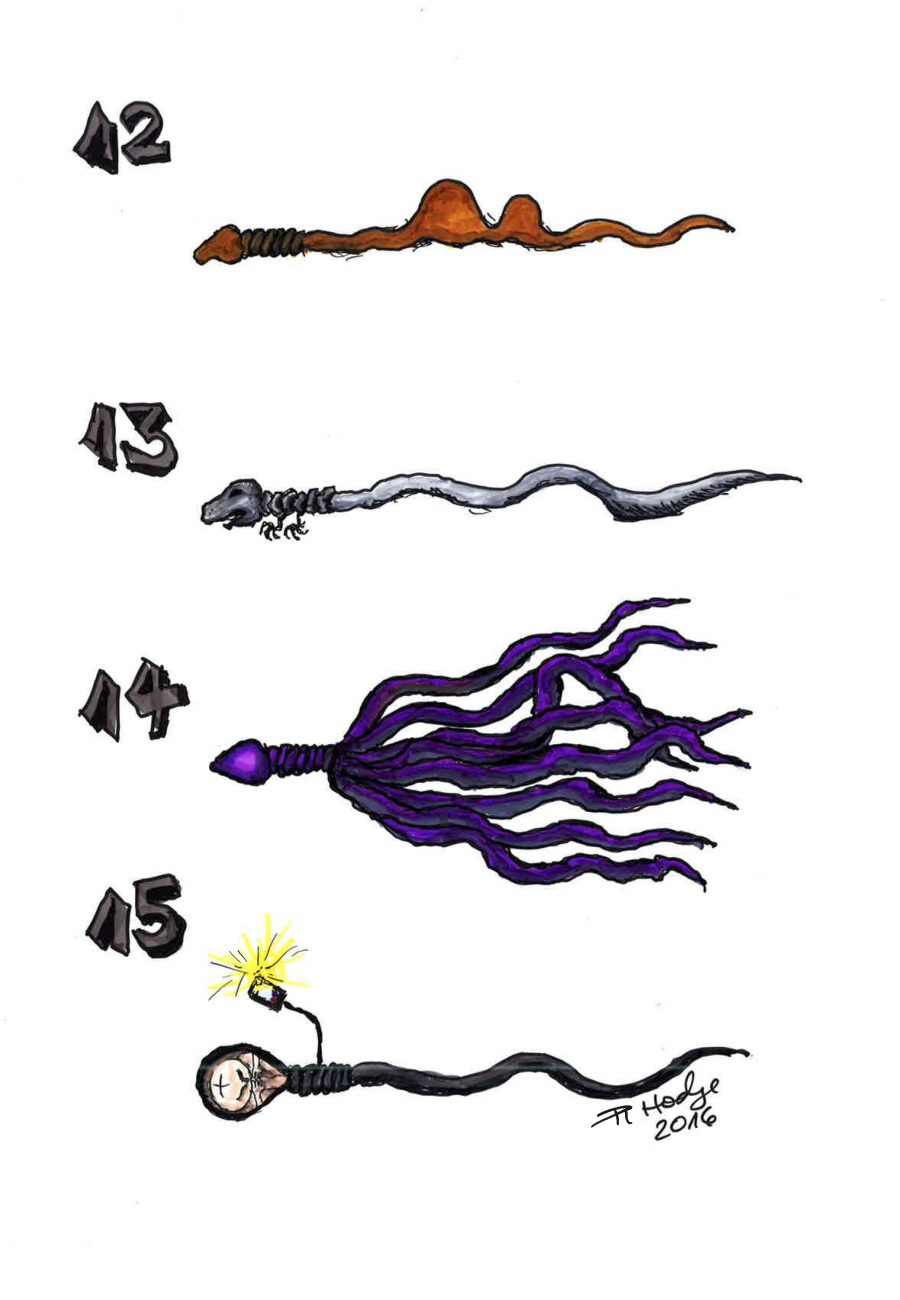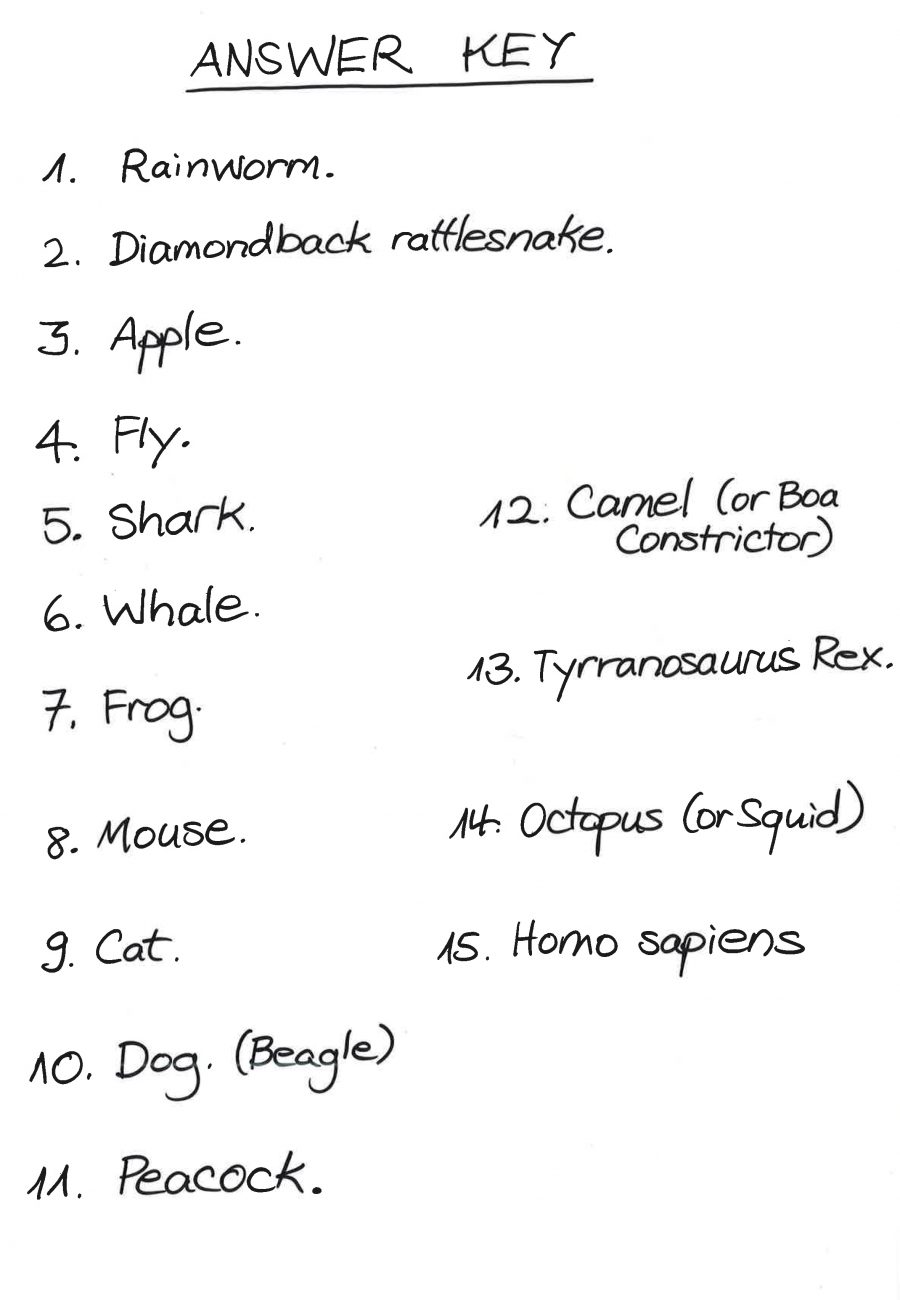
Molecular biology cartoons: A field guide to sperm

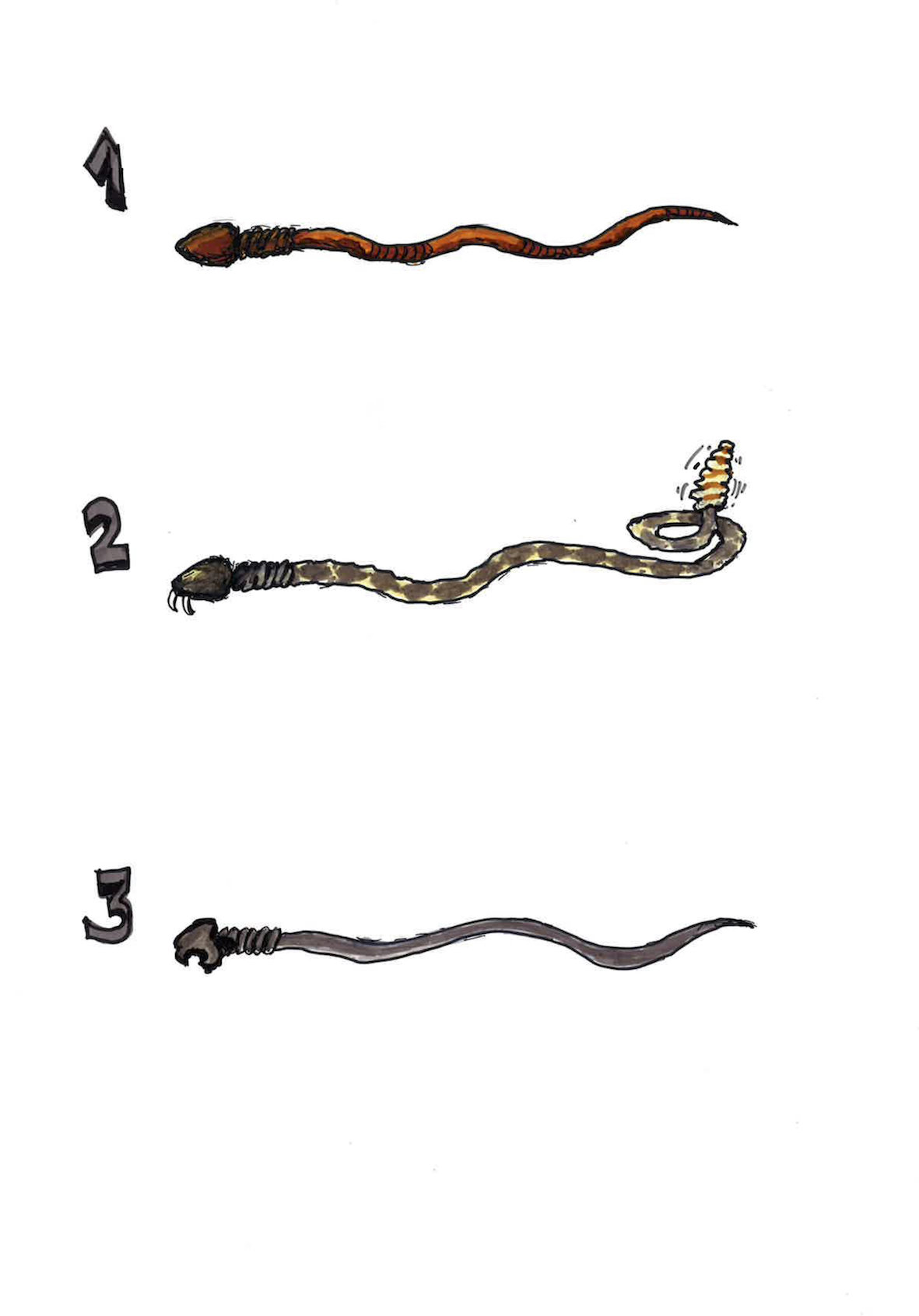
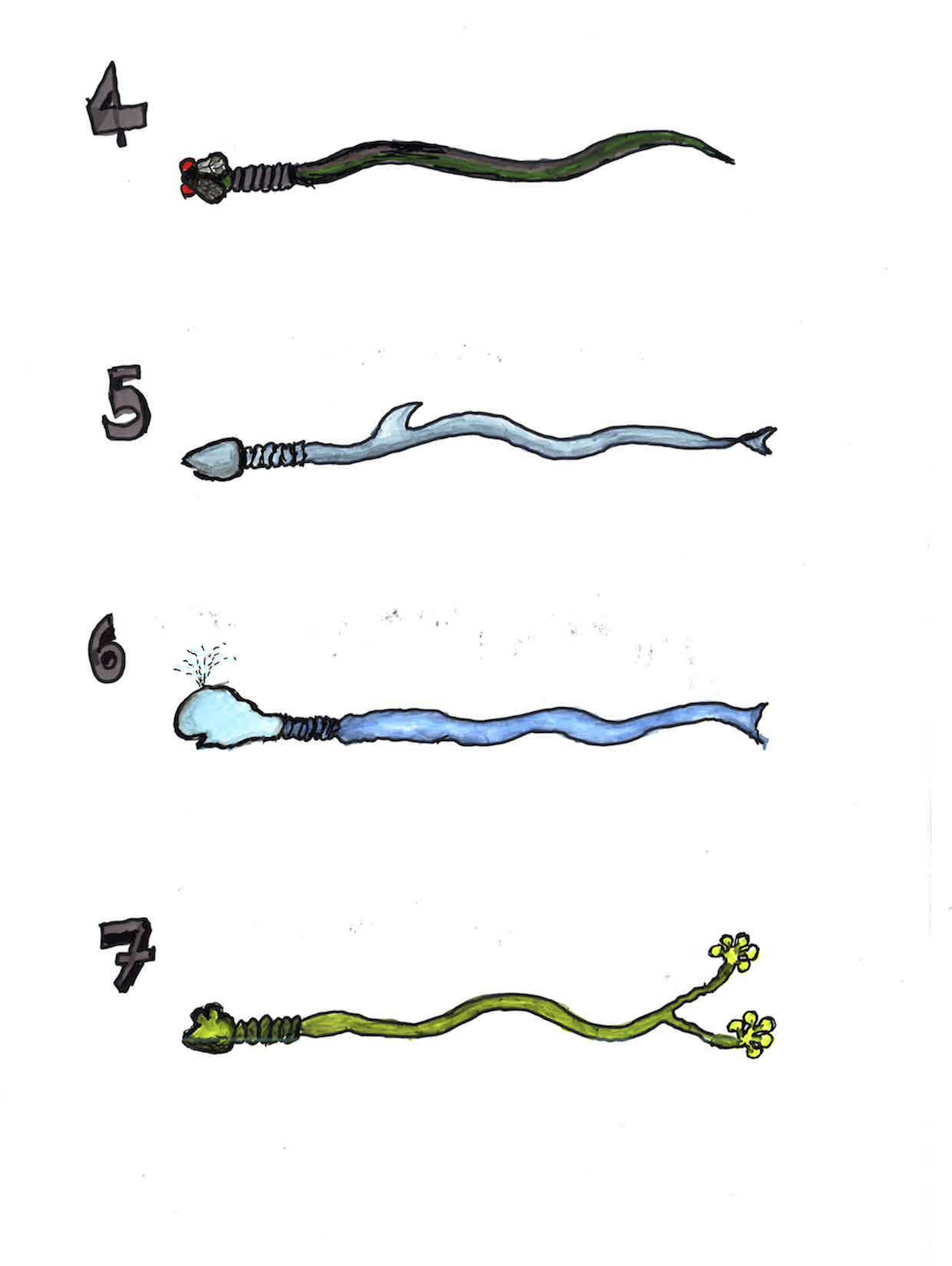
Mating is most successful when it involves members of the same species…

…but the sperm of different organisms look awfully similar. This handy Field Guide will help you discriminate the different types and thus avoid the negative long-term consequences of hybridisation.

sperm1

sperm2

sperm3

sperm4

sperm5       sperm6

The Devil’s dictionary, Dec. 4 update

See the complete Devil’s Dictionary of Scientific Words and Phrases here.

3707_001


note: all entries in the Devil’s Dictionary copyright 2016 by Russ Hodge

digestion  a process that plays an essential role in an organism’s health by undoing the negative effects of eating. This requires aggressive enzymes that are contained in a sort of high-security facility called the gut, which prevents them from escaping and digesting the organism they reside in. Digestion is also crucial to the long-term maintenance of ecological systems. Without it, large organisms would eat all the smaller organisms and exhaust the food supply. Digestion returns those at the top of the food chain to the bottom in the following way: a large organism eats another large organism, thereby breaking it down into smaller units so that it can be eaten by organisms with smaller mouths; their digestion, in turn, reduces this matter into even smaller units that can be eaten by other organisms with even smaller mouths, and so on, until the units are so small that they can be eaten by microbes, which have no mouths at all. That’s not the end of it; the process continues to the level of molecules, quarks, superstrings, and stops just before reaching infinitismity. Each passage through a digestive system performs a public service by removing toxins that would otherwise kill the smaller species that feed on its feces. Digestion is the main piece of evidence for the “Giant Robot” school of evolutionary theory, which claims that multicellular organisms arose as the most efficient way for bacteria to reach the food that is stored on high shelves.

conglomerate  an entity consisting of several partners, usually institutes or businesses, which have been joined together, thereby forming a glom. The precise historical meaning of “glom” has been lost, but it most likely referred to the sticky masses of alcohol, bodily secretions, cigarette butts, and other detritus of human civilization that fall to the floor of a bar and become glued together, forming gloms. EU collaborations or multinational corporations are examples of conglomerates.

corroborate  derived from the verb “to rob,” meaning to commit a theft. To corroborate means to join together in a gang or band to commit a crime, usually intellectual in nature.

postulate  to proclaim something while standing on a post: a precarious position from which one can easily be knocked off by the wind, a cow, or the shotgun of a rancher who does not look kindly upon trespassers who stand on his posts.

to deliberate – to consider a topic in a group for the time required to take into account all relevant points of view and as many irrelevant ones as can be produced in the time that is available. This happens most often in a situation such as a faculty meeting where attendance is compulsory and everyone must stay to the end, which places deliberations, from a legal point of view, into a grey area between kidnaping and hostage-taking. The amount of time required for a deliberation depends on the amount of time it ought to take a single person to come to a decision and the number of participants (n). If ten minutes would normally suffice, the time needed for a deliberation can be calculated according to the following formula:

Time = 10n

range  a defined finite space whose boundaries are often described by numbers, in which a cow or another free-roaming object, such as a piece of data, wanders aimlessly about in a leisurely and random manner, sometimes stopping to eat something it finds on the ground, such as a boot, a weed, or a dead armadillo, chewing it repetitively for as long as it takes until it can be swallowed. “Ranging from 1 to 5” indicates the position of the fences that border this space, which an item within the range should not cross. Otherwise it risks being electrocuted by the fence or shot by the farmer whose land begins on the other side.


If you liked the Devil’s Dictionary, you’ll probably also enjoy:

Cussing in Kansas


New cartoons – October 11

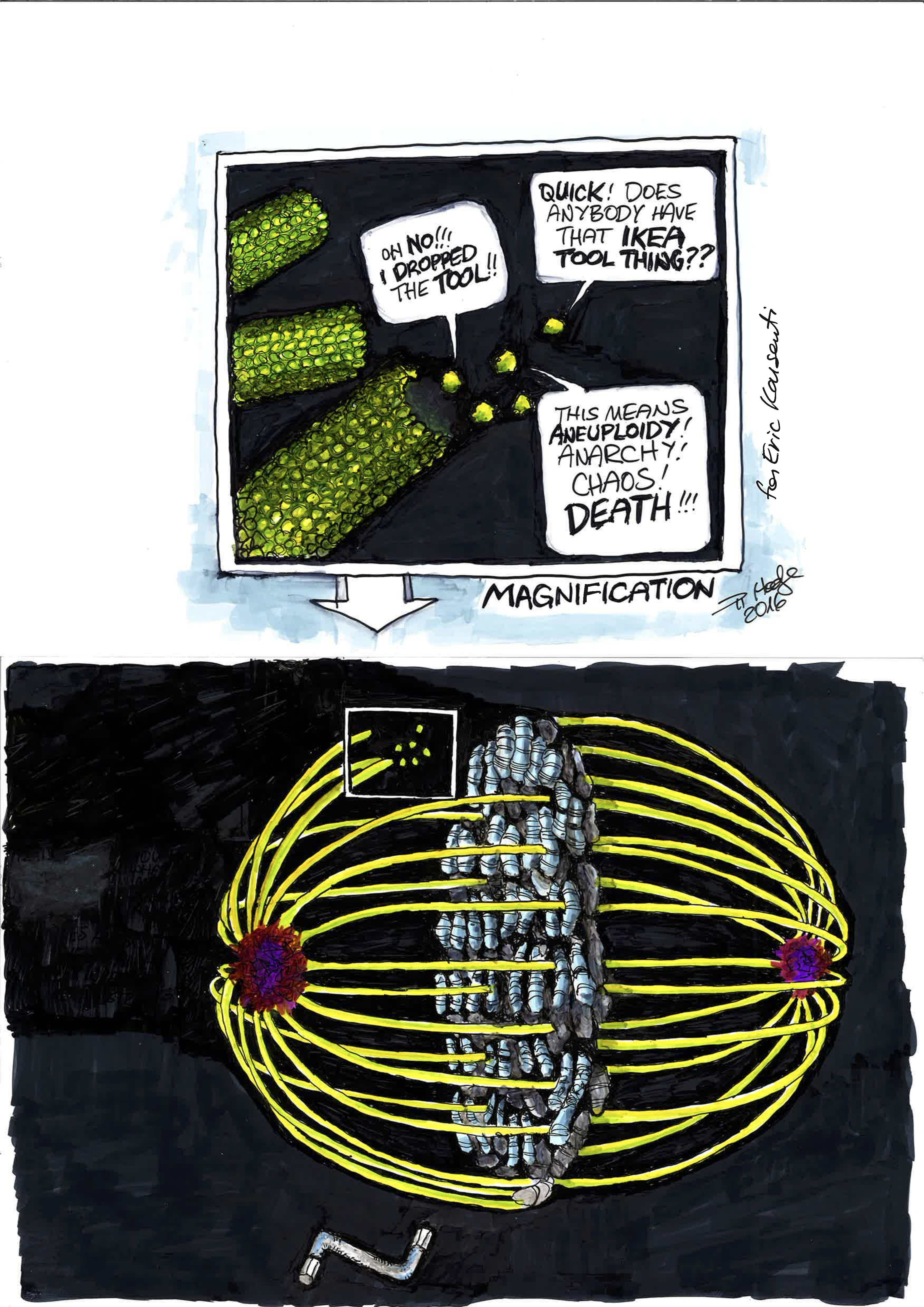
Today’s features include the mitotic spindle – drawn for my good friend Eric Karsenti, retirement parties for proteins, and existential questions upon the fusion of sperm and egg.

As always, feel free to repost and send to friends, citing “copyright 2016 by Russ Hodge, http://www.goodsciencewriting.wordpress.com.”

0235_001


0236_001

0237_001

0239_001

The Devil’s dictionary, Oct. 9 update

See the complete Devil’s Dictionary of Scientific Words and Phrases here.

3707_001


offal  something inside an animal that is removed so that it can be eaten by another animal, thus returning to the inside where it belongs. An example is the Scotish dish haggis, made by thrusting a hand into the mouth of a sheep so forcefully that it passes all the way through and emerges from the other end, then grasping the tail and executing a sudden jerk in the headwards direction until the sheep is turned inside out, with its intestines on the exterior. After seasoning, the animal is roasted or baked until it shows no further signs of resistance. The first time an Englishman saw this practice he called it “awful”, to the great pleasure of the Scots, whose esteem for anything (such as the EU) rises in direct proportion to the degree of displeasure it causes the English. The Scots proudly began calling their dish “awful” haggis, but their pronunciation made it sound like “offal” to the English, who readopted it as a term to refer to “any innards that only a barbarian would eat.”

Organs that have been extracted for the purpose of transplantation are not normally considered offal, unless they are eaten by mistake. Vomit is considered offal by cats, but not humans, except in the case of projectile vomiting, which in the most severe cases includes bits of organs.

An example of the word’s proper use can be found in the sentence: “How awful is a wall of falafal full of offal.”

efflux  something that comes out of a body, usually involuntarily. Removed from its natural environment and placed, for example, on the sidewalk, or on your dinner plate, efflux usually generates a sense of disgust and nausea, because you realize that there is more of the stuff in your body. This usually leads to reflux. From a legal standpoint, efflux has the same status as garbage: once you’ve put it out on the street, it becomes public property. Dogs may come by and roll in it. DNA samples may be taken from it without a warrent. You can no longer patent it. Anyone is free to come by in a pick-up truck, take it away, and display it on their lawn, or sell it on e-bay, or use it as the basis of a start-up company.

influx  to pick up some efflux and insert it into your body, usually via the mouth, which frequently triggers reflux. If the material originally came from your own body, this is not considered cannibalism.

reflux  to eject a disgusting substance from your body for a second time by, for example, vomiting. The first time it came out it was efflux. After studying the contents of, for example, the vomit you decided it contained something your body needed, such as a kidney, and tried to return it to its natural environment (influx). The second rejection is the reflux. By this point most people figure out that the body is rejecting the substance and give up. But the literature reports a few cases of triflux, quintiflux, and a pathological condition called millifluxitis.


All entries in the Devil’s Dictionary are copyrighted 2016, by Russ Hodge, and may be freely used by citing the author and this website.


If you liked the Devil’s Dictionary, you’ll probably also enjoy:

On the publication of Remote Sensing


The Devil’s dictionary, Sept. 26 update!

See the complete Devil’s Dictionary of Scientific Words and Phrases here.

3707_001


sonogram  the standard unit for measuring the weight of a sound. Contrary to popular belief, loud sounds are not heavier than soft ones. Weight is determined by pitch: the lowest pipe on an organ, for example, produces a bassogram, which when converted to standard measurements is approximately the weight of an adult whale. By contrast, a sopranogram weighs about as much as a hummingbird.

maternal lineage  anything – physical or metaphysical – that binds a daughter to her mother, including the umbilical cord, a leash with a collar, the choice of an inappropriate partner, or various sticky substances found in the refrigerator.

preservation  any artificial procedure that extends the shelf life of organic material beyond its natural expiration date, usually to ensure that there will be a supply of food in the future. Various methods are used, including freezing. Humans are often cryopreserved, for example, so that someday they can be cured of diseases, or eaten, depending on the state of society when the electrical grid breaks down.

GFP  Good Freaking Pie

optimize  to improve the performance of a procedure or machine that has produced inconclusive or fuzzy results by putting on your eyeglasses.

ramification  what happens to a door during the springtime if you put a ewe on one side and a male sheep on the other.


If you liked the Devil’s Dictionary, you’ll probably also enjoy:

Letting science communication (and a cat) out of the box


At long last! Updates to the Devil’s dictionary, Aug. 10

See the complete Devil’s Dictionary of Scientific Words and Phrases here.

3707_001

anterior  the part of the body above the posterior, provided you have access to gravity, and are not standing on your head. Otherwise, place your hands on your posterior; the anterior end is everything in the opposite direction.

posterior  if you are sitting down, what you’re sitting on; otherwise, what you would be sitting on, and everything below it. The posterior is also the part of a person that you have to ask your spouse whether it is getting too fat.

ventral  the part of an organism that expands in direct proportion to the amount of beer that is consumed.

dorsal  the region of a person that is opposite the ventral side; the part you can’t scratch or see without access to a mirror. If the ventral side is the side of a hotdog you put mustard and horseradish on, the dorsal side is the part near the bun.

p value  In statistics, the p value is a number which indicates whether life is a sequence of random events with no meaning, or whether the universe really is out to get you. The p value can be useful when an experiment doesn’t work and you must decide whether to repeat it. While it may work the second time around, there’s always a risk that the results might turn out even worse; you might, for example, acidentally create some antimatter. Even if you created only a tiny little amount, hardly anything at all, not even a dollop, it doesn’t take much to cause the solar system to implode. Since this has never happened before, it’s hard to estimate the probability that it will on any given day. The p-value might hover at around 0.03 for weeks or months, and then suddenly, within just a few minutes, jump into the millions. If you’ve ever seen it happen, it’s pretty impressive. In general, scientists try to keep the p value for undesirable things as low as they can and raise it as high as possible for things they would like to happen. This is possible because the probability of the bad thing is often almost exactly the inverse of the probability of something good. In figuring the p value, put in any quantitative information that might be relevant.

As an exercise, estimate the p value of a zombie apocalypse. Here the only quantitative value you really need to determine is the maximum number of days that it might take until the zombie apocalypse occurs, which is probably the total number of days left before the sun expends all its energy, providing scientists are unable to develop a zombie apocalypse inhibitor beforehand. Since scientists place the future lifespan of the sun at about five billion years, the likelihood that a zombie apocalypse will occur on any given day is 5 billion x 365.4 (1,827,000,000,000). So the p value will be p = 1/1,827,000,000,000. Remember that tomorrow you will need to recalculate; tomorrow the p value will be 1/1,826,999,999,999. (Note, if your experiment involves antimatter, there won’t be any days left before the zombie apocalypse occurs, so p = 1/0; this is an irrational number, but you won’t be around to worry about it.)

In clinical science, the p value represents the amount a clinic will pay you for a warm cup of urine, or charge you for it, depending on whether they are asking you for the urine or you are asking them to take it from you.


If you liked the Devil’s Dictionary, you’ll probably also enjoy:

Some little-known facts about Kansas


Today’s updates in the Devil’s Dictionary

See the complete Devil’s Dictionary of Scientific Words and Phrases here.

3707_001


enantiomer  a form of asymmetry which becomes obvious when a glove is put on the wrong hand, a shoe on the wrong foot, or an arm or leg is surgically reattached to the wrong side of the body, which happens more often than you would think, but which at least puts the glove or shoe back on the correct foot. In this case the gloves and shoes are still called enantiomers, but at least they’re the matching enantiomers. Most molecules are enantiomers, which gives them the same sort of problem with gloves. Human beings are not enantiomers, at least not in this dimension, unless you count your evil twin who lives in the mirror. This raises the fascinating philosophical question: if you could choose someone to be your enantiomer, whom would you pick?

 null hypothesis  a theory claiming that everything is nothing, or nothing is anything, or that nothingness pervades the universe, or would do so if the universe existed, but according to the null hypothesis it doesn’t, so what would there be to be filled with an infinite amount of nothingness? And does a system containing only nothingness obey the Second Law of Thermodynamics? Can the same volume hold different degrees of nothingness, which differ only in the density of nothingness against a background of nothingness, and if so can the nothingness in a system increase over time, or decrease, depending on how you see these things, to the point that eventually all the nothingness will be gone, and there will be nothing left at all, not even any nothingness?

potential drug target  something in a biological system that is not affected by any known drug and probably never will be.

sally forth  a more elegant way to say “go”, which should be used as often as possible in scientific papers.

If you like the Devil’s Dictionary, you will probably enjoy these older posts:

Searching for Oslo: a non-hypothesis-driven approach

Ontogeny recapitulates sobriety: from the Archaeal origins of life to the pinnacle of evolution: a PhD

Plus the other pieces in the categories “satire”, “science cabaret,” and “hilarious moments in science communication.” And there are, of course, many serious pieces on the site.

Feel free to pass along the link to your fellow science nerds! And, of course, quote the Devil’s Dictionary – just remember the reference! All material here is copyrighted Russ Hodge.

Today’s updates in the Devil’s Dictionary

See the complete Devil’s Dictionary of Scientific Words and Phrases here.

3707_001

press release  a shortened form of the expression “press and release:” a description of the activity of the intestines when trying to digest and then expell a piece of science that has been swallowed without chewing.

p value  a numerical value used in statistics to shows whether life is a random, meaningless sequence of events, or whether the universe really is out to get you. If an experiment doesn’t work out, the p value can help as you try to decide whether to repeat it, or give up science and become a sheep herder. The p value shows that no matter how bad things are, they can always get worse. Suppose, for example, when you redo an experiment you produce some antimatter. Even a very small amount might blow up the galaxy. This hasn’t happened before, as far as we know, which means the p value for antimatter is probably very low, less than one. But until we get some data, the number might jump up into the millions, with no warning whatsoever. It is easier to estimate the p value of other things, for example, the chance that your group leader will be struck on the head by a bowling ball that a passenger flushed down the toilet of an airplane. Here the p value will be higher than 0, since all group leaders die someday (100%), and in a few cases the cause will be a bowling ball. Start by calculating the maximum number of days your group leader might live under optimal circumstances (daystotalgroupleadermightlive). Skew the figures a little bit to account for the fact that Tuesday is the most popular day for dying. Throw in a few other numbers just for fun, and then start calculating. The result should be p = approximately 1 / daystotalgroupleadermightlive. If the bowling ball does not descend that day, you will have to recalculate the p value the next day, because every day that passes without a fatality reduces the total number of days before death is inevitable, (daystotalgroupleadermightlive – 1). Since p is inversely correlated with this number, p will get a little higher every day, just like the rising, anticipatory mood in the lab. The same approach can be used to figure out the p value of a zombie apocalypse (hint: 1 / daysmaximumuntilzombieapocalypse). Since no one knows the value that should be inserted for daysmaximumuntilzombieapocalypse, you can insert different numbers until you get a p value that pleases you. Note that these two formulae can be combined, somehow, to account for the possibility that your group leader will be one of the first victims of the zombie apocalypse.

simple  the quality of being simple. While scientists prefer that things be simple, they don’t like their descriptions of things to sound simple, because people might get the idea that science is simple, and then anyone could do it. So scientists have developed many alternative ways of describing simple things, including the following: “a gratifyingly low degree of complexity, bordering on null,” or “a state of not having achieved, evolved, or developed any apparent structural modularity,” or, “an entity or process which can be described without adding a lot of boring, unnecessary detail, particularly those features or properties that have no effect on the outcome of an experiment.” For those who prefer a single word, the base “simple” can be ornamented with some useless consonants: simplifical, simplificability, or simplificabilical. A word can also be built on some other base whose simple meaning can be deduced by anyone with a thorough knowledge of Latin and classical Greek: aheterocomplificatory, apolymorphological, nonmultifeaturologicistical, unquantiplurifiable, monouniformalogically integrated, etc.

If you like the Devil’s Dictionary, you will probably enjoy these older posts:

Searching for Oslo: a non-hypothesis-driven approach

Ontogeny recapitulates sobriety: from the Archaeal origins of life to the pinnacle of evolution: a PhD

Plus the other pieces in the categories “satire”, “science cabaret,” and “hilarious moments in science communication.” And there are, of course, many serious pieces on the site.

Feel free to pass along the link to your fellow science nerds! And, of course, quote the Devil’s Dictionary – just remember the reference! All material here is copyrighted Russ Hodge.
Today’s updates in the Devil’s Dictionary

See the complete Devil’s Dictionary of Scientific Words and Phrases here.

3707_001

manufacturer’s specifications  the way a sales rep describes how a machine or protocol should work, which usually does in fact work until the sales rep leaves, at which point it no longer works. A system of planned obsolescence which provides employment for the company’s technicians and consultants.

nonetheless  is an expression which means, “starting at this point you should ignore everything that I have said in the last 20 pages.”

nunc est bibendum  An expression commonly put at the end of papers, which basically means, “The End.”

patent  what a discovery is called after a lawyer finds out about it. Most scientists are unaware of the huge number of lawyers lurking around laboratories, because they are clever at disguising themselves as cadavers, or genetically modified rats. To get them to come out just shout the word “Eureka!” or “Aha!” and one will run up to you and hand you patent application forms.

simple  the quality of being simple. While scientists prefer that things be simple, they don’t like their descriptions of things to sound simple, because people might get the idea that science is simple, and that might make them wonder why scientists get the big bucks to do it. So they have come up with alternative ways of describing simple things, including the following: “a gratifyingly low degree of complexity, bordering on null,” or “a state of not having achieved, evolved, or developed any apparent structural modularity,” or, “an entity or process which can be described without a multiplication of features or properties, in a way that does not affect the predicted outcome.” For those who prefer a single word, the base “simple” can be ornamented with some useless consonants: simplifical, simplificalogical, simplificability, simplificabilicous; or a synonymous base can be used: apolymorphological, amultifeaturological, nonquantiplurifiable, etc.


If you like the Devil’s Dictionary, you will probably enjoy these older posts:

Searching for Oslo: a non-hypothesis-driven approach

Ontogeny recapitulates sobriety: from the Archaeal origins of life to the pinnacle of evolution: a PhD

Plus the other pieces in the categories “satire”, “science cabaret,” and “hilarious moments in science communication.” And there are, of course, many serious pieces on the site.

Feel free to pass along the link to your fellow science nerds! And, of course, quote the Devil’s Dictionary – just remember the reference! All material here is copyrighted Russ Hodge.

EVEN MORE updates in the Devil’s Dictionary

See the complete Devil’s Dictionary of Scientific Words and Phrases here.

3707_001

hither  the opposite of thither.

thither  the opposite of hither; almost but not quite yon.

yon  an abbreviation of the word yonder, which is where you’ll end up if you don’t complete your thesis.

reductionism  to repair a piece of equipment that has already been repaired once using duct tape by applying another layer of duct tape.


in the same fashion  today this means “in the same way.” Until around the 1970s, however, it meant that everyone in a lab had to wear the same clothes. The group leader had full authority over the dress code, including underwear (or not). The practice began after a paper in a psychology journal suggested that giving group leaders this power would improve their mood, the morale of their labs, and thus the impact of their papers. Most groups adopted the generic lab coat (underwear optional), but others took a more creative approach. Popular themes for laboratory wear included: monogrammed shirts with the logo of the lab bowling team (membership obligatory), black tuxedos, white tuxedos, Vikings, woolen sweaters knitted by the group leader’s mother, Disco, Star Trek, penguin costumes, the Village People, hockey uniforms, Octoberfest, pimps & hookers, Elvis impersonators, the Court of Versailles, the band KISS, characters from the Godfather films, etc. (The “cowboy” theme was forbidden after the first few shootouts.)

last but not least  a phrase commonly used in talks that functions like an alarm clock, or a defibrillator, rousing members of the audience who have entered comas, raising hopes that they may live to hear the end. Speakers who are unable to hold the audience’s attention in any other way use the expression about once every five minutes, even several times in the same paragraph. Officially, this is considered a foul, and any speaker who is caught doing it gets an automatic yellow card and a one-year suspension from the conference circuit.


If you like the Devil’s Dictionary, you will probably enjoy these older posts:

Fundamentalist math: another outtake from the science cabaret

Some little-known facts about Kansas


Plus the other pieces in the categories “satire”, “science cabaret,” and “hilarious moments in science communication.” And there are, of course, many serious pieces on the site.

Feel free to pass along the link to your fellow science nerds! And, of course, quote the Devil’s Dictionary – just remember the reference! All material here is copyrighted Russ Hodge.