Signaling
Chapter 1: The evolution of receptors and ligands
1.


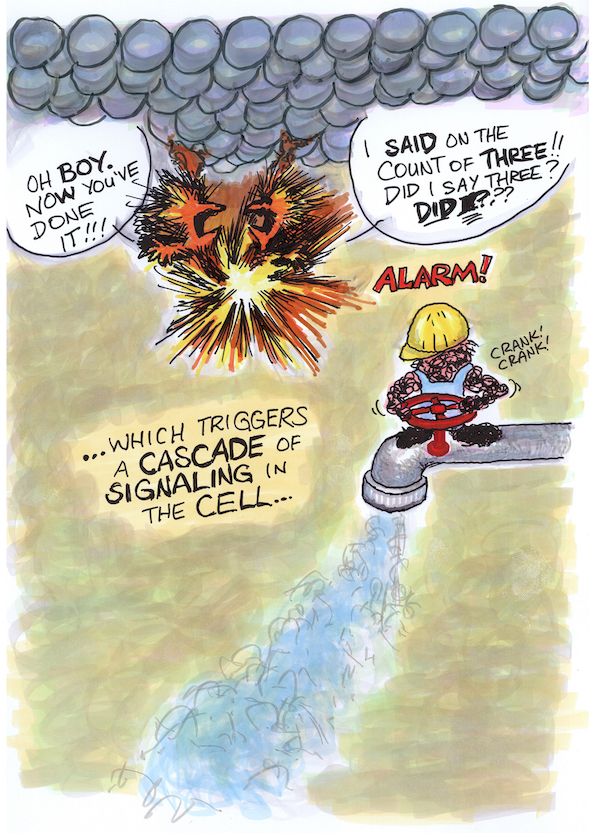
Other methods of stimulating signaling pathways, tried and discarded by evolution:
2.

3.

4.

5.

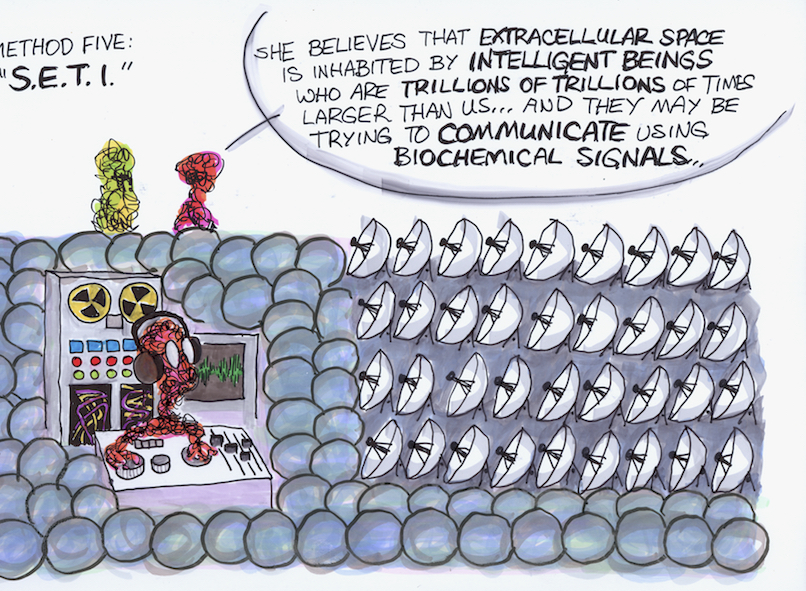
Classics of (mis)communication in science…
1.
Other methods of stimulating signaling pathways, tried and discarded by evolution:
2.
3.
4.
5.
All entries copyright 2017 by Russ Hodge.
philosophy a field of knowledge which aims to prove that knowing anything is impossible – well, except for that. Years of study are required to unlearn everything a person has picked up over the years, followed by great mental discipline and constant vigilance to prevent information from seeping into the vaccuum that has been created. The brain has a natural hunger for knowledge and finds clever ways to smuggle it in without a person’s knowledge, which causes difficulties because anything you don’t know that you know is hard to identify and remove because it never occurs to you to look for it. The extent of unlearning required by a true philosopher is usually only achieved upon earning a doctorate, at which point you have racked up about $300,000 in debt from student loans in the pursuit of ignorance. On the salary provided by the 7-11 or Dairy Queen, which are the only jobs you are qualified to do, it takes about a 3000 years to repay this sum, not taking inflation into account. But perhaps it is worth it; philosophy may be the key to a happy life, although by definition, there is no way to know this.
Philosophy is sometimes called “the Queen of the Sciences,” but only by philosophers, revealing a secret bias toward monarchical forms of government. Actual scientists, on the other hand, call it something else, such as “a bunch of malarkey covered in spam and generously topped with Cheeze Whiz.” Natural scientists consider philosophy a completely theoretical field that has no bearing whatsoever on the real world, because philosophy has neither mass nor energy, and thus by definition cannot interact with matter. Philosophers counterargue that millions of books have been written on the subject and can be viewed in archeologial sites called libraries. Natural scientists respond by calculating the cost of printing all of these books, in terms of the millions of acres of trees that have been sacrificed, and thus the extent to which philosophy is accelerating the end of the world.
Despite the inherent antagonism between these two views, it should be noted that many natural scientists go through a brief phase of intellectual flirtation with philosophy, usually when confronted with the task of writing a dissertation. This little fling usually doesn’t cause any permanent damage, unless it produces a child or lasts too long. Sustained dosages of philosophy are toxic and can lead to a mild disassociative state in which a scientist believes his or her body to be a robot under the control of aliens, or secret government powers using mind-control devices, which is why so many of them wear tinfoil hats. Documented symptoms of full-blown cases of philosophy include hemlock poisoning, insanity through syphillis, depression, existentialism, atheism and nihilism, although the order in which they appear may vary. Happily, in most cases of temporary philosophy, an external stimulus causes the mental fog to dissipate, much the way pressing a button can open a garage door and let out the cats, or opening a keg of beer produces pandemonium. A person infected by philosophy may remember going into a bookstore to buy a copy of Also Sprach Zarathustra; then there’s a gap in your memory, and suddenly you wake up on the side of a barren hill in a foreign land, surrounded by a large herd of goats. If this ever happens to you, philosophy is probably the culprit. That, or aliens. Although some philosophers become contract killers instead of goatherds.
A typical dialog between a scientist and a philosopher goes something like this:
Scientist: Hey, how are you doing today? Oh, I forgot that you maintain that we can never know for sure what day it is, or if such a thing as a day even exists.
Philosopher: That’s correct, but it is possible to talk about a day without establishing that it exists. Providing we share a frame of reference that contains “day” as a concept.
Scientist: But wouldn’t the frame have to exist, for us to share it?
Philosopher: Not necessarily; it’s enough to postulate that it does, and that your framework and mine are similar enough to permit communication.
Scientist: But what basis can there be for doing so? Doesn’t it make all communication a thinly-veiled lie?
Philosopher: No, because lying presupposes the existence of a truth that can be lied about.
Scientist: …And somehow you get out of bed in the morning. Me, I get up, develop a hypothesis that it’s Tuesday, which it either is or isn’t; it can’t be both. So I perform an experiment that will disambiguate the situation by clarifying the Tuesday-ness of a particular day. For example, by asking my wife.
Philosopher: Ah, but who’s to say that your wife’s Tuesday is the same as your Tuesday? When your wife asks you if her butt is fat, is fat to her the same as it is to you?
Scientist: I’m not in the mood for the “fat” argument today. Keep it up and things are going to get ugly.
Philosopher: Why does the the failure of objectivity as a tenable world view always incite you to violence?
Scientist: I can tell you for certain that what you mean by violence isn’t what I mean. You’ll find out, though, if you brainwash any more of my PhD students.
Philosopher: Is that so?
Scientist: You betcha.
Philosopher: Well maybe I will, just to prove a point.
Scientist: Go ahead, I dare you.
(pause)
Philosopher: By the way, did you drive to work today? My car’s in the shop.
Scientist: Yeah, you need a ride home?
Philosopher: I’d really appreciate it. Should I come by around five?
Scientist: Works for me. Catch you later.
psychology a field devoted to the study of invisible, immaterial, and other formless entities such as the mind, the psyche, and large imaginary rabbits. Psychologists use invisible tools to cut these phenomena into subcomponents that are also invisible, but smaller. This produces new entities such as the Id, the Superego, and a ghost called Elvira. By studying defects in the interactions of these components, and the use of silverware by psychiatric patients, psychologists have identified the causes of a number of mental diseases which no one previously recognized. Diseases are assigned names based on characters from Greek mythology who have committed terrible acts of a sexual nature.
Psychology is considered a science only by its practitioners and those they manage to draw into their collective delusion. They justify this claim by pointing out that the psychology curriculum requires them to take a course in statistics. They also do a research project in which they stand at a window, watch the behavior of zoo animals, and count whatever happens, usually acts of a sexual nature. The real trick is to find clever excuses to discount any evidence that fails to confirm the initial hypothesis. Either that, or to make up the hypothesis after the observations have been performed. Statistical methods are then used, in a random order, to convert the hypothesis into a theory that can be immediately applied to human society.
Psychologists claim to be studying the brain, although most of them have never actually seen one. If some other part of the body takes part in an activity that interests them, such as acts of a sexual nature, they are not required by law to shut their eyes and ignore it. Noticing it deliberately is considered bad form, however, because it encroaches on territory claimed by specialists in other branches of medicine. The eyes, for example, lie in the domain of optometrists, while facial muscles are the province of plastic surgeons. Hair is the exclusive territory of coiffeurs with names like Raimondo or Giancarlo, unless it emerges from the nostrils or ears. That places it in the domain of psychologists again.
litmus test a scientific method to determine whether something is what someone claims it is or is in fact something else. A litmus test is performed by sticking a thin strip of blue paper into the mouth of the subject, or whatever orifice is available, and waiting to see whether it turns red, or sticking in a red strip of paper to see if it turns blue. This will tell you whether something is what it is supposed to be or something else, but only if you know how to interpret the results, and haven’t somehow mistaken a strip that was originally red for one that was originally blue and then turned red again, or vice versa, respectively. Ideally litmus tests are performed as double-blind, randomized studies in which the person who inserts a strip knows neither what color a particular strip was to start with, nor what color it is now; neither should the person administrating the test hope for a particular result, or know what a color would mean if it occurs, which is usually not a problem by this point; otherwise it can be solved by wearing sunglasses.
all text and images copyright 2017 by Russ Hodge
omnivore as nearly the exact opposite of a vegan as you can get.
accessoire a technical term for anything that must be removed from the body before undergoing an examination with an MRI machine.
monomer Derived from the Australian pronunciation for “my number,” this expression has been traced back to an incident that occurred in a bar between an Australian and an attractive young lady who spoke some more natural form of English. Before parting company the Australian offered to give her “monomer”, which she misinterpreted as an obscenity and then promptly fled the scene. By extension, in biology, the term is now used to refer to a molecule that can’t get a date.
digit structures on the hands and feet of animals that originally evolved from twigs. In the earliest animals, digits were still very twig-like. Animals grew from the tips of their fingers and toes, sometimes to amazing distances from the body they belonged to. Leaves and fruits sprouted from the twigs, which put a lot of food conveniently within grasp. But mutations in an early animal stunted the growth of digits to the point that they could no longer bud. Genetic engineers might have helped restore these characteristics, but the Crispr/Cas system hadn’t yet been acquired from simpler organisms, due to conflicts over issues of rights and patents.
After about 100 million years, evolution managed to get the digits hooked up to body utility services such as the vasculature and sewage lines, and at some point a cable company appeared and linked them into the network of the CNS, suddenly placing them under the control of the brain. There were advantages: digits could now be used to pick lice off a spouse, or grab a potential spouse by the hair, or point at things you wished for your spouse to bring to you, such as a bottle of beer, and you could even indicate the number of beers you wanted, provided it didn’t exceed 10 at a time. That was all right because 10 was about the most bottles your spouse could handle in a single trip. Finger-pointing covered most situations that otherwise would have required language, so the evolution of that region of the brain was postponed for a few more hundred million years. During that period mouths were used mostly for eating things and the tongue for picking food from the teeth. Any utterances were simply the by-product of exhaling air through a larynx, past the glottis, the tongue, the teeth, etc.
hydrophile a customer in a bar who orders exclusively Perrier, which is frequently an indicator that you are dealing with a recovering alcoholic. Compare with vinophile and hopsophile.
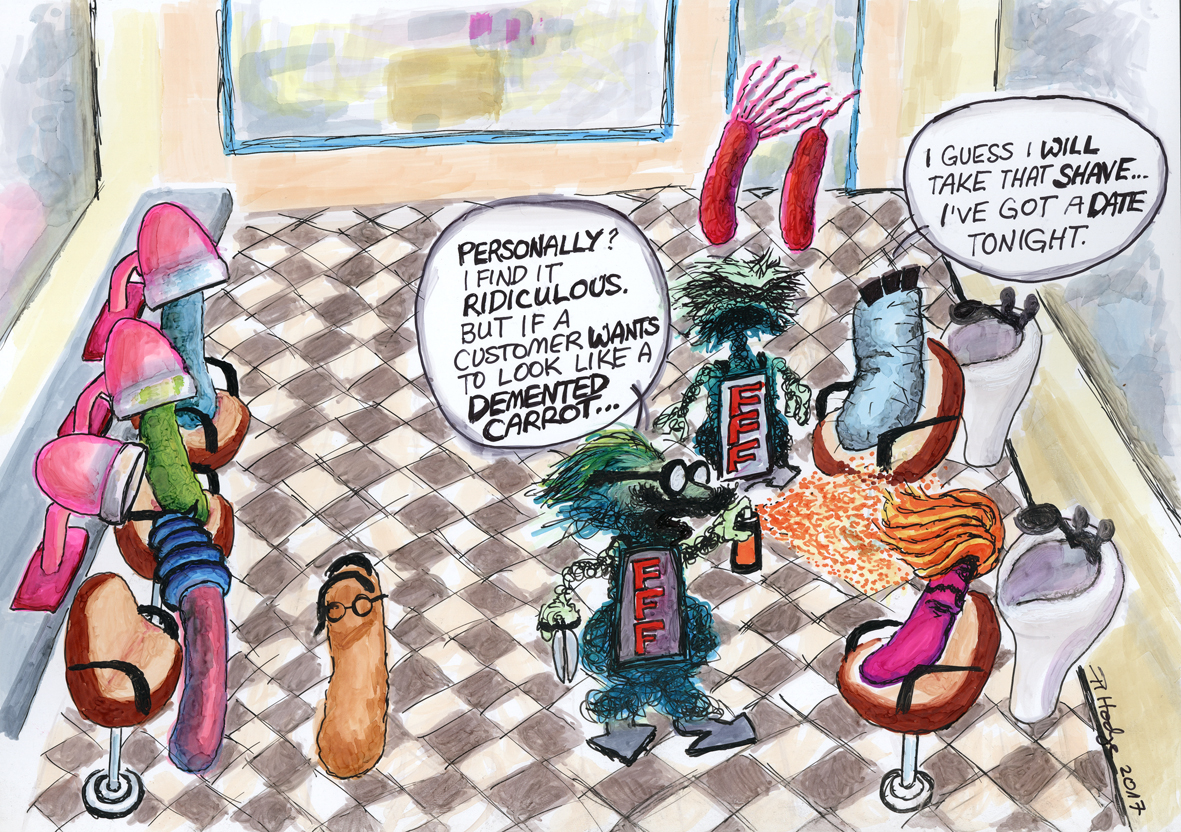
keratinization any process that produces a carrot from some object that is different enough from a carrot that if you had seen it before it became a carrot, in its undeveloped state, you would never guess that its fate was to produce a carrot.
oviduct Today this refers to a chute or apparatus in an egg factory which transports an egg from its point of origin in a chicken to its destination in an egg carton. The etymology of the word is interesting; the roots are derived from ovi- (eggs) and ductus, which was a Medieval vocal composition to be performed during marches or processions. The link between eggs and music is a custom from ancient times that began before dawn every day when a procession of soldiers, priests, and other dignitaries marched to a farm, selected an exceptional egg, and marched it back to the palace, setting the pace by singing a ductus. At the palace the egg was delivered to the Duke of Breakfast, who examined it for cracks or other obvious flaws, such as syringe marks, which might be an indication of an assassination attempt, in a ceremony adorned by plenty of Pomp and whatever Circumstances the occasion might require. After the Duke’s formal acceptance of the egg, he placed it in a bejeweled container called an ovi-carton and personally delivered it to the King. The King conducted his own inspection, with the option of declaring it kingsworthy and handing it to a page for delivery to the kitchen, or rejecting it and cutting off the Duke’s head.
Thus the original meaning of oviduct is best captured by a phrase such as, “Processional music for the King’s Egg.” The oviductus was one of the major musical genres of the late Renaissance and Early Baroque eras, undergoing an evolution not dissimilar to that of the sonata, dance suite, opera, and kazoo symphony, fulfilling an essential social function by providing a livelihood for musicians who were contractually obligated to compose a new one every day for as long as they were employed by the court, unless they died or went insane. All oeuvres in the genre share a feature: the rhythmic structure of the “Colonel Bogey March.”
In modern times Kings get their eggs from Amazon.com, sometimes using the delivery-by-drone service, and this sounded the death knell of/hammered the final nail into the coffin of/brought a definitive end to the art form known as/ushered in the Götterdämmerung of the musical genre known as the oviductus.
When a thing disappears the word often follows, unless it jumps the species barrier to inhabit another object. Oviductus was rehabilitaed in the shorter form oviduct: understood as a chute, apparatus, delivery robot or limousine service that collects a product at its source (chicken) and delivers it to its destination (egg carton). Linguistic creativity led to the combination of -duct with other roots in words such as aquiduct, boviduct, air conditioning duct, etc. In the process –ducts came to represent passageways between the starting position of a thing and its final resting point: Acquiduct, for example, is the route by which “aqua” (water) is passed to cities and towns and ultimately into kidneys for recycling. Bovi-, the Latin root for cattle, has now been used to coin the term boviduct, a passageway in slaughterhouses used by cows who have been selected for passage to the Other Side, and a new plane of existence which must be pretty wonderful because they are never heard from again. By extension, one should understand air conditioner duct as the network of passageways in a house by which air conditioners are shuttled from room to room.
I recently came across a modern reference to a boviduct in a text in Dutch on a website. Here I present the original and a rough translation. (For those of you who don’t speak Dutch, a word of caution: be aware that according to some scholars, Dutch isn’t a real language. It’s a random mixture of German and English and some old Viking words, thrown together with any word order a speaker feels comfortable with, and then vocalized in a Scottish brogue. This is actually wonderful for translators, because it gives them a great deal of freedom in interpreting the text.) I certainly wouldn’t call myself an expert in Dutch, but after a weekend of immersion I’m starting to get enough of a feel of it to offer a rough translation:
Original
Een aantal panden kan worden afgevoerd omdat ze inmiddels zijn gesloopt of zodanig verbouwd dat de historische kantjes er wel af zijn. Maar de speurders kunnen er ook wat aan toevoegen: karakteristieke stukjes bebouwing die beschermd dorpsgezicht zouden moeten worden, mogelijke archeologische vindplaatsen (Oene) en een aantal kleine cultuurhistorische objecten. Een daarvan is het ‘boviduct’ in Vaassen, een tunneltje als doorgang voor het vee onder de Geelmolensebeek door, die even voor de Geelmolen in een hoge bedding stroomt. Het zou de enige boviduct in Nederland kunnen zijn.
Translation:
A portion of panda can work effectively if governed in the middle of ten sloppy sudden buildings where the historical corners are well-seen. But the spurters can hook something up to the tobogan; characteristic pieces built the smeary (beschmierde) dork-face that has suddenly become mute (Note: the word in the original Dutch is moet, and the author may instead be referring to the alcoholic beverage), perhaps like archeological wind palaces (or at least one of them) and a smidgen of small culturo-histo objects. A divan is the “boviduct” in Vaassen, a tunnel which begins at the doorway of the horny moles’ back door, which existed even before the horny moles needed it to “storm” (move with effort) a huge bedding. It is there that the only boviduct in the Netherlands can be seen today.
Reference: https://ampt-epe.nl
methane an organic substance produced by enzymes and other components of the metabolic machinery making up the gastrointestinal tract of cows. Methanes have an affinity for each other, and so in the cow gut they accumulate until they form a bubble which can only be ejected from the system by a fart. This is one of three sounds that a cow can produce. The others are lowing, a sound that a cow makes when it is trying to be discrete (ref: “Away in a manger,” Kirkpatrick 1895, Murray 1887) and mooing, which typically indicates distress or loneliness. An ability to control the release of a fart would give bovide a third sound which, if used with the others in a combinatorial system, would vastly increase the number of concepts that could be expressed in cow language. However, it has been impossible to reproduce an initial experimenting hinting that the temporal distribution of farts is non-random, which would lend credence to the control hypothesis. The result is a hot debate in the field, the literature, and the barn over whether cows possess such a fart regulatory system, or whether its existence is simply another case of scientific wish-fulfillment-as-the-end-of-the-current-funding-period-grows-nigh. If the system exists, it opens the door on another controversy: whether the mechanism is physically located in the gut or in some other tissue that is close enough to make sense, such as the tail. In any case, once methane escapes a cow’s body, through a type of release valve at the posterior end of the animal, the bubble bursts and methane scatters into the atmosphere, where it interacts with other volitile substances in ways that, according to current climate models, will completely destroy the Earth’s atmosphere in about 12 years.
Searching for Oslo: a non-hypothesis-driven approach
Ontogeny recapitulates sobriety: from the Archaeal origins of life to the pinnacle of evolution: a PhD
Plus the other pieces in the categories “satire”, “science cabaret,” and “hilarious moments in science communication.” And there are, of course, many serious pieces on the site.
Feel free to pass along the link to your fellow science nerds! And, of course, quote the Devil’s Dictionary – just remember the reference! All material here is copyrighted Russ Hodge.
Feel free to use, repost, etc. Just cite, “copyright 2017 by Russ Hodge” and www.goodsciencewriting.wordpress.com
1.


2.
3.
4.


1.


2.




3.

genus a clade of organisms which are exceptionally talented in any area of activity except spelling.
operon the smallest functional acoustic unit of an opera, typically but not necessarily a very short note that is sung or played by an instrument. Operons can also be produced through other mechanisms: snores from the audience, the sound made by a director’s baton when it accidentally flies out of his hand and strikes a musician in the eyeball, the noise made by a horn player engaging his spit valve, or a long rest in the music interrupted by flatulence, probably also from the horn player.
outbreeding to engage in the act of reproduction in an distant location, usually outdoors, as in the situation: “Can Jane come to the phone?” “Sorry, she’s outbreeding at the moment, may I take a message?”
fitness a term in evolutionary theory which reflects the degree to which a person accurately reports his or her waist size. Fitness is calculated according to the following formula:
Actual waist size – Reported waist size = X
where X yields the degree of fitness. A score of 0 represents perfect fitness. Other values for X are negatively correlated with fitness, on a logarithmic scale. Claiming to wear clothes that are one size too small, for example, would yield X = 1 and a degree of fitness of 10% of the ideal. Underestimating your clothing by two sizes would yield a fitness score of 2 (1%), etc. Fitness plays a huge role in the evolution of species because individuals who chronically underreport their clothing sizes tend to buy tighter pants and eventually become sterile. This leads to negative selection which, over thousands of generations, eliminates tight-pants SNPs from a species’ gene pool.
Fitness cannot be improved by over-reporting waist size. This generally causes pants to fall down, entangling the feet, which is not advantageous for fleeing from predators.
open reading frame a browser window left open by a gene in a public place and unprotected by a password, allowing any old transcription factor to come along, hack into its network, and order stuff using its credit card.
rho factor a handicap system to make rhoing matches more exciting by giving slower teams a head start on the river. The rhoing factor represents the amount of head start given to the weaker team; a rhoing factor of 100 would mean 100 meters or 100 kilometers, depending on the comparative level of skill of the two teams. This system levels the playing field even when pitting professionals against amateurs. And even greater handicaps can be awarded. For example, when the Cambridge University Rhoers were matched against the Rhoing and Knitting Club for Sopranos Who have Retired from the Grandview United Methodist Church Choir, the Cambridge team was required to rho upstream while the Methodists were permitted to rho downriver, with the help of an outboard motor.
Hardy-Weinberg equilibrium a mathematical equation devised by two mathematicians – fortunately, because the chances of its accuracy are greater that way – while sitting on a teeter totter and debating the role of recessive genes in evolution. The Hardy-Weinberg equilibrium proves that a group of average people will remain average for generation after generation until they are finally forced to get off the sofa through the arrival of some new form of selective pressure. Examples include invasions by extraterrestrials or WalMarts; any sort of planetary holocaust; an out-of-control Crispr/Cas9 experiment that creates cockroaches the size of battleships; any increase in sales tax; a death, marriage, divorce, homocide, or sterility induced by tight underwear; or all of the above, although not necessarily in that order. If you knew in advance which scenario would occur, you might be able to make preparations, for example by going commando, or constructing really large roach motels. Unfortunately, natural processes are random and unpredictable, so your genome has to be ready for anything – making it advisable to carry a toothbrush with you at all times. Any significant chnge in the environment will upset the teeter totter and send either Hardy or Weinberg flying up through the air, and the other crashing down on his delicate bits.
curmudgeon a hybrid between a human being and a crustaceon
lumen an empty space inside an organ or tissue which should be kept isolated from the surrounding environment to prevent toxic effects. A pocket of gas trapped in the gastrointestinal tract is an example of a lumen.
Feel free to pass along the link to your fellow science nerds! And, of course, quote the Devil’s Dictionary – just remember the reference! All material here is copyrighted Russ Hodge.
…and stay tuned for more tomorrow…
1.

2.

3.
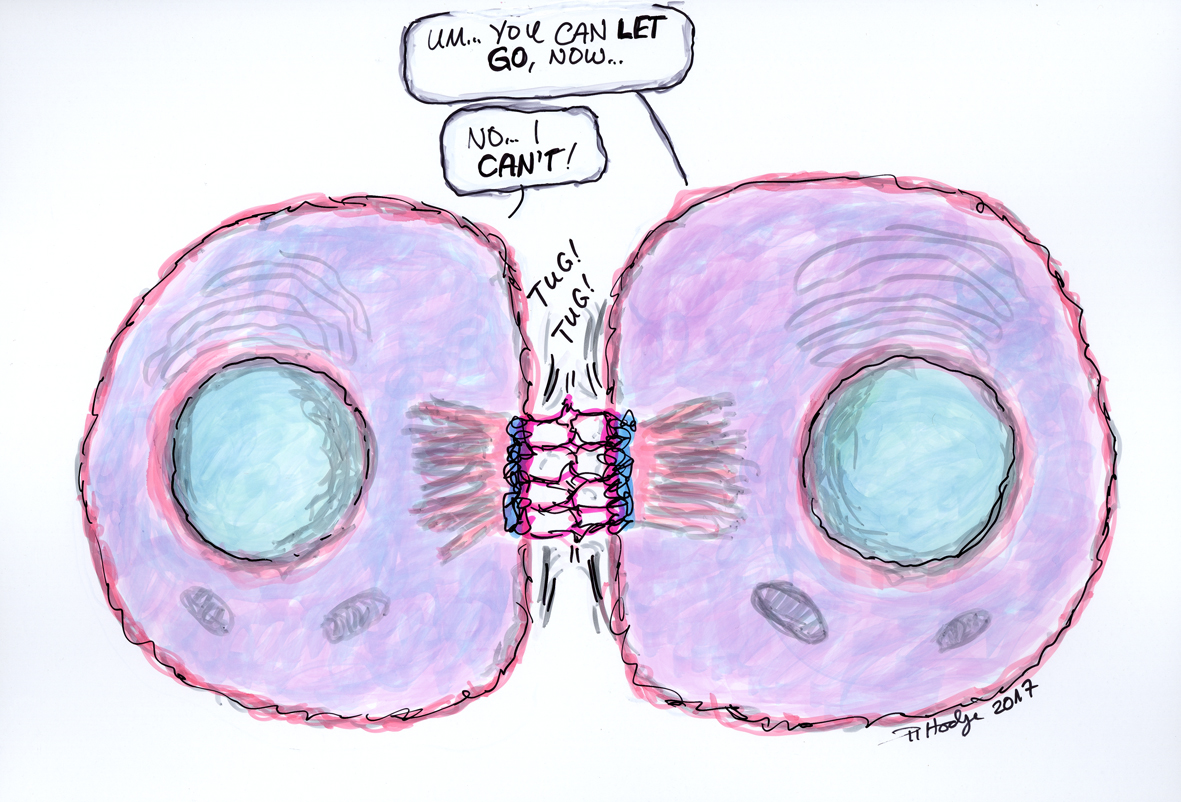
All entries in the Devil’s Dictionary copyright 2017 by Russ Hodge
proboscis a tissue extending from the front of the face which evolved as a mechanism to probe the space ahead, a bit like a blind person’s cane, or the front bumper of a car. If an animal walked slowly enough and hit an obstacle, it would first detect the impact via the proboscis, which is composed of tissue soft enough to absorb the impact providing the animal is not traveling faster than about 10 cm per second. Upon encountering an obstacle, sensors in the proboscis trigger a reflex that instinctively brakes the rest of the body before it suffers so much damage that insurance companies need to get involved. In many mammalian species this function became redundant through the evolution of whiskers, which is why the species with the longest whiskers tend to have the smallest noses (felines), and vice versa (elephants, whose tiny whiskers are purely ornamental). Derivatives include proboscuity, a habitual and socially offensive behavior in which the proboscis is inserted into places, situations or affairs where it has no business being.
alignment placing two things next to each other in a way that lines up their ends, at which point they will be determined to have equal length or not. If not, the problem generally needs to be corrected. If aligning one end causes the other not to align, the standard procedure is to chop off the longer one to achieve double-ended alignment. If you cut off too much then the other item will now be the longer one and you must now repeat the operation on the second item, being careful not to get them confused. It is considered aesthetic to align hair, for example, on opposing sides of a person’s head to achieve a symmetrical result, but the actual process of ensuring that each hair on the left side aligns with its partner hair on the right is so complex that it must generally be done by experts and costs about $400. Amateurs often misalign the two sides numerous times in succession, which is the major cause of baldness. This can be avoided by placing a bowl on the head of the person you are trying to align, checking to ensure that their spine and head are straight through the use of a leveling device, and then cropping the hair evenly around the rim of the bowl. The bowl itself, of course, must be perfectly symmetrical and balanced at the exact zenith of the head, preferably by fixing it into place with a small nail or powerful adhesive so that slippage does not occur.
In genetics the term refers to aligning the genomes of two species to determine which one has “the longer one.” Anything hanging over is probably responsible for features found in one species but not the other. It is a myth that females tend to choose mates with extra letters that extend the length of their genomes. Technique is just as important.
conditioning any process of training which causes a biological entity, such as your hair, to behave the way you want it to rather than to follow its natural instincts.
diuretic a substance produced by plants which, when ingested by an animal, causes it to release the water it has taken up from the environment more quickly, and closer to its source, rather than carrying it long distances away and depositing it in a foreign watershed. This phenomenon means that diuretic plants get more water and have an advantage in natural selection. A high number of non-diuretic plants in a particular environment usually triggers the rapid development of deserts: the water needed by the plants is carried too far away to do them any good. Upon the death of such plants, the organisms that eat them migrate away, further reducing the recycling of water. The effect is self-reinforcing, which ultimately causes animals to cluster along coastlines, resulting in a huge spike in real estate prices and making a species susceptible to extinction by tsunami. Over the long term this cycle leads to environmental conditions like those found on the moon and Mars, which could have been prevented by the evolution of a single plant with diuretic properties.
generation time the period of time that a mother requires between giving birth to one child or litter and the next. Mathematically the generation time for a species can be calculated using the following formula:
gestation time + x
where gestation is the amount of time between conception and birth and x is the amount of time between giving birth and the resumption of sexual activity by the mother, usually due to the insistent behavior of her partner.
For humans this generally results in a generation time of 9 months + 20 minutes
habituation the process by which the brain becomes desensitized to sounds, smells, advertising, well-meaning advice from family members, and various other annoying stimuli rather than responding in an instinctual way, for example by becoming an ax murderer.
mammary gland what you say to your mother if it becomes necessary to refer to her boob.
If you liked the Devil’s Dictionary, you’ll probably also enjoy:
Some little-known facts about Kansas
A little of that very particular cell biology humor today…
1.


3. 
THREE new series today… Enjoy. As usual, feel free to repost or use, just cite “copyright 2017 Russ Hodge” and link to the website.
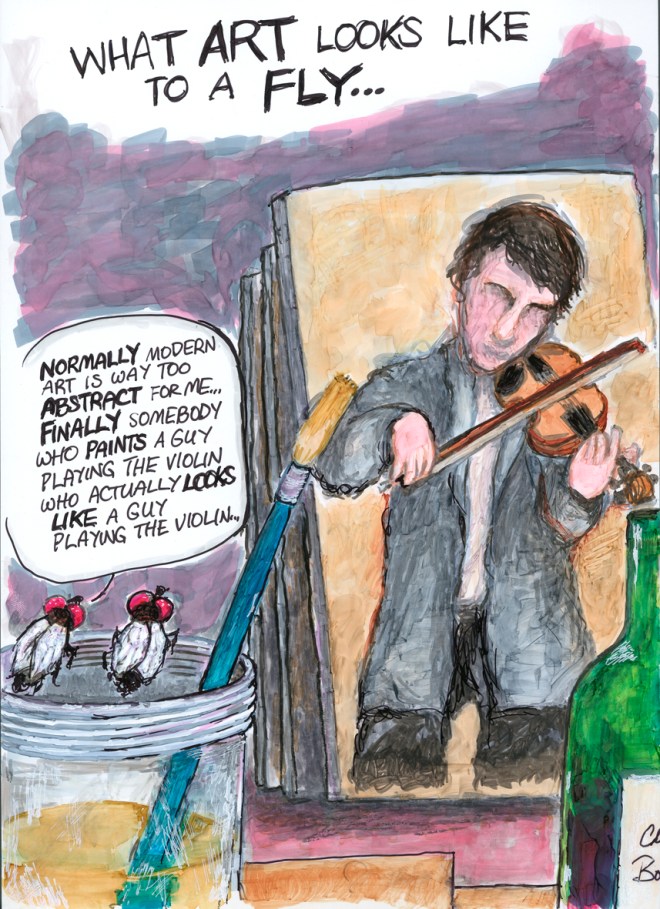
1.
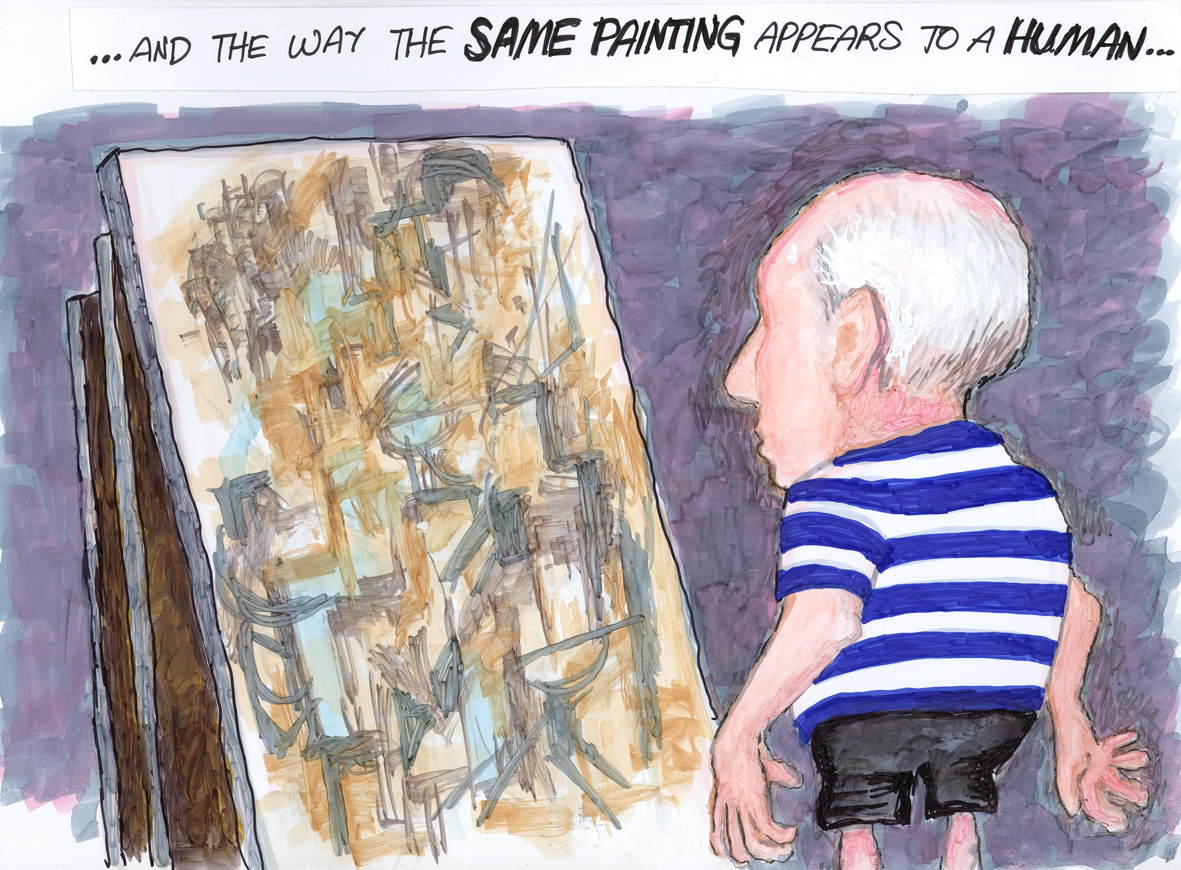
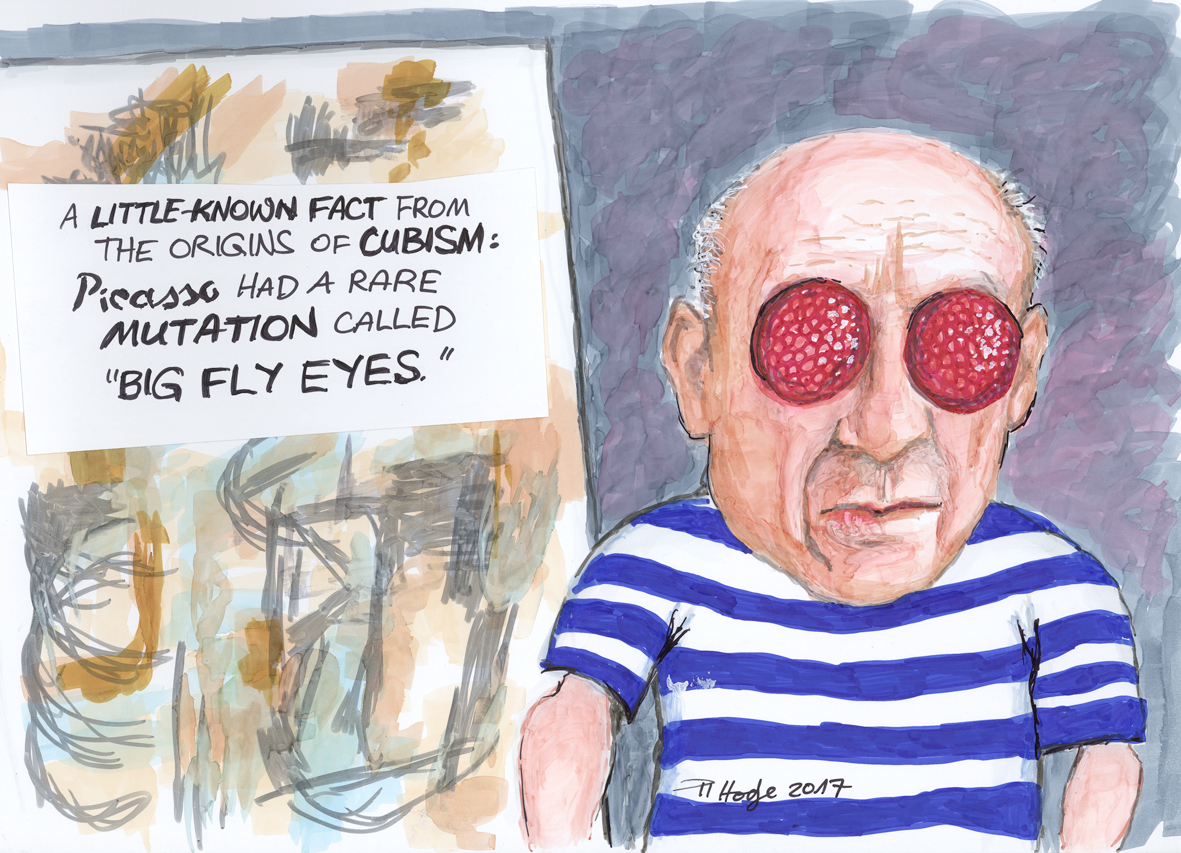
2.


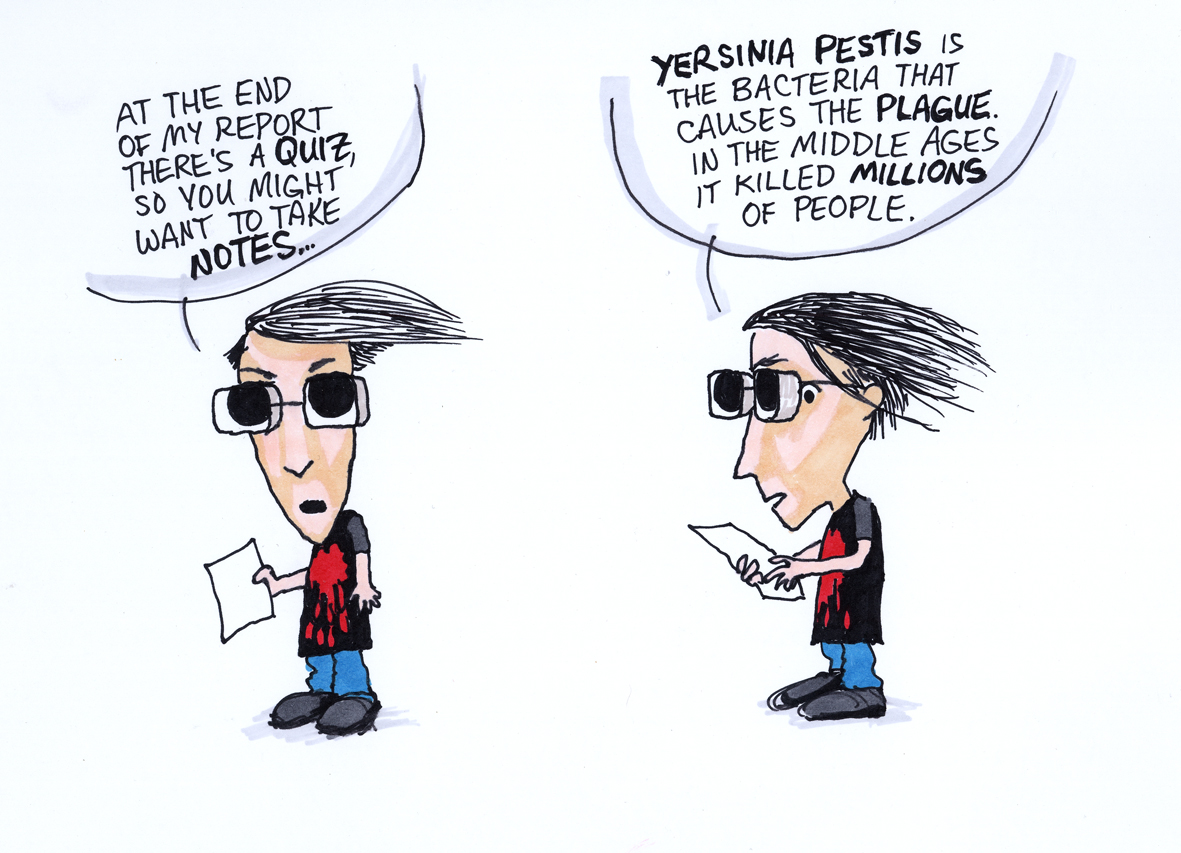
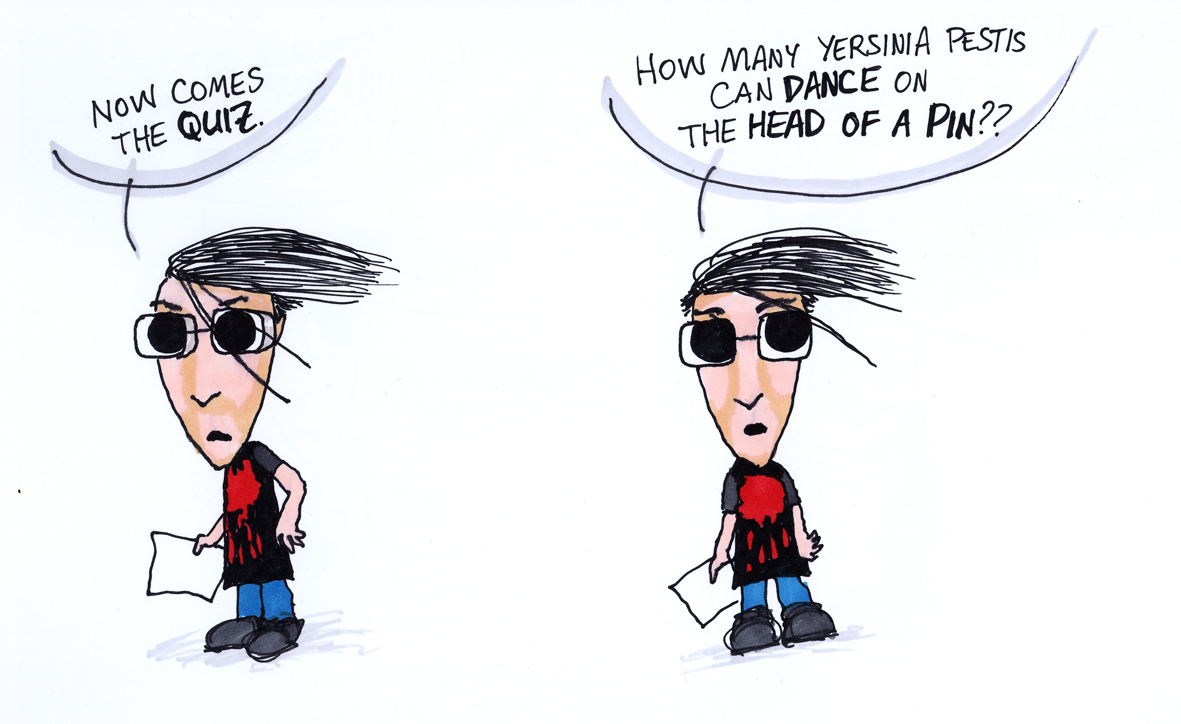
3. And another in the series, “Future Nobel Prize Winners in the 2nd grade…”

 Good Science Writing