Scientists now know what no nose knows vs. what the nose knows but no nose knows that noses know


A minireview


I don’t know how closely you’ve been following recent research into the nose – that didn’t come out quite the way I intended – but things are flowing right along. A big paper came out this week, just two years after the last one, which is impressive when you consider that entire decades can go by without a major finding in the nose. Individuals find something in there all the time, of course, but they don’t usually get scientific papers out of it.

Why hasn’t the nose achieved the prominence in science that it has on our faces? Noses don’t have the sex factor – a major disease to lobby for them. You don’t see stories that begin, “Every year three million Europeans die of infections due to the magenta nose virus, which causes the nose to turn a deep shade of magenta and then fall off. Patients who survive experience a decrease in quality of life due to the discomfort of wearing a prosthesis. Transplants offer an alternative, but they are often rejected, by both the person’s immune system and everyone who looks at the foreign nose, creating an important social burden.”

Cases of magenta nose virus are rare – in fact, nonexistent – so scientists are forced to start their stories with leads like, “The central position of the nose makes it a natural focal point for scientific inquiry.” Or, “Here we address an issue that has long puzzled a number of scientists, although not that big a number, and not that long, although it seems like it to those who work in the nose lab.”

The current paper answers the question: How many genes does it take to build a human nose? Previous estimates ranged anywhere from 1 to 23,500. The new study says 4 genes are required. That sounds about right: one for length, one for width, and one for each nostril. To know how they solved this you’d have to read the methods section, which is usually about as interesting as reading the instruction manual for your toaster. One approach would be to knock down 23,496 genes until the embryo developed only a nose.

The conclusion of the paper was somewhat modest, which is disappointing, because it’s the place where authors are usually willing to make wild speculations. Instead I’ll repeat what one of the authors said in an interview, anonymously: “This represents such a dramatic step forward in nose science that we believe it would not be entirely unreasonable to expect that it will open an avenue, a car-pool lane, or at least a mule path toward an entirely new discipline. We propose the following name: Systems Biology for the Regeneration of Personalized Noses, or SyBiRePeNos, although we may change the acronym because when people say it out loud it sounds like ‘cyber-penis.'”

I found this statement a bit grandiose, but at least the author didn’t claim they’d found the Holy Grail of the Nose. Maybe they wanted to but couldn’t – the Holy Grail of the Nose had already been found – just two years ago, in the study mentioned earlier.

* * * *

Every scientific field has a Holy Grail – which is good, because otherwise, why would people waste years of their lives looking for it? Holy Grails are so common in research, in fact, that if you pick up a rock you’re liable to find one. It happens every couple of weeks in one part of science or another, and the scientists who found it get free champagne and a parade. A single lab can find more than one Holy Grail, but only after the previous one passes its expiration date, which is more than two years.

To qualify as a Holy Grail, your work has to meet four criteria, and the Holy Grail of the Nose found in May 2014 met them all. The work has to involve 1) a group of experts (in this case, plastic surgeons); 2) the use of a high-throughput technology (questionnaires); 3) an appropriate model system (people’s faces); and 4) the thing you actually find.

What the lab discovered was a nose, of course, but not just any nose: they found the Perfect Nose. And if that doesn’t raise your pulse rate, notice where it was found: on the head of actress Scarlett Johansson. More specifically, on the ventral side of the head, running in a line along the anterior-posterior axis that divided the face almost perfectly symmetrically, slightly below the midline of the face.

This is the kind of study that sounds like it started in a bar at a convention of plastic surgeons; unusually, somebody remembered upon emerging from the next morning’s hangover, collected data, ran it through analytical and statistical programs, and voilà!  Scarlett Johansson had the “perfect nose.” Hey, if it passes through the peer review system, it qualifies as science, right?

How fortunate it was that the perfect nose was found on someone who was already a celebrity. It gave noses an instant spokesperson who could raise international awareness of the issue (the political issue, not the fluid), start funding drives for the nose-impaired, attract money for research, and lobby for an International Nose day.

It was also a nice experience for Scarlett’s individual nose; in 2014 other parts of her body had just been awarded the title “Sexiest Woman Alive.” Her nose was invited to that ceremony, of course, as a guest, so that it would appear the red carpet pictures. But it hadn’t received a single mention in the press – or any appreciation for the thankless, essential role it had played in her success. I doubt very much that Scarlett would have received all those film roles or been crowned “Sexiest Woman Alive” without a nose.

Scarlett’s nose quickly became the focus of intense media attention, got invited to all the best parties, made the talk show circuit, signed a book deal. Her nose got its own Facebook page, twitter account, marketing campaign, and a product line that could be bought from the official website; the best-seller has been scented tissues. For 59 days “Scarlett Johansson’s nose” was the top-searched item on Google, and that doesn’t include a thousand variations typed in by people who couldn’t remember whether there were double-Ts or Ns, added some more, left some out, or had missed school the day they taught the apostrophe.

Fame, however, is a double-edged sword. At first the attention was nice, but soon it began to take its toll. Entire fleets of paparazzi began following her nose around, to the point that it needed its own bodyguard. And not all of the public commentary was polite. Scarlett’s nose was made a political issue, particularly by the Tea Party, who managed to link her nose to the climate change debate, then held it as proof that the nose could not have arisen by the principles of Darwinian evolution. Donald Trump stated that if he were elected President, he would deport her nose, because it could not produce a proper birth certificate, and once it was outside the country, he would build a wall so that it could not come back in. Feelings on the issue intensified to the point that a single mention of Scarlett Johansson’s nose set off fist-fights, which usually ended in someone’s getting their nose broken.

As the nose was, literally, in the foreground of the media frenzy, many of the effects spilled over onto other parts of her face. “At the beginning it was very strange,” she said in a recent interview. “I’d do an interview on television, and the entire time the camera would be zoomed in on my nose. It had very little media experience on its own; I had to train it to hold still when I talked, for example. Everybody’s nose moves, but you never notice because the whole face is moving.”

People would come up to talk, she said, and during the entire conversation their eyes would be fixed on her nose. “They’d be thinking, What makes it so special, so much better than mine?’ You couldn’t catch their eye; they were always looking a little farther down on your face. It was as if my nose had developed special powers, some sort of irresistible force. When people realized it they tried to tear their eyes away, but within just a few seconds they’d be drawn back to it again.” The only way to get them to stop, she said, was to zap their eyes with a laser pointer.

* * * *

While the Perfect Nose had been found, the mechanisms that led it to develop on Scarlett Johansson’s face remained unknown. This week’s study provides a way of finding them, by comparing the sequences of four of her genes to those found in the rest of the population. Presumably she has a unique combination of sequences that explains both her Perfect Nose and the imperfect noses of everyone else.

The chances of these particular versions coming together in one person may be so small that they will never occur again, unless the actress engages in inbreeding and her descendants continue to do so for many generations. Alternatively, CRISPR/Cas gene editing technology may one day be advanced enough to introduce perfect nose genes into human embryos.

At the moment, ethical considerations would make this illegal. There is nothing, however, to prevent scientists from placing Scarlett’s genes in animal genomes. So in the near future we can expect to see mice, rats, and other model organisms, including zebrafish, flies, and worms, all bearing the perfect nose.

One thing the discoverers of the Holy Grail of the Nose might not have taken into account: It is currently impossible to carry out gene therapy to correct most defects in adult tissues. If these challenges can be resolved, however, it may eventually be possible to infect an existing nose with a virus that will rebuild it and render it perfect. In identifying the Perfect Nose, the scientists may have unwittingly triggered the demise of their own profession, by making the Nose Job a thing of the past.


References:

Kaustubh Adhikari, Macarena Fuentes-Guajardo, Mirsha Quinto-Sánchez, Javier Mendoza-Revilla, Juan Camilo Chacón-Duque, Victor Acuña-Alonzo, Claudia Jaramillo, William Arias, Rodrigo Barquera Lozano, Gastón Macín Pérez, Jorge Gómez-Valdés, Hugo Villamil-Ramírez, Tábita Hunemeier, Virginia Ramallo, Caio C. Silva de Cerqueira, Malena Hurtado, Valeria Villegas, Vanessa Granja, Carla Gallo, Giovanni Poletti et al. A genome-wide association scan implicates DCHS2, RUNX2, GLI3, PAX1 and EDAR in human facial variation. Nature Communications 7, Article number: 11616. 19 May 2016. http://www.nature.com/ncomms/2016/160519/ncomms11616/full/ncomms11616.html


Omar Ahmed, MD; Amrita Dhinsa; Natalie Popenko, BS; Kathryn Osann, PhD, MPH; Roger L. Crumley, MD, MBA; Brian J. Wong, MD, PhD. Population-Based Assessment of Currently Proposed Ideals of Nasal Tip Projection and Rotation in Young Women. JAMA Facial Plast Surg. 2014;16(5):310-318. doi:10.1001/jamafacial.2014.228.
http://archfaci.jamanetwork.com/article.aspx?articleid=1883794

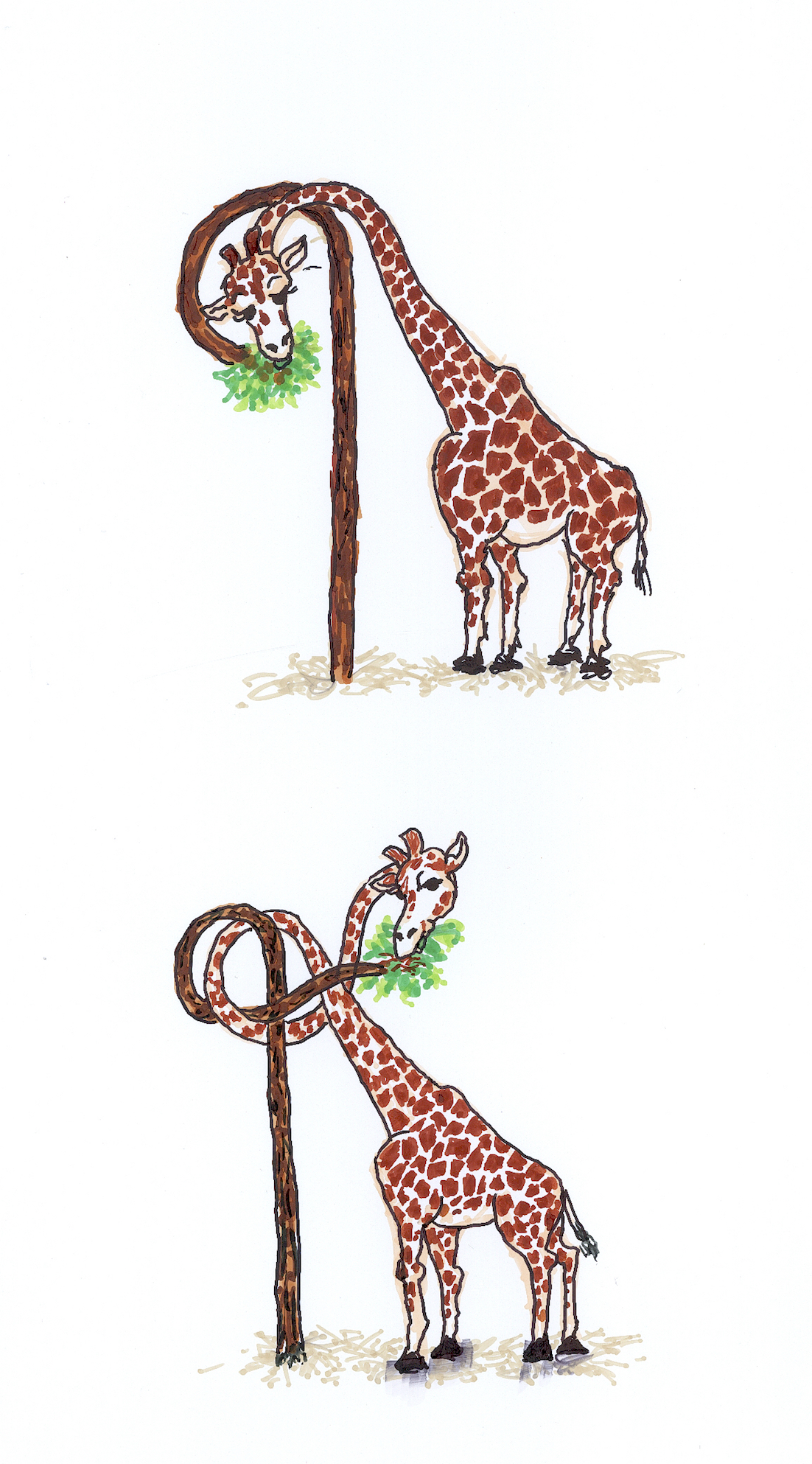
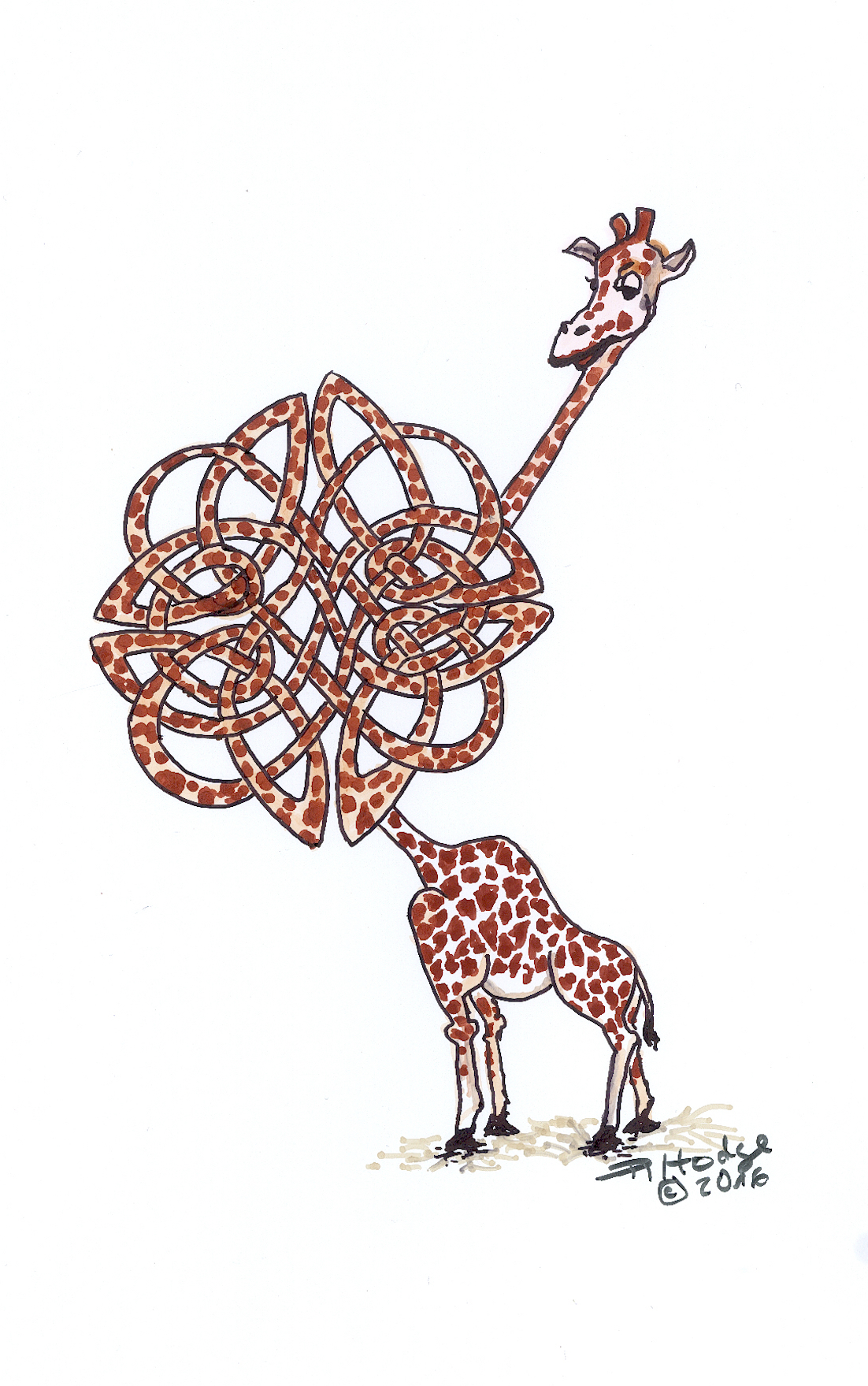
Cartoons: The evolution of the giraffe and a bit of Neanderthal genomics

New cartoons you can feel free to use and repost – especially around your institutes and to any colleagues that might be interested in such things – by citing “copyright 2016 by Russ Hodge, goodsciencewriting.wordpress.com.” The first set comes from a new series I’m calling: “MISHAPS from the evolutionary workbench.”

g1

g2

g3

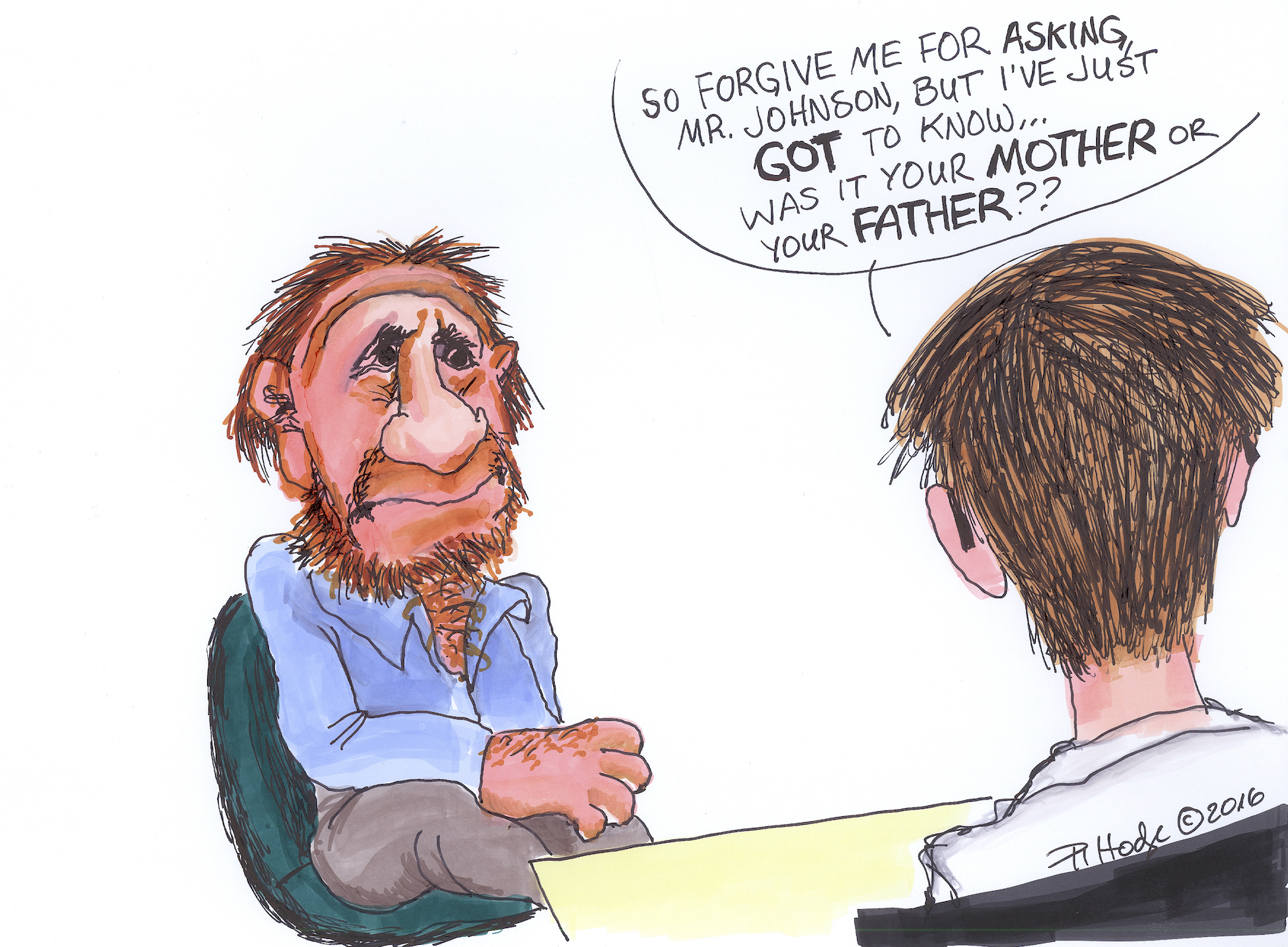
In the following cartoon, resemblance to any living person (for example, my friend Thomas Wienker in his younger days) is completely unintentional.

n1a

n1b

n1c

n1d

Best of PubMed – another Christmas Special!

Just in time for Christmas – finally another edition of the Best of PubMed! For those of you unfamiliar with these articles, these are references to publications (mostly from the Biomedical literature) listed at www.pubmed.org. If you want to follow up on an article, cut and paste the “PubMed ID” number into the search field at the PubMed website. Happy reading and happy holidays!

Check out past “Best of PubMed” entries on a range of themes – from Halloween to the World Series to the dangers of shooting out your eye with a BB gun – here on the blog. More to come soon!

Do reindeer and children know something that we don’t? Pediatric inpatients’ belief in Santa Claus.
Cyr C.
CMAJ. 2002 Dec 10;167(12):1325-7. No abstract available.
PMID: 12473618

The tooth fairy, Santa Claus, and the hard core drinking driver.
Chamberlain E, Solomon R.
Inj Prev. 2001 Dec;7(4):272-5. No abstract available.
PMID: 11770650 Free PMC Article

[Why is Santa Claus bowed?].
Leirisalo-Repo M.
Duodecim. 1998;114(23):2481-6. Finnish. No abstract available.
PMID: 11757148

Christmas, santa claus, sugarplums and the grinch.
Lau DC.
Can J Diabetes. 2011 Dec;35(5):484-5. doi: 10.1016/S1499-2671(11)80001-8. No abstract available.
PMID: 24854970

All I want for coagulation.
Nunn KP, Bridgett MR, Walters MR, Walker I.
Scott Med J. 2011 Nov;56(4):183-7. doi: 10.1258/smj.2011.011154. Review.
PMID: 22089036

“Here comes Santa Claus”: what is the evidence?
Highfield ME.
Adv Emerg Nurs J. 2011 Oct-Dec;33(4):354-8. doi: 10.1097/TME.0b013e318234ead3.
PMID: 22075686

“Yes, Virginia, there is a Santa Claus”.
Angelica JC.
J Pastoral Care Counsel. 2011 Spring-Summer;65(1-2):10.1-2. No abstract available.
PMID: 21928502

Safer toys coming, but not with Santa Claus.
Thibedeau H.
CMAJ. 2009 Sep 15;181(6-7):E111-2. doi: 10.1503/cmaj.109-3003. No abstract available.
PMID: 19752130 Free PMC Article

Visiting Santa: a supplemental view.
Trinkaus J.
Psychol Rep. 2008 Dec;103(3):691-4.
PMID: 19320200

Hemoglobin’s moving around (to the tune of “Santa Claus is Coming to Town”).
Ahern K.
Biochem Mol Biol Educ. 2007 Nov;35(6):478. doi: 10.1002/bmb.118. No abstract available.
PMID: 21591150

Song: Glucagon is coming around (to the tune of “santa claus is coming to town”)*.
Ahern K.
Biochem Mol Biol Educ. 2006 Jan;34(1):36. doi: 10.1002/bmb.2006.49403401036. No abstract available.
PMID: 21638631

Germs and angels: the role of testimony in young children’s ontology.
Harris PL, Pasquini ES, Duke S, Asscher JJ, Pons F.
Dev Sci. 2006 Jan;9(1):76-96.

Santa Claus and staff retention.
Olivi PM.
Radiol Manage. 2005 Sep-Oct;27(5):10-1. No abstract available.
PMID: 16294580

Oliver Twist and Santa Claus.
Gannon F.
EMBO Rep. 2004 May;5(5):431. No abstract available.
PMID: 15184969

[Is Santa Claus still needed?].
Tamminen T.
Duodecim. 2003;119(23):2317-22. Finnish. No abstract available.
PMID: 14768260

Images in cardiovascular medicine. Santa Claus in the echo lab.
Kobza R, Duru F, Jenni R.
Circulation. 2003 Dec 23;108(25):3164. No abstract available.
PMID: 14691023

Neurogenetics: three wishes to Santa Claus.
Coutinho P.
Arch Neurol. 2000 Jan;57(1):59. No abstract available.
PMID: 10634444

[Santa Claus as a consultant. “Then we together will rejoice, children’s eyes will shine with joy”].
Puumalainen AM, Vapalahti M.
Duodecim. 1997;113(23):2467-70. Finnish. No abstract available.
PMID: 10892154

[Santa Claus is perceived as reliable and friendly: results of the Danish Christmas 2013 survey.]
Amin FM, West AS, Jørgensen CS, Simonsen SA, Lindberg U, Tranum-Jensen J, Hougaard A.
Ugeskr Laeger. 2013 Dec 2;175(49):3021-3023. Danish.
PMID: 24629466

Syntrophin proteins as Santa Claus: role(s) in cell signal transduction.
Bhat HF, Adams ME, Khanday FA.
Cell Mol Life Sci. 2013 Jul;70(14):2533-54. doi: 10.1007/s00018-012-1233-9. Epub 2012 Dec 21. Review.
PMID: 23263165

What does God know? Supernatural agents’ access to socially strategic and non-strategic information.
Purzycki BG, Finkel DN, Shaver J, Wales N, Cohen AB, Sosis R.
Cogn Sci. 2012 Jul;36(5):846-69. doi: 10.1111/j.1551-6709.2012.01242.x. Epub 2012 Mar 29.
PMID: 22462490

Santa Claus: good or bad for children?
Nelms BC.
J Pediatr Health Care. 1996 Nov-Dec;10(6):243-4. No abstract available.
PMID: 9052114

Perhaps there is a Santa Claus.
Van Eldik DT.
J Fla Med Assoc. 1994 Dec;81(12):795-6. No abstract available.
PMID: 7861106

Encounter with reality: children’s reactions on discovering the Santa Claus myth.
Anderson CJ, Prentice NM.
Child Psychiatry Hum Dev. 1994 Winter;25(2):67-84.
PMID: 7842832

Do you believe in Santa Claus?
Atkinson J.
Nurs Stand. 1988 Dec 31;3(13-14):20-1. No abstract available.
PMID: 3068551

Epidemiology of reindeer parasites.
Halvorsen O.
Parasitol Today. 1986 Dec;2(12):334-9.
PMID: 15462756

A letter to Santa Claus.
Shusterman C.
Am Laund Dig. 1985 Dec 15;50(12):14-6. No abstract available.
PMID: 10275266

In the absence of Santa Claus.
Tebben MP.
Public Health Rep. 1985 Jul;100(4):355. No abstract available.
PMID: 19313171

Picture Reports: Influenza virus, Santa Claus, or a mouse playing tennis?
Getty B.
Br Med J (Clin Res Ed). 1984 Dec 22;289(6460):1744. No abstract available.
PMID: 20742372 Free PMC Article

Children’s belief in santa claus: a developmental study of fantasy and causality.
Prentice NM, Schmechel LK, Manosevitz M.
J Am Acad Child Psychiatry. 1979 Autumn;18(4):658-67.

Imaginary figures of early childhood: santa claus, easter bunny, and the tooth fairy.
Prentice NM, Manosevitz M, Hubbs L.
Am J Orthopsychiatry. 1978 Oct;48(4):618-28.

Santa Claus will probably be coming.
Ammer DS.
Hosp Purch Manage. 1977 Dec;2(12):2-3. No abstract available.
PMID: 10305079

A note on the absence of a Santa Claus in any known ecosystem: a rejoinder to Willems.
Baer DM.
J Appl Behav Anal. 1974 Spring;7(1):167-9. No abstract available.
PMID: 16795462 Free PMC Article

The d.a. Who was Santa Claus?
Peyraud AP.
CAL. 1972 Dec;36(6):26-30. No abstract available.
PMID: 4510978

Another note to Santa Claus.
Cummins S, Garms N, Zusne L.
Percept Mot Skills. 1971 Apr;32(2):510. No abstract available.
PMID: 4932683

Meet Dr. Cloonan Santa Claus 365 days a year.
Penny PL.
CAL. 1970 Dec;33(6):15-9. No abstract available.
PMID: 5277587

Santa Claus drawings by Negro and white children.
Coyle FA Jr, Eisenman R.
J Soc Psychol. 1970 Apr;80(2):201-5. No abstract available.
PMID: 4924834

Barefoot in the hospital park or yes Virginia, there is a Mrs. Santa Claus known as the administrator’s wife.
Spencer V.
Hosp Manage. 1967 Dec;104(6):33-7. No abstract available.
PMID: 6063631

Charlie’s Santa Claus.
Stollard ML.
Nurs Times. 1965 Dec 24;61(52):1762. No abstract available.
PMID: 5849676

[The sweet Christmas rash.]
Gyldenløve M, Nepper-Christensen S, Thyssen JP, Faurschou A.
Ugeskr Laeger. 2013 Dec 2;175(49):3025-3026. Danish.
PMID: 24629468

The Christmas tree foreheadplasty: a novel technique used in combination with a bandeau for fronto-orbital remodelling in craniosynostosis.
Britto JA, Gwanmesia I, Leshem D.
Childs Nerv Syst. 2012 Sep;28(9):1375-80. doi: 10.1007/s00381-012-1806-9.
PMID: 22872251

The need for gas-specific “Christmas tree” connections.
Atlas G, Lee M.
J Patient Saf. 2012 Jun;8(2):88. doi: 10.1097/PTS.0b013e31824a4af4. No abstract available.
PMID: 22610127

[A woman with Christmas in sight].
Fickweiler W, de Vries MM, Postma G.
Ned Tijdschr Geneeskd. 2011;155(51):A4242. Dutch.
PMID: 22200154

SIRT1 regulates the ribosomal DNA locus: epigenetic candles twinkle longevity in the Christmas tree.
Salminen A, Kaarniranta K.
Biochem Biophys Res Commun. 2009 Jan 2;378(1):6-9. doi: 10.1016/j.bbrc.2008.11.023. Epub 2008 Nov 21. Review.
PMID: 19010308

The importance of elves.
Nurs Spectr (Wash D C). 1996 Dec 16;6(26):3.
Hess RG Jr.
PMID: 9433318

The gnome of Dulwich.
Goodwin P.
Nurs Times. 1971 Sep 2;67(35):1096.
PMID: 5565702

[Santa Claus is perceived as reliable and friendly: results of the Danish Christmas 2013 survey.]
[Article in Danish]
Amin FM1, West AS, Jørgensen CS, Simonsen SA, Lindberg U, Tranum-Jensen J, Hougaard A.
Ugeskr Laeger. 2013 Dec 2;175(49):3021-3023.

Abstract
INTRODUCTION:
Several studies have indicated that the population in general perceives doctors as reliable. In the present study perceptions of reliability and kindness attributed to another socially significant archetype, Santa Claus, have been comparatively examined in relation to the doctor.
MATERIALS AND METHODS:
In all, 52 randomly chosen participants were shown a film, where a narrator dressed either as Santa Claus or as a doctor tells an identical story. Structured interviews were then used to assess the subjects’ perceptions of reliability and kindness in relation to the narrator’s appearance.
RESULTS:
We found a strong inclination for Santa Claus being perceived as friendlier than the doctor (p = 0.053). However, there was no significant difference in the perception of reliability between Santa Claus and the doctor (p = 0.524).
CONCLUSION:
The positive associations attributed to Santa Claus probably cause that he is perceived friendlier than the doctor who may be associated with more serious and unpleasant memories of illness and suffering. Surprisingly, and despite him being an imaginary person, Santa Claus was assessed as being as reliable as the doctor.

What does God know? Supernatural agents’ access to socially strategic and non-strategic information.
Purzycki BG1, Finkel DN, Shaver J, Wales N, Cohen AB, Sosis R.
Cogn Sci. 2012 Jul;36(5):846-69. doi: 10.1111/j.1551-6709.2012.01242.x. Epub 2012 Mar 29.

Abstract
Current evolutionary and cognitive theories of religion posit that supernatural agent concepts emerge from cognitive systems such as theory of mind and social cognition. Some argue that these concepts evolved to maintain social order by minimizing antisocial behavior. If these theories are correct, then people should process information about supernatural agents’ socially strategic knowledge more quickly than non-strategic knowledge. Furthermore, agents’ knowledge of immoral and uncooperative social behaviors should be especially accessible to people. To examine these hypotheses, we measured response-times to questions about the knowledge attributed to four different agents–God, Santa Claus, a fictional surveillance government, and omniscient but non-interfering aliens–that vary in their omniscience, moral concern, ability to punish, and how supernatural they are. As anticipated, participants respond more quickly to questions about agents’ socially strategic knowledge than non-strategic knowledge, but only when agents are able to punish.

Christmas, santa claus, sugarplums and the grinch.
Lau DC.
Can J Diabetes. 2011 Dec;35(5):484-5. doi: 10.1016/S1499-2671(11)80001-8.
PMID: 24854970

All I want for coagulation.
Nunn KP1, Bridgett MR, Walters MR, Walker I.
Scott Med J. 2011 Nov;56(4):183-7. doi: 10.1258/smj.2011.011154.

Abstract
Evidence-based medicine underpins modern practice of medicine. This paper describes a fictional consultation between Santa Claus and a doctor regarding deep vein thrombosis (DVT) prophylaxis, giving a review of the evidence for DVT prophylaxis in travellers while exposing the difficulty in applying evidence to atypical clinical encounters. Medline and the Cochrane Library were searched, and guidelines reviewed. Keywords used were DVT, thromboembolism, deep vein thrombosis and air travel-related venous thromboembolism. All relevant studies found, have been included in this review, with additional studies identified from the references in these articles. In conclusion, compression stockings, with or without a one-off dose of either aspirin or heparin, are the most evidence-based approaches for prophylaxis in someone with established risk factors for DVT prior to a long-haul flight. Simple exercises should also be encouraged.

“Here comes Santa Claus”: what is the evidence?
Highfield ME1.
Adv Emerg Nurs J. 2011 Oct-Dec;33(4):354-8. doi: 10.1097/TME.0b013e318234ead3.

Abstract
The purpose of this article is to examine the strength of evidence regarding our holiday Santa Claus (SC) practices and the opportunities for new descriptive, correlation, or experimental research on SC. Although existing evidence generally supports SC, in the end we may conclude, “the most real things in the world are those that neither children nor men can see” (Church, as cited in Newseum, n.d.).

Save the date! Science cabaret on Jan. 23, 2015, DAI Heidelberg

If you’ll be in or near Heidelberg (for example, somewhere in the Milky Way galaxy) at 8pm on Jan. 23, don’t miss my first Heidelberg performance of the Science cabaret – “The revenge of the mammoths.” An hour of stand-up comedy on the topic of the collision between science and society.

Details in German here.

Here’s the announcement in English:

Science is zooming by in the fast lane at 250 km/h, leaving most of us stuck behind a truck. Are we headed for a massive traffic jam? Or will the “zipper system” finally work? Russ Hodge, native Kansan (his parents’ fault), long-time resident of Germany (his wife’s fault), and science writer (his own fault) takes us to the edge of today’s research (and occasionally way over the edge) in a talk loaded with fascinating information. For example, the human genome is 4% Neanderthal, 14% Genghis Khan, and 48% Jim, a sheep farmer from Ohio. Random and useless facts are woven together with practical information about the Republican plan for surviving the Zombie Apocalypse, building your own anti-tornado device, and how to launch a successful Biotech start-up using only the contents of your belly-button. We’ll explore the evolution of horror films, how to distinguish true Conspiracy Theories from crazy stuff on blogs, and the search for Amelia Earhart’s DNA in the species that most likely ate her.

The talk will be held in Kansas English, refined and distilled for European consumption.

The science story that has it all

Some scientific stories – think of Watson and Crick’s discovery of the structure of DNA – are so electrifying that you instantly realize they’re bound for a Nobel prize or some other lofty pinnacle of greatness. This wasn’t one of them. My first impression was that it was free-falling rapidly in the other direction. If nobody has put it up it for an IgNobel yet, you may consider this article an official nomination.

It’s one of those quirky little pieces that make you think, “Wow, you can obtain funding for anything if it’s crazy enough,” or “The guy who wrote this grant must be a genius; let’s hire him,” or “There are waaay too many people getting PhDs these days.” But then you bite into it, the way you might try a hamburger made of soybeans, just to please your girlfriend, and you realize that it’s the gift that keeps on giving, if only in the form of several days of gastrointestinal distress.

I’m speaking, of course, of the invention of 3D eyeglasses for praying mantises. If you haven’t seen the pictures, visit this site and prepare not to get much work done for the next few hours.

The project is the work of Jenny Read, from the Institute of Neuroscience at Newcastle University. The story issued by their press office doesn’t mention publication in a peer-reviewed journal, but it does say that the group received £1 million pounds from a certain Trust, so who cares? (I’m not naming the Trust until I’ve sent them five grant applications that I’ve been hanging onto, waiting for just the right funding body; I found the story, so I have the right to a head start.) In case you were wondering, £1 million pounds amounts to 1.23 million Euros at today’s rate of exchange.
Besides, who cares about getting a paper published when your work produces a video that will go instantly viral? Or maybe the lab was about to be scooped, and had to get the story out there.

I will return to the fascinating scientific aspects of this story, and its wonderful potential for industrial applications, but first let me say that this is obviously one of those projects that started in a pub. They caught a praying mantis by trapping it in a beer glass; everybody gathered around, and somebody said, “Hey, I bet to that bug, we look like we’re on a huge IMAX screen.”

A lot of British studies, particularly from psychological research, start in a pub and spend millions proving things we already know. Remember the classic paper proving that “Men and women who have consumed a moderate amount of alcohol find the faces of members of the opposite sex 25% more attractive than their sober counterparts.” That one got its support from the Universities of St. Andrews and Glasgow, which were probably closest to the pub.

This type of research is much harder than it sounds. It requires a particular skill set: you have to be able to do statistics, or at least count, while drunk. Then you have to remember to save all the soggy napkins and beer coasters that you’ve been using to gather statistical data. Finally, you must be able to read your own handwriting in the morning. It’s worth cultivating these talents as you work on your PhD; they’ll practically guarantee you a position in a lab in the UK.

But back to the praying mantis. One intriguing part of the story is that, as opposed to other insects, this species already has 3D vision. That’s because they have smooth eyes, as opposed to the eyes of certain dragonflies and moths, which are broken up into 30,000 or so bubble-like ommatidia. I guess that means they have 30,000D vision, which probably makes it hard to see anything at all. It’s a good thing such insects don’t drive cars, because they’d need a lot of mirrors – all of which would be labeled, “Objects in the mirror are fewer than they appear.” Now those are insects that could really use 3D glasses, just to watch normal TV, but it would take a farm of Cray supercomputers 12 billion years to work out the optics and design the things, and by that time the dragonflies would have evolved into helicopters.

How do you attach glasses to a praying mantis? With beeswax, of course. You grab a mantis, glue some glasses to its eyes, and stick it in front of a computer monitor which is showing The Fast and the Furious 17, or whatever number they’ve gotten to these days. If the mantis jumps back to avoid getting mashed on the grill of an oncoming car, you know that the glasses work. Another good piece of evidence is if the mantis tries to grab Paul Walker, mate with him, bite off his head, and eat him. I’ve known a few human women who respond the same way when they see Paul Walker in 3D.

One of the researchers involved in this project was a certain Dr. Vivek Nityananda; say it three times in a row, fast, and you really have to wonder if Newcastle is pulling our leg. He proclaims: “This is a really exciting project to be working on. So much is still waiting to be discovered in this system. If we find that the way mantises process 3D vision is very different to the way humans do it, then that could open up all kinds of possibilities to create much simpler algorithms for programming 3D vision into robots.”

I find this somewhat enthusiastic, but molecular biologists say such things, too; translated into their discipline it comes out: “3D glasses attached to the eyes of praying mantises present a promising new target for potential cancer therapies.” Particularly cancer of the eyeball, I suppose.

Dr. Vivek Nityananda doesn’t mention the fact that the research should also result in a lot more customers attending the local IMAX. You could fit 1,980,722,314,222 praying mantises into the theater, although it’s unclear how they will pay, unless the research subjects are getting a cut of that £1 million pounds.

For a writer there’s an even more compelling reason to be interested in this project. Garrison Keillor, the great American humorist, once said that a great story has five elements: a mystery, religion, money, sex, and family relationships. In a Nov. 8, 1997 broadcast of A Prairie Home Companion, he managed to capture them all in just twelve words, although it’s 14 if you expand the contractions:

“God,” said the banker’s daughter, “I’m pregnant. I wonder who’s the father?”

By extension, the perfect science story would have those elements, too, plus a bit of technology. That’s rare, but here we have them all, if you think about the mating practices of female praying mantises, usually with males from their own species, or perhaps with Paul Walker. Add this story’s elements of murder and cannibalism, and I foresee a book, a screenplay, and a feature film. I’m currently trying to buy the rights to the story. There’s still time to get in on this; just send me a mail and I’ll tell you where to send your contribution.

The sun has a sibling – but are they holding hands?

I guess the birth announcement got lost in the mail, which is understandable given the fact that it happened a few billion years ago, somewhat before the invention of e-mail or even a postal system. In case you haven’t heard: our Sun has a sibling! And it’s a girl!

She’s called HD 162826, which will give her some grief during grade school, but probably not as much as if she had been named Moon Unit Zappa, Elbow (3 children were given that name in 2009), Hotdog (2 in 2012), or Freak (34 in 1995). I don’t know how you determine the sex of a star, but apparently someone can, because everybody says HD 162826 is a sister. I’d love to send my congratulations to the parents, but their identity is somewhat vague.

In any case, the discovery of the Sun’s sister has triggered an outpouring of emotional responses and some typically wild speculations on the part of the press. The first article I saw on this was here, and this piece is interesting for a number of reasons. It gets off to a great start with this sentence:

“Researchers from the University of Texas at Austin has discovered that a previously known star may actually be the sibling of our own Sun.”

“Researchers… has discovered” is a little strange, but maybe that’s how they talk in Texas. All right, in the excitement it seems petty to quibble about the conjugation of verbs. The article continues:

“The possible solar system is located a mere 110 light years away from the solar system.”

This sentence is also intriguingly strange. First off, there’s nothing “mere” about “110 light years away,” at least if you’re using Google Maps to plan your trip. (I tried, and the closest hit is Hd’s Mesa, an employment agency on 1826 W. Broadway Road, Mesa, Arizona, a mere 9,100 km from my present location.)

A light year is 9.4605284 × 10¹⁵ meters. It would take the Voyager 1 spacecraft, which is traveling at a maximum rate of 62,136 km/h, at least 1,909,787,303,382.4 years to get there. That’s only if Voyager 1 is pointed exactly in the right direction, which I kind of doubt, and only if I’ve done the math right. If you find an error in my calculations, let me know.

Of course you have to take into account that 1,909,787,303,382.4 years is about 138 times longer than the current age of the universe (depending, of course, on the date at which you are reading this.) In 1.9 trillion years the universe will either still be expanding, or collapsing in on itself, depending on your feelings on the topic of dark matter. In the expanding universe scenario, some scientists calculate that the universe might double its size in 11.4 billion years. It’s unclear how things will go after that, but Voyager 1 will clearly need somewhat longer to arrive. If, on the other hand, you’re a proponent of universal contraction, everything will be closer together, so the trip won’t take quite as long. Maybe Voyager 1 should just park somewhere and wait.

But the intriguingly strange sentence above (“The possible solar system is located a mere 110 light years away from the solar system”) has more to offer. I suppose “the possible solar system” means that the sibling sun might also have a solar system, and “the solar system” at the end of the sentence presumably means “our solar system.” If I’m wrong, and these two phrases refer to the same solar system, I don’t quite understand how a thing can be 110 light years away from itself. Unless you are talking about some sort of weird, alternate reality. Of course, physicists like that kind of thing – remember Schrödinger’s cat, which demonstrates not only the possible existence of parallel universes, but also that Erwin Schrödinger had some serious issues with cats.

The idea that our planets might have long-lost siblings is old news. Earth’s first sibling was found in 2007, as you can read here. I’ve covered that story in an earlier article. A second sibling was found this year. The first candidate, Gliese 581c, is a mere 20 light years away, while Kepler 186f is 500 light years from us. That’s just how it goes: “children” (or planets, in this contorted world of familial metaphors) grow up, relocate to distant places, attend the university, and acquire huge amounts of debt before moving back home to live in the basement.

Both of these planets are “sisters.” It’s easier to tell the sex of a planet, I suppose; at least you can get closer and inspect them, without getting burned to a crisp.

* * * * *

In case you hadn’t noticed, I could go on talking about unusual grammar and interstellar sex determination all day. But the discovery of our “sister sun” has also prompted some scientific speculations that are worth considering. Consider this from the Tech Times article I cited above:

“Aside from being a potential sister star to the Sun, Ramirez and his colleagues also believe that there is a very small chance that the HD 162826 system could have planets suitable for life. While the chances may be small, the researchers are certain that the odds are not zero.”

I can’t resist one linguistic point here: the first sentence implies that the potential sister star is Ramirez and his colleagues. This is a common grammatical mistake called a “dangling participle.” The problem becomes clear if you consider a sentence such as, “Hanging from a tree, the firemen rescued a cat.” But more intriguing is the comment, “the researchers are certain that the odds are not zero.” It’s hard to find just about anything for which the odds are truly zero (rather than 0.0000000…00001); try it sometime and you’ll see.

Another article about the finding puts it this way:

“One of the most exciting consequences… is the likelihood that these stars support planets, and possibly even life. Back when the Sun’s siblings were all hanging out in their nursery together, there would have been a robust, inter-system exchange of planetary material and chemical runoff. Enriched chunks of early Earth could have been launched into other fledgling solar systems, seeding the potential for life on other planets.”

Now I don’t know how this passage strikes you, but there’s a point at which you have to be cautious about metaphors. There’s some serious hanky-panky going on in this nursery school. “Exchange of planetary material and chemical runoff” are clearly euphemistic references to some sort of bodily fluids. If you’re generous you might think the topic is spilling KoolAid, but then you get to the part about launching “enriched chunks of early Earth,” and it’s hard not to think about kids throwing around poop. Finally we get to “seeding the potential for life” – a figurative climax, if not a literal one. If by that point you haven’t figured out what the author is talking about… Let’s just say it’s not the kind of day care I’d consider for my kids.

Coming back to the science, one should remember that this nursery probably existed over 4 billion years ago, when things were pretty hot, and I’d say the limb that supports these speculations is a pretty long one. But some notable scientists – Berzelius, Kelvin, Hermann von Helmholtz, Francis Crick, and Stephen Hawking – have promoted this type of panspermia hypothesis, and I’m not one to argue with such bright bulbs.

This second piece from motherboard.vice.com (clearly one of the first places you’d go to check out the latest findings from research) goes on to say:

“The idea that we might have genuine biological relatives on planets orbiting distant solar siblings is certainly tantalizing.”

I don’t quite know what they mean by “genuine biological relatives,” unless they’re referring to Vulcans, or a long-lost cousin named Bob, but it’s safe to say that the idea is tantalizing. Most things are, to somebody.

I’d like to jump into the fray of wild speculations by suggesting that our Sun and its sibling might be holding hands. That happens sometimes, as shown by the recent birth of twins. On Mother’s Day, at that. What are the odds of that? Certainly not zero.

Mating with Neanderthals

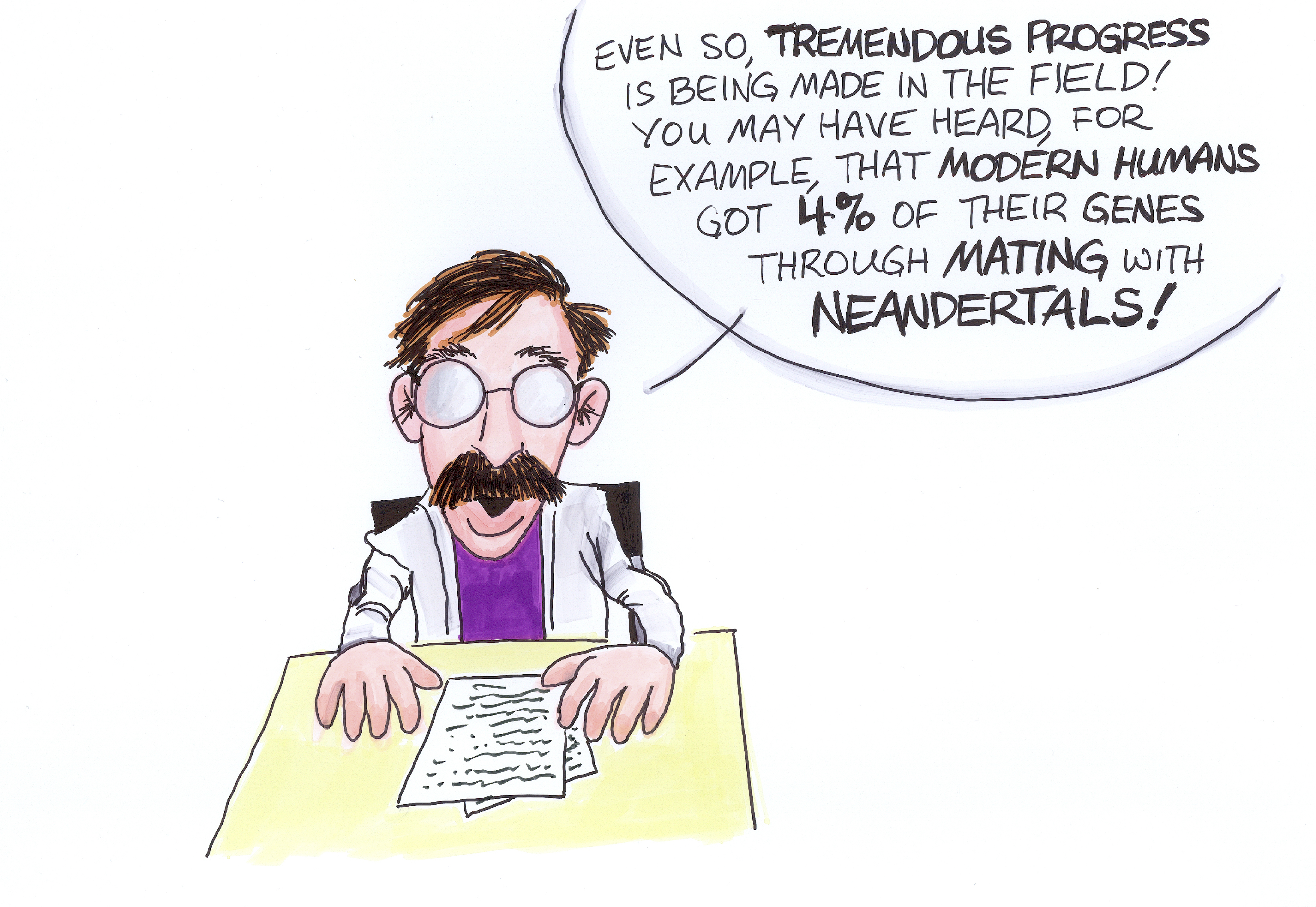
Today, April 1, Nature Communications reports on another study on those sneaky Neanderthal genes that crept into the modern human genome, probably by climbing up a tree in the yard and entering through a bedroom window. In a popular article describing the project, Emily Willingham writes:

…Khrameeva and her colleagues noted that speculation regarding some Neanderthal-H. sapiens gene flow through sexual reproduction is “appealing.” And experts in the field generally agree that the idea is plausible, even if it’s not their favored explanation.

Now most Homo sapiens wouldn’t consider mating with a Neanderthal very appealing, but we do have to consider that about 4% of our genome derives from Neanderthals, so I’m guessing about it appeals to about 4% of the population. Since some governments are considering expanding the definition of marriage to include relationships with other species, at least when submitting their tax returns, it’s time for this minority to speak up and be heard.

Best of PubMed – Christmas Special!

“Here comes Santa Claus“: what is the evidence?
Highfield ME.
Adv Emerg Nurs J. 2011 Oct-Dec;33(4):354-8. doi: 10.1097/TME.0b013e318234ead3.
PMID: 22075686

“Yes, Virginia, there is a Santa Claus“.
Angelica JC.
J Pastoral Care Counsel. 2011 Spring-Summer;65(1-2):10.1-2.
PMID: 21928502

Visiting Santa: an additional look.
Trinkaus J.
Psychol Rep. 2007 Dec;101(3 Pt 1):779-83.
PMID: 18232433

Hemoglobin’s moving around (to the tune of “Santa Claus is Coming to Town”).
Ahern K.
Biochem Mol Biol Educ. 2007 Nov;35(6):478. doi: 10.1002/bmb.118.
PMID: 21591150

Santa Claus and staff retention.
Olivi PM.
Radiol Manage. 2005 Sep-Oct;27(5):10-1.
PMID: 16294580

Visiting Santa: an informal look.
Trinkaus J.
Psychol Rep. 2004 Oct;95(2):587-8.
PMID: 15587225

[Is Santa Claus still needed?].
Tamminen T.
Duodecim. 2003;119(23):2317-22. Finnish.
PMID: 14768260

Do reindeer and children know something that we don’t? Pediatric inpatients’ belief in Santa Claus.
Cyr C.
CMAJ. 2002 Dec 10;167(12):1325-7.
PMID: 12473618

The tooth fairy, Santa Claus, and the hard core drinking driver.
Chamberlain E, Solomon R.
Inj Prev. 2001 Dec;7(4):272-5.
PMID: 11770650

[Why is Santa Claus bowed?].
Leirisalo-Repo M.
Duodecim. 1998;114(23):2481-6. Finnish.
PMID: 11757148

Neurogenetics: three wishes to Santa Claus.
Coutinho P.
Arch Neurol. 2000 Jan;57(1):59.
PMID: 10634444

[Santa Claus as a consultant. “Then we together will rejoice, children’s eyes will shine with joy”].
Puumalainen AM, Vapalahti M.
Duodecim. 1997;113(23):2467-70. Finnish.
PMID: 10892154

Santa Claus: good or bad for children?
Nelms BC.
J Pediatr Health Care. 1996 Nov-Dec;10(6):243-4.
PMID: 9052114

Perhaps there is a Santa Claus.
Van Eldik DT.
J Fla Med Assoc. 1994 Dec;81(12):795-6.
PMID: 7861106

Encounter with reality: children’s reactions on discovering the Santa Claus myth.
Anderson CJ, Prentice NM.
Child Psychiatry Hum Dev. 1994 Winter;25(2):67-84.
PMID: 7842832

Do you believe in Santa Claus?
Atkinson J.
Nurs Stand. 1988 Dec 31;3(13-14):20-1.
PMID: 3068551

Epidemiology of reindeer parasites.
Halvorsen O.
Parasitol Today. 1986 Dec;2(12):334-9.
PMID: 15462756

A letter to Santa Claus.
Shusterman C.
Am Laund Dig. 1985 Dec 15;50(12):14-6.
PMID: 10275266

In the absence of Santa Claus.
Tebben MP.
Public Health Rep. 1985 Jul;100(4):355.
PMID: 19313171

Picture Reports: Influenza virus, Santa Claus, or a mouse playing tennis?
Getty B.
Br Med J (Clin Res Ed). 1984 Dec 22;289(6460):1744.
PMID: 20742372

Children’s belief in santa claus: a developmental study of fantasy and causality.
Prentice NM, Schmechel LK, Manosevitz M.
J Am Acad Child Psychiatry. 1979 Autumn;18(4):658-67.
PMID: 541471

Imaginary figures of early childhood: santa claus, easter bunny, and the tooth fairy.
Prentice NM, Manosevitz M, Hubbs L.
Am J Orthopsychiatry. 1978 Oct;48(4):618-28.
PMID: 707613

Santa Claus will probably be coming.
Ammer DS.
Hosp Purch Manage. 1977 Dec;2(12):2-3.
PMID: 10305079

A note on the absence of a Santa Claus in any known ecosystem: a rejoinder to Willems.
Baer DM.
J Appl Behav Anal. 1974 Spring;7(1):167-9.
PMID: 16795462

The d.a. Who was Santa Claus?
Peyraud AP.
CAL. 1972 Dec;36(6):26-30.
PMID: 4510978

Santa Claus drawings by Negro and white children.
Coyle FA Jr, Eisenman R.
J Soc Psychol. 1970 Apr;80(2):201-5.
PMID: 4924834

Barefoot in the hospital park or yes Virginia, there is a Mrs. Santa Claus known as the administrator’s wife.
Spencer V.
Hosp Manage. 1967 Dec;104(6):33-7.
PMID: 6063631

Charlie’s Santa Claus.
Stollard ML.
Nurs Times. 1965 Dec 24;61(52):1762.
PMID: 5849676

The northwest Santa and Mrs Claus–the real thing!
Copeland JA.
Caring. 2008 Dec;27(12):26-9.
PMID: 19278113

A visit from the Candy Witch: factors influencing young children’s belief in a novel fantastical being.
Woolley JD, Boerger EA, Markman AB.
Dev Sci. 2004 Sep;7(4):456-68.
PMID: 15484594

Why Rudolph‘s nose is red: observational study.
Ince C, van Kuijen AM, Milstein DM, Yürük K, Folkow LP, Fokkens WJ, Blix AS.
BMJ. 2012 Dec 14;345:e8311. doi: 10.1136/bmj.e8311.
PMID: 23247980

Song: the E. coli song (to the tune of “rudolph the red-nosed reindeer“).
Ahern K.
Biochem Mol Biol Educ. 2006 Nov;34(6):426. doi: 10.1002/bmb.2006.494034062569.
PMID: 21638738